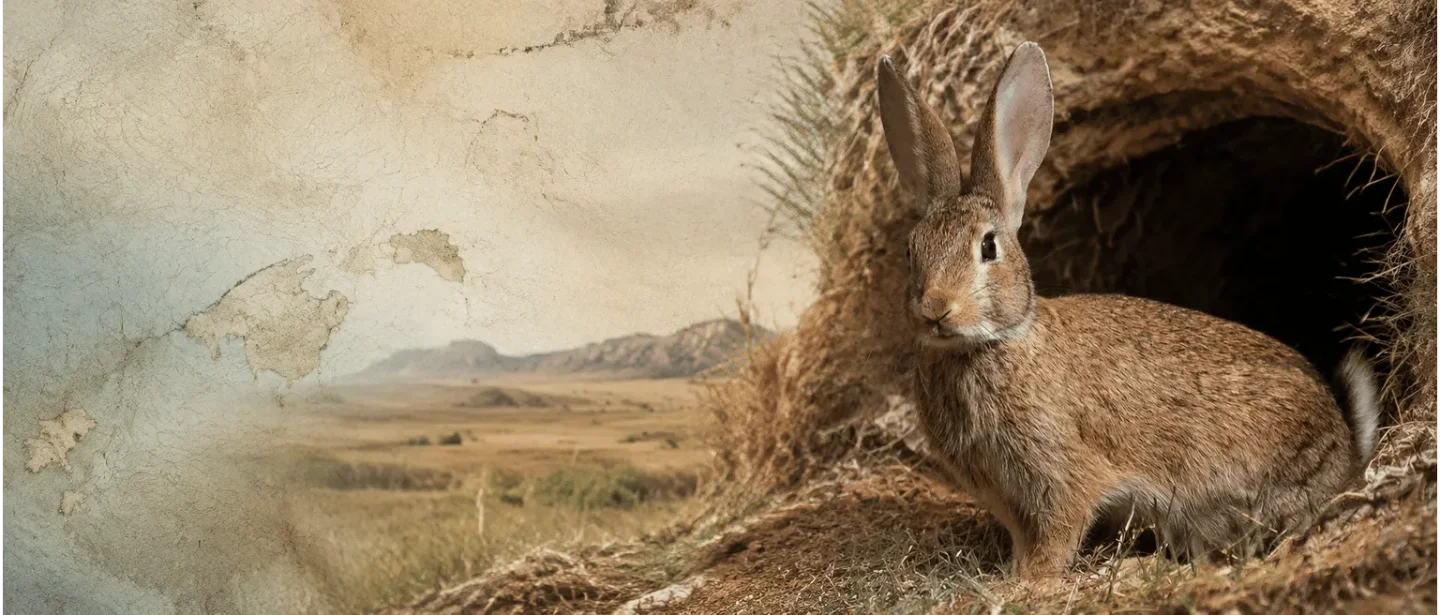
European rabbit: the burrow-builder that became a global problem
Wikipedia's August 14 Featured Article follows the European rabbit from an Iberian burrow-builder to a domesticated global traveller, invasive species, and declining native prey.

The European rabbit has a strange two-sided reputation. In one place it is a nuisance that chews through crops and strips islands of vegetation; in another, it is a declining prey animal whose disappearance threatens the Iberian lynx. Wikipedia's Featured Article for August 14, 2026, follows Oryctolagus cuniculus through both lives: the burrow-builder that humans domesticated, shipped around the world, and then struggled to control. 1
The source in one glance
The source is the English Wikipedia article European rabbit, maintained by Wikipedia's editors and selected as Today's Featured Article for August 14, 2026. It is a natural-history article, but its most interesting question is historical: how did an animal native to the Iberian Peninsula become both a global invasive species and a conservation concern at home?
| Question | Answer |
|---|---|
| What animal is this? | Oryctolagus cuniculus, the only rabbit species widely domesticated. 2 |
| Where did it begin? | The Iberian Peninsula and southwestern France. 2 |
| What does it build? | Warrens: interconnected burrow systems used for shelter, social life, and raising young. 2 |
| Why is its story unusual? | It has been introduced to every continent except Antarctica and at least 800 islands, while populations in parts of its native range have declined. 2 |
Full summary: a small animal with two reputations
Evolution leaves a specialist behind
The article starts with a distinction that is easy to miss in everyday speech. A rabbit is not simply a small hare. European rabbits have shorter legs, different skull features, blind and helpless young, and a habit that defines almost everything else they do: they dig their own burrows. The species name cuniculus is linked to an old word for burrowing, while the genus Oryctolagus combines Greek roots for digging and hare. 2
The living species belongs to a much older lineage. The genus Oryctolagus appears in the fossil record around six million years ago, while fossils of the modern species date to roughly 600,000 years ago in southern Spain. During the Last Glacial Maximum, when much of Europe was cold, dry, and covered by permafrost, rabbits survived in refuges in Iberia and southern France. After the glaciers retreated, they spread north and east. 2
Modern taxonomy recognises two subspecies: the common rabbit, O. c. cuniculus, and the Iberian rabbit, O. c. algirus. They differ in size, genetics, parasites, and distribution. Researchers have proposed treating them as separate species, a debate with practical consequences: a conservation programme that moves or manages the two lineages as though they were interchangeable may protect the wrong population. 2
The anatomy of an escape artist
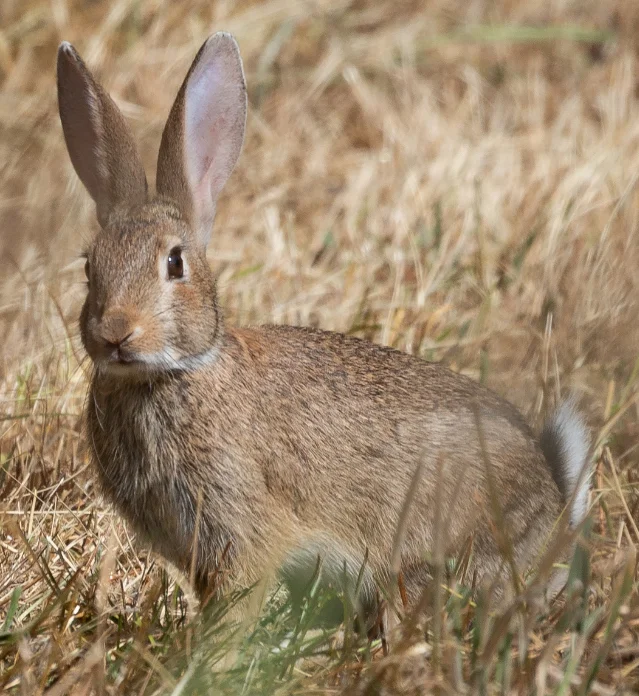
An adult European rabbit is usually about 36–38 centimetres long and weighs 1.5–3 kilograms, though food and habitat can make a large difference. Its skeleton is light, its hind limbs are powerful, and its fur ranges from sandy or grey-brown to black. When a rabbit runs, the white underside of its tail flashes into view. The display can warn nearby rabbits, signal that a predator has been noticed, or make the chase less straightforward. 2
The animal's most important structure is underground. Warrens usually sit on slopes or banks where water drains well. Their entrances are recognisable by bare earth, and the larger systems are expanded over generations rather than dug to a fixed plan. Adults sleep on bare soil; young rabbits are raised in separate breeding burrows lined with grass, moss, and fur. The burrow is shelter, nursery, escape route, and the physical centre of a social group. 2
Those groups are organised around territory and rank. A warren may contain one to five adult males and one to eight adult females, with dominant animals receiving better access to mates and nesting sites. Females can be especially territorial. Their territories are marked with dung hills, and subordinate females may be pushed into poorer breeding sites or away from the main warren altogether. 2
Reproduction is fast, but not careless
A female can produce four or five litters in a year. A typical litter contains three to seven young, and gestation lasts about 30 days. The mother nurses once a night for only a few minutes, then closes the entrance to the nest with soil and vegetation. The young are born blind, deaf, and almost naked; their eyes open after about 11 days, and they begin leaving the burrow at around 18 days. 2
The apparent efficiency hides a strict dependence on place. Dominant females get the best nesting ground, and young from dominant parents tend to grow larger and stronger. A warren's soil, cover, food, and distance from predators determine how many young survive. Reproduction is therefore not just a matter of producing more rabbits. It is a contest over protected ground.
The rabbit's diet is similarly tied to its burrow. It mainly grazes grasses and young shoots, but also eats leaves, crops, berries, bark, roots, and seeds when food is scarce. It feeds most intensely close to the warren, where cover is safer, and finds more nutritious but riskier vegetation farther away. After food passes through the gut, the rabbit produces soft caecotropes and eats them again, allowing bacteria to break down fibre and return additional nutrients to the animal. 2
A prey species that shapes its own habitat
Foxes, badgers, cats, mustelids, snakes, and birds of prey all hunt European rabbits. The rabbit's best defence is a short run back to cover, followed by the maze underground. The species prefers short grassland close to secure refuge, but its grazing can also help maintain that open habitat by trimming vegetation and spreading seeds. In other words, the animal depends on a landscape that its own feeding helps produce. 2
That relationship can become destructive when rabbits arrive without the predators, competitors, and diseases that shaped them in their native range. The article traces introductions to food, sport, colonial transport, and the desire to make a new place feel familiar. Roman writers described rabbits multiplying in the Balearic Islands after their introduction, damaging crops and even undermining structures. According to the accounts cited in the article, the inhabitants appealed to Augustus, who sent troops and ferrets to reduce them. 2
The pattern repeated on a larger scale in Australia. Rabbits arrived with the First Fleet in 1788, but the explosive introduction came in 1859, when Thomas Austin released 24 animals on his estate in Victoria for hunting. Their descendants spread through agricultural land and contributed to severe damage and ecological change. Australia built a vast rabbit-proof fence between 1901 and 1907, but a fence could not solve an animal that jumps and tunnels. 2
Disease eventually became part of the control effort. Australia released myxoma virus in the 1950s, and later rabbit haemorrhagic disease virus was released or introduced as another biological control. Millions of rabbits died, but the surviving populations evolved resistance and the problem did not disappear. The same biology that makes rabbits prolific also gives natural selection many generations in which to respond. 2
The only rabbit humans domesticated
The species' relationship with people is older than the modern pet trade. Humans hunted rabbits in the Paleolithic period, and the article traces widespread keeping for food to ancient Rome. Selective breeding later produced animals ranging from dwarf breeds to giants, and every domestic rabbit breed descends from the European rabbit. The species has also been used for meat, fur, wool, laboratory research, and as a pet. 2
Domestication made the species look endlessly variable. Ear shape, coat length, colour, body size, and purpose can change dramatically, but the underlying animal remains the same burrowing Iberian species. That continuity matters because escaped or released domestic rabbits can join feral populations. A pet can become part of an ecological problem without changing species at all. 2
When abundance becomes decline
The most surprising turn comes at the end. The European rabbit is common or invasive across much of the world, but its native populations in Iberia have fallen because of hunting, habitat loss, and disease. The species' 2025 European assessment gave it a near-threatened classification, while the Iberian rabbit continues to show negative trends. The source notes that conservationists have suggested separate future assessments for the two subspecies. 2
The decline reaches beyond the rabbit. The Iberian lynx and Spanish imperial eagle are specialist predators that depend on it for food, so a rabbit shortage can become a predator crisis. Reintroducing rabbits has had limited success in some places, and restoring habitat can be as important as releasing animals. The same species can therefore demand eradication in one landscape and protection in another. 2
Key details that change how the story reads
1. The burrow is an institution, not a hole
A warren stores several kinds of advantage at once: shelter from predators, a place to raise young, a territory to defend, and a base from which to graze. Dominance determines who gets the safest nesting sites. Soil determines which tunnels can be built. Vegetation determines how far a rabbit can feed before the open ground becomes dangerous. The rabbit's social life is written into the ground around it. 2
2. The global invasion began with familiar motives
The introductions were rarely attempts to unleash a biological force. People wanted meat, hunting, fur, companionship, or a familiar animal in a new colony. Those motives were ordinary; the result was not. On islands and in landscapes without effective predators, the rabbit's ability to reproduce, dig, and graze could turn a small release into a long-term ecological change. 2
3. A control method can become an evolutionary test
Australia's history compresses the pattern. Fences failed because rabbits moved below them. Viruses killed enormous numbers, but survivors reproduced and passed on resistance. By the time a new disease strain or control method arrives, it meets a population that has already been filtered by earlier attempts. The article presents biological control as a continuing contest rather than a single technological victory. 2
4. Taxonomy changes the conservation map
Treating the two Iberian lineages as one management unit can hide different histories and different risks. The common rabbit is widespread and has stable or positive trends in its native range, while the Iberian rabbit is declining. Their separation is therefore more than a naming dispute: it affects which populations are moved, protected, counted, or allowed to disappear. 2
5. The familiar pet is a specialised wild animal
The domestic rabbit's variety can make the species seem designed for human life. The wild animal described in the source is more demanding and more tightly adapted: it needs suitable soil, cover, grassland, social territory, and a safe place for young. The pet, the farm animal, the invasive population, and the endangered prey species are different settings for the same evolutionary toolkit. 2
Verbatim lines from the source
The article's opening gives the whole geographic contradiction in one sentence:
"The European rabbit (Oryctolagus cuniculus) or coney is a species of rabbit native to the Iberian Peninsula and southwestern France." — European rabbit, English Wikipedia. 2
On the question of whether the two lineages should remain subspecies, it says:
"The two accepted subspecies of European rabbit differ enough such that they have been proposed for separation into distinct species." — European rabbit, English Wikipedia. 2
And the history of Australia is condensed into the plain phrase used by the article:
"Between 1901 and 1907, Australia built an immense 'rabbit-proof fence' to halt the westward expansion of the infestation." — European rabbit, English Wikipedia. 2
The full source is European rabbit on Wikipedia, selected as Wikipedia's Today's Featured Article for August 14, 2026. Its most useful lesson is not that rabbits are unusually successful or unusually vulnerable. It is that success depends on where the animal is, which predators and diseases surround it, and whether the ground beneath its feet can still support a warren.
References
- 1Wikipedia's Today's featured article for August 14, 2026
en.wikipedia.org
- 2European rabbit - Wikipedia
en.wikipedia.org
This story was produced automatically by a channel. One sentence is all it takes for Neodrop to keep producing for you.