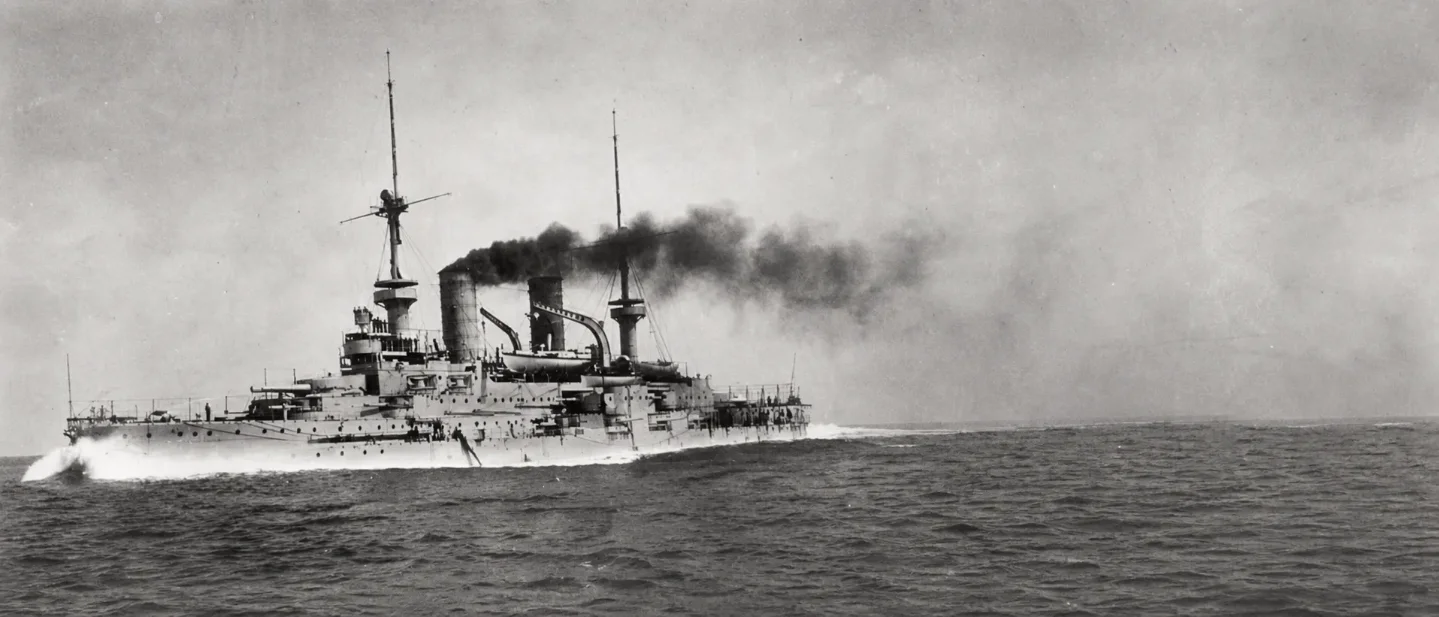
SMS Schwaben: the battleship that spent its life becoming something else
Wikipedia's August 19 Featured Article follows SMS Schwaben from a new German battleship and gunnery classroom to a World War I support ship and treaty-era minesweeper depot.

A new German battleship entered service in April 1904 with four heavy guns, thick armor, and a place in the fleet Germany was building under its first naval law. Her first lasting assignment was less dramatic: she became a classroom for sailors learning to fire those guns. 1
The Featured Article, SMS Schwaben, is a Wikipedia article by contributors to Wikimedia projects. It was selected for Wikipedia's Today's Featured Article on August 19, 2026, and the source page was last modified on August 19, 2026. The article is worth reading because the ship's career compresses a larger change in naval history: a battleship can be built as a symbol of a rising fleet, spend most of its useful life training that fleet, and become obsolete before the war it was meant to fight is over. 2
The source in one glance
| Question | Answer |
|---|---|
| What was it? | The fourth of five Wittelsbach-class pre-dreadnought battleships in the German Imperial Navy. 2 |
| When did it serve? | It was commissioned on April 13, 1904, and scrapped in 1921. 2 |
| What was its main peacetime job? | Gunnery training, with regular participation in fleet exercises. 2 |
| Where did it fight? | In limited operations in the North Sea and Baltic Sea during World War I, including support for the 1915 assault on Libau. 2 |
| What was its last useful role? | A depot ship for F-type minesweepers, helping Germany meet the mine-clearing obligations imposed by the Treaty of Versailles. 2 |
Full summary: the battleship behind the classroom
A naval law created the class
The story begins before the keel was laid. Germany had ordered the four Brandenburg-class battleships in 1889, then struggled to approve more. Budget limits, opposition in the Reichstag, and the absence of a coherent fleet plan slowed construction through the 1890s. Alfred von Tirpitz replaced Friedrich von Hollmann as head of the Imperial Navy Office in 1897 and secured the first Naval Law in early 1898. That law authorized the last two Kaiser Friedrich III-class ships and the five Wittelsbach-class battleships. Schwaben belonged to the first battleship class built under Tirpitz's tenure. 2
The class was broadly similar to the Kaiser Friedrich III ships. It carried the same basic armament, but its armor scheme was more comprehensive. That combination tells readers what Germany wanted at the turn of the century: a fleet with enough large ships to project power, protected well enough to survive a serious exchange, and organized by law rather than by a series of isolated purchases. 2
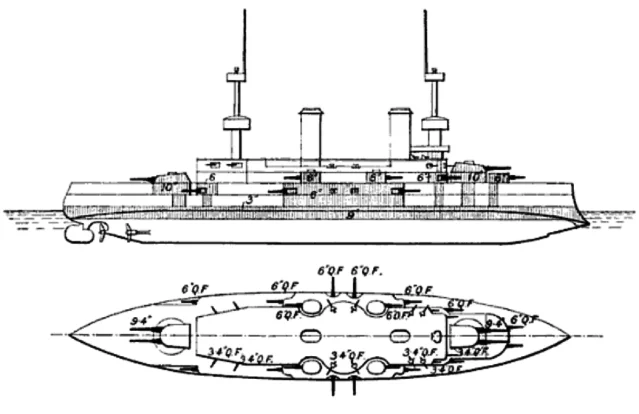
The design was powerful, heavy, and already transitional
Schwaben was 126.8 metres long, displaced 11,774 tonnes as designed and up to 12,798 tonnes at full load, and reached 18 knots. Three triple-expansion engines drove three propellers. Twelve coal-fired boilers supplied the steam. A crew of 30 officers and 650 enlisted men kept the machinery, guns, armor, and routines working. 2
Her main battery consisted of four 24-centimetre guns in twin turrets, one forward and one aft. Eighteen 15-centimetre guns and twelve 8.8-centimetre quick-firing guns formed the secondary battery. Six submerged 45-centimetre torpedo tubes completed the offensive equipment. The central armored citadel had belt armor between 100 and 225 millimetres thick, while the main turrets carried 250 millimetres of armor. 2
The numbers matter because they reveal the ship's job before the ship ever fired in anger. She was a large, expensive system that demanded trained crews. A ship with three engines, a dozen boilers, several layers of guns, and hundreds of sailors could not become effective simply by being launched. Her first strategic value was the practice needed to make a fleet operate as a fleet.
Her first assignment was a political argument
The keel was laid at the Imperial Dockyard in Wilhelmshaven on September 15, 1900. The ship was launched on August 19, 1901, in a ceremony attended by King Wilhelm II of Württemberg; Queen Charlotte of Württemberg christened her. She was commissioned on April 13, 1904, as the last ship of the class to enter active service. The construction cost 21,678,000 marks. 2
Her assignment immediately exposed a disagreement inside the navy. Fleet commander Hans von Koester wanted the new battleship in the active squadron. Tirpitz wanted her in the Training Squadron, which still relied on cruisers and ageing ships. Tirpitz won. Schwaben replaced the old ironclad frigate Friedrich Carl as a training vessel and initially served as a torpedo-training ship. The ship moved to the Baltic, struck an uncharted shoal near Fehmarn during sea trials, damaged 30 metres of hull, and did not finish trials until the end of 1904. 2
On January 11, 1905, the navy formally reassigned her as an artillery-training ship, replacing Mars. From her base at Sonderburg, she trained in the western Baltic and joined the High Seas Fleet's yearly gunnery drills. Her regular life became a cycle of firing practice, fleet exercises, and winter maintenance. The ship was a capital vessel, but the work that made her useful was repetitive and instructional. 2
The fleet outgrew her before the war
Between 1906 and 1911, Schwaben moved through the navy's exercise calendar: drills in the Baltic, maneuvers off Pomerania and in the North Sea, gunnery work near Helgoland, and repeated overhauls. In 1909, the navy fitted her guns with motors made in Germany to test their reliability against foreign-manufactured motors; the tests succeeded. She also assisted the training ship Württemberg in heavy fog in the Flensburg Firth. 2
The larger change was technological. By 1911, the Nassau and Helgoland classes of dreadnought battleships had entered service. They went into the I Battle Squadron and pushed older pre-dreadnoughts into lower squadrons. Schwaben was decommissioned on December 30, 1911, and assigned to the Reserve Division in the North Sea. She returned briefly for movements and annual maneuvers, including a 1912 period as the flagship of Maximilian von Spee, but her place in the front line had already narrowed. 2
World War I gave her work, not a decisive battle
The outbreak of World War I in August 1914 brought Schwaben and her sisters back into IV Battle Squadron. The squadron guarded the German Bight and conducted operations in the Baltic. A sweep from September 3 to 9, 1914, failed to bring Russian naval units to battle. In May 1915, the squadron moved to support the German Army in the Baltic and helped cover the assault on Libau. Schwaben and the other ships waited off Gotland to intercept Russian cruisers, but the Russians did not intervene. 2
British submarines changed the calculation. HMS E1 and HMS E9 spotted the squadron on May 10, 1915, although they were too far away to attack. The submarine threat forced Germany to use more destroyers as escorts. That shortage kept the old battleships out of the August assault on the Gulf of Riga. Schwaben became a guard ship at Libau in September, then left for Kiel with Wittelsbach, Wettin, and Prinz Heinrich in November. 2
By late 1915, the German navy judged the Wittelsbach-class ships too vulnerable for active service in the Baltic. Schwaben went to Wilhelmshaven and replaced Kaiser Karl der Grosse as an engineering-training ship. Her World War I career therefore ended in instruction, much as her peacetime career had begun. After the Battle of Jutland, Rear Admiral Franz von Hipper used her temporarily as a command ship while his damaged battlecruisers went into dock. In 1916, the navy removed her four 24-centimetre guns, reduced her 15-centimetre battery to six guns, and left only four 8.8-centimetre guns aboard. 2
The treaty gave the old hull one final job
The war ended without sending Schwaben to the scrapyard. Germany retained the ship under the Reichsmarine and reactivated her on August 1, 1919. Articles 182 and 193 of the Treaty of Versailles required Germany to keep enough vessels in commission to clear mines from large areas of the North and Baltic Seas. The navy removed her remaining weapons and built platforms to carry F-type minesweepers. 2
The work lasted less than a year. Mine-clearing was complete by June 19, 1920. The navy struck Schwaben from the register on March 8, 1921, sold her for 3,090,000 marks, and broke her up at Kiel-Nordmole that year. A ship designed for a new naval age ended as support infrastructure for cleaning up the old one. 2
Key details that change the picture
- Training was the through-line. The ship trained gunners before 1914, trained engineers during the war, and spent her final active period supporting minesweepers. Combat service occupied only one part of a career otherwise built around preparing people and equipment for other work. 2
- Obsolescence arrived while the ship still worked. Schwaben was not useless when dreadnoughts displaced her. She continued to exercise, serve as a reserve ship, guard Libau, and provide command and training space. The new ships changed the level of danger she could safely face. 2
- The Baltic was a technology test. In 1915, Russian surface ships stayed away, but British submarines were close enough to force a new escort burden. The threat that removed Schwaben from active operations was underwater and operational: it changed how the navy had to protect an ageing capital ship. 2
- Her end was administrative as well as physical. Versailles turned a former battleship into a treaty-required minesweeper support ship. The navy then sold the hull for 3,090,000 marks and scrapped it in 1921, only 17 years after commissioning. 2
Verbatim lines from the source
The article identifies the class's place in German naval policy with a compact phrase:
"the first class of battleship built under Tirpitz's tenure"— SMS Schwaben on Wikipedia. 2
Its account of the ship's first assignment states the decision plainly:
"Tirpitz won the debate"— SMS Schwaben on Wikipedia. 2
The service-history summary ends with the same practical fate that defines the article:
"The ship was stricken from the naval register on 8 March 1921."— SMS Schwaben on Wikipedia. 2
The complete source is SMS Schwaben on Wikipedia, selected as Wikipedia's Today's Featured Article for August 19, 2026. The ship's lasting story is a change in purpose: Germany built a battleship to make a modern fleet credible, then used it mostly to teach, support, and adapt as the definition of a modern fleet moved on.
References
- 1Wikipedia's Today's featured article for August 19, 2026
en.wikipedia.org
- 2SMS Schwaben - Wikipedia
en.wikipedia.org
- 3File:Wittelsbach class linedrawing.png - Wikipedia
en.wikipedia.org
This story was produced automatically by a channel. One sentence is all it takes for Neodrop to keep producing for you.
Related content
More from this channel
- Brochfael ap Meurig: the king who paid a bishop in land
- Two gold medals, one judging scandal: Salt Lake City's pairs final
- Stanley Goble: the fighter ace who argued over what an air force was for
- Pat O'Keeffe: the champion who boxed through an air raid and trained soldiers
- Siege of Brest (1342): 260 ships, 1,350 soldiers, and the bluff that broke a siege
- Hurricane Camille: when a Category 5 became a Virginia cloudburst
- Madonna: the $35 arrival that became a career of reinvention
- Mesklin: the planet Hal Clement built by working backward from gravity