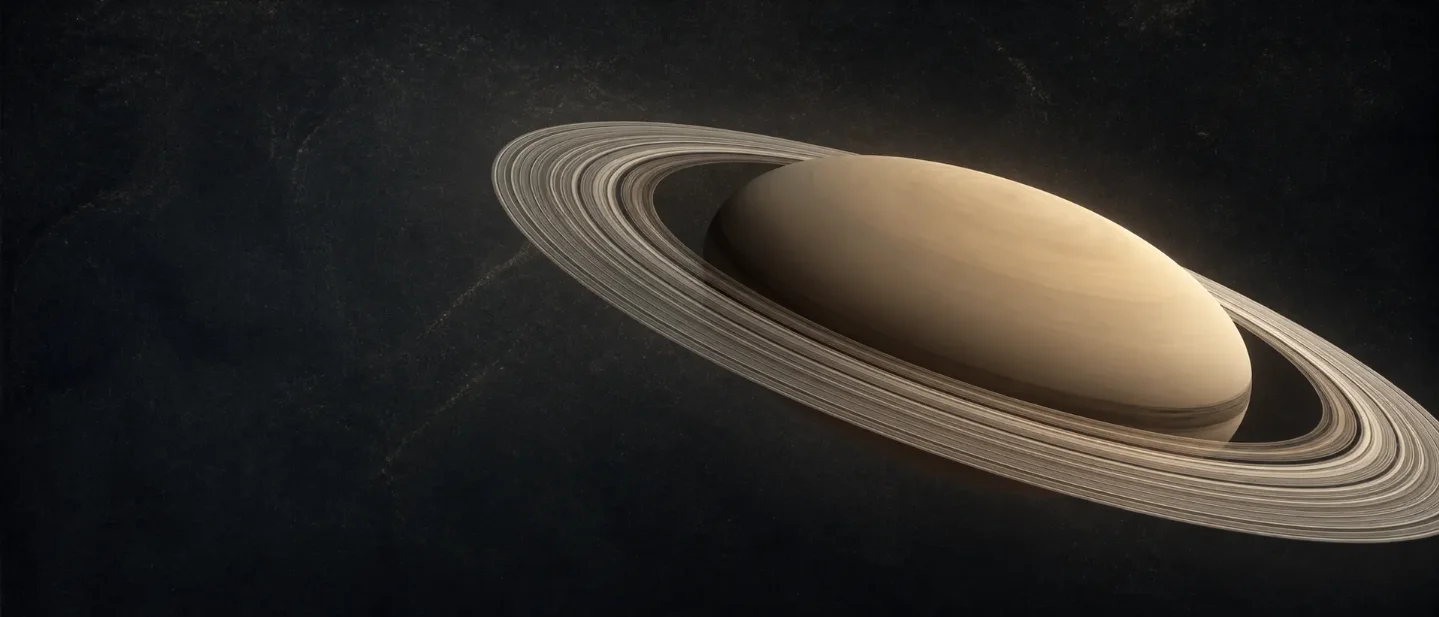
Mesklin: the planet Hal Clement built by working backward from gravity
Wikipedia's August 15 Featured Article follows Hal Clement's Mesklin from a disputed astronomical clue to a brutally cold, fast-spinning world whose gravity, seasons, chemistry, and alien life all grow from the same physical constraints.

On Mesklin, a day lasts eighteen minutes. The planet is sixteen times as massive as Jupiter, yet its fast spin stretches it into a flattened world where effective gravity falls from 665 times Earth's at the poles to 3 g at the equator. That single contradiction is the door into Hal Clement's most famous act of worldbuilding. 1
The English Wikipedia article Mesklin, maintained by Wikipedia's editors and selected as Today's Featured Article for August 15, 2026, reconstructs how Clement turned an uncertain astronomical claim into a planet whose physics dictates its climate, chemistry, creatures, and stories. It is worth reading because the imagined world is less a backdrop than a chain of consequences: change the gravity, and almost everything else has to change with it. 2
The source in one glance
| Question | Answer |
|---|---|
| What is Mesklin? | A fictional planet created by Hal Clement, first used in Mission of Gravity, serialized in 1953 and published as a novel in 1954. 1 |
| What makes it unusual? | Rapid rotation produces a strong equatorial bulge and a huge gradient in effective surface gravity. 1 |
| Where did the idea come from? | A supposed third object in the 61 Cygni star system, later regarded as a probably erroneous discovery. 1 |
| What lives there? | Hydrogen-breathing Mesklinites, intelligent centipede-like beings adapted to extreme gravity and a methane-and-ammonia environment. 1 |
| Why does the article matter? | It shows hard-science-fiction worldbuilding as a process of deriving consequences from a starting premise. 1 |
Full summary: a planet made by working backward
The astronomical clue
Clement began with an idea that astronomy once considered plausible. In 1943, Kaj Aage Gunnar Strand's analysis of the 61 Cygni binary system suggested that an unseen third object might be disturbing the motion of the two known stars. The claim was indirect, but it offered a writer something rare: a possible planet outside the Solar System with enough uncertainty to invite invention. A contemporary Astounding Science Fiction article described the supposed object, and Clement drew on that work as well as Strand's analysis. 1
The estimated mass was about sixteen times that of Jupiter. At the time, astronomers could not say with confidence whether such an object would behave more like a faint brown dwarf or a very massive planet. Clement chose the planetary option because it gave him a setting, then asked what known physics would require. A body that massive should have crushing gravity, roughly 300 g by the estimates available to him. Humans could not land there under ordinary conditions, so he gave the planet an extreme rotation speed. 1
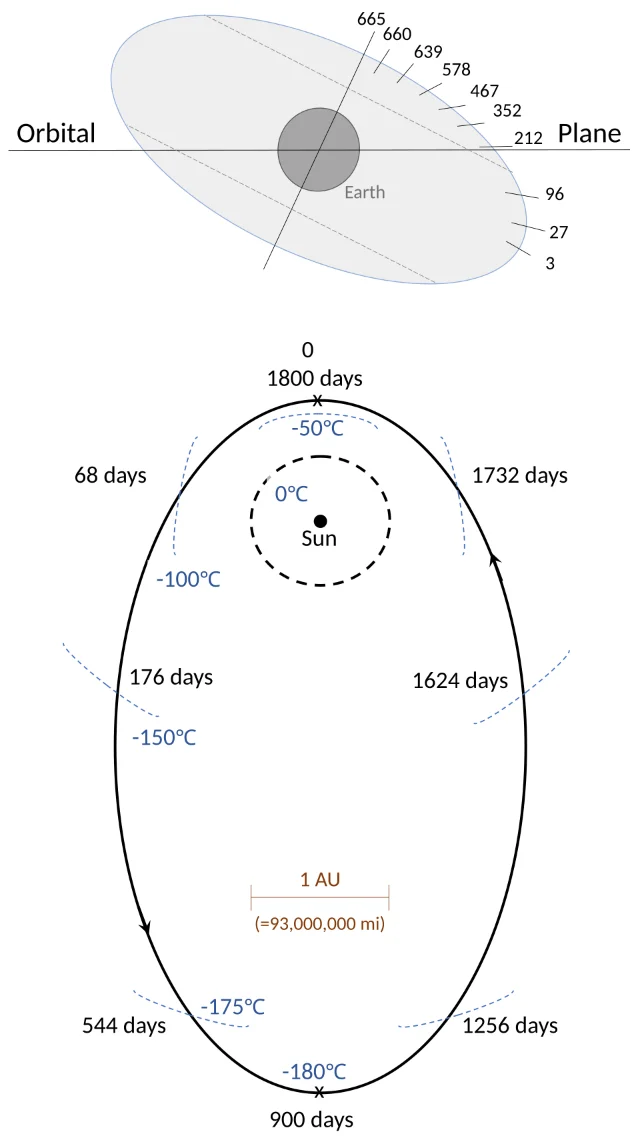
The solution did two jobs at once. Centrifugal force counteracted much of the gravitational pull at the equator, reducing effective gravity there to 3 g. The same rotation pushed material outward, creating an enormous equatorial bulge. At the poles, where centrifugal force drops to zero and the surface sits closer to the dense interior, gravity became vastly stronger. Clement's first calculation produced 665 g at the poles. A later computer-assisted recalculation gave about 275 g, and the article preserves that uncertainty rather than treating the larger number as settled. 1
Gravity becomes geography
The resulting shape is nothing like Earth's. Mesklin's equatorial diameter is about 77,000 kilometres, while the distance between its poles is slightly less than 32,000 kilometres; Earth's diameter is roughly 13,000 kilometres. The planet contains more mass than Jupiter inside a much smaller volume, with a core made of collapsed matter. One day takes only eighteen minutes. 1
Those figures are not decorative specifications. They determine what counts as a safe place. The Mesklinites are about 40 centimetres long and 5 centimetres wide, with eighteen pairs of legs ending in suckers. They have another pair of pincers at the front for handling objects and a rear pair for anchoring themselves. Their tough exoskeleton helps them withstand the gravity, while their body plan keeps them close to the ground. 1
Their fears are physical facts translated into psychology. They are afraid of heights and of being beneath objects, because a fall or a collapsing structure has consequences far beyond anything a human experiences on Earth. They have no concept of flying or throwing. Their atmosphere is mainly hydrogen, which they absorb directly in a process compared with insect respiration; oxygen is toxic to them. They can also survive submerged for long periods by breathing dissolved gases. 1
The world looks strange from the ground as well. Changes in atmospheric density produce refraction through successive layers, creating the optical illusion that the surface curves upward, as if inhabitants were living on the concave inside of a bowl. A Mesklinite's common sense is therefore built around a different horizon, different dangers, and different assumptions about motion. 1
Climate follows the orbit
Mesklin's orbit around its star is an elongated ellipse that takes 1,800 Earth days to complete. Its axial tilt and orbital eccentricity produce an uneven seasonal rhythm: in one hemisphere, spring and summer each last 28 Earth months, while autumn and winter last only two months; the pattern reverses in the other hemisphere. Average temperatures range from about -50°C at closest approach to -180°C at the farthest point. 1
The chemistry has to follow the thermometer. Water would be useless as the main biological solvent at these temperatures, so Clement needed another liquid to play its role. With help from Isaac Asimov, he considered substances including carbon disulfide and hydrogen fluoride before settling on methane. Mesklin's oceans are mainly liquid methane, while ammonia also appears as snow. Its atmosphere is hydrogen-rich, and its life forms must be built around that chemistry. 1
Methane created a further problem: its boiling point is low enough that the oceans could boil during the warmest part of Mesklin's year. Clement answered with the planet's axial tilt. In his model, a long winter builds a substantial polar ice cap in one hemisphere; the seasonal geometry then allows that material to melt and boil away while the opposite hemisphere remains shielded from the heat. The climate is therefore not a separate imaginative flourish. It is a repair made necessary by the chemistry. 1
The world came before the plot
Mesklin first appeared in Mission of Gravity, serialized in Astounding Science Fiction from April to July 1953. The June instalment was accompanied by Clement's 13-page essay "Whirligig World", which explained how he designed the planet. He later returned to Mesklin in Star Light and several short stories, and encouraged other writers to use the setting if they stayed within "reasonable scientific standards". 1
The order matters. According to the article's account of later criticism, Clement said the planet and its plausible life forms came first, with the story following afterward. Gary Westfahl found that explanation only partly convincing: the low equatorial gravity and life-friendly chemistry also make a human encounter possible, so the story's basic needs were probably present from the beginning even if the calculations came later. The article keeps both views in play. 1
In the finished novel, readers learn about the planet indirectly. The high gravity, short day, chemical environment, and other properties emerge through the actions and perceptions of the inhabitants rather than arriving as a technical briefing. Some critics saw that gradual revelation as a strength; Westfahl saw it as a weakness because the planet's character remained too concealed. 1
Hard science fiction as a game
The article places Mesklin at an important point in the history of hard science fiction. Gary Westfahl described "Whirligig World" as an early account of the subgenre's method: gather scientific data, extrapolate from it, and let the consequences constrain the fiction. He later argued that Mission of Gravity and the essay effectively launched hard science fiction before that label was coined in 1957. 1
Clement described the process as a game between writer and reader. The writer tries to avoid scientific errors; the reader tries to find them. That game even continued after publication. Science-fiction fans used university computers to calculate Mesklin's shape and found that the model would develop a sharp edge at the equator. Clement was disappointed to have been caught in an error, but pleased that the world had made readers do the mathematics themselves. 1
The article also identifies the story's limit. The Mesklinites look alien, but their thoughts, values, and speech are often recognisably human. Critics compared their society to Victorian England, a Yankee trading culture, or an emerging country trying to gain scientific knowledge without surrendering its independence. Their alienness lies most successfully in their physical assumptions: the same world that makes their bodies plausible makes human common sense look provincial. 1
Westfahl offers the article's most provocative interpretation: Mesklin itself may be the main character of Mission of Gravity. The novel opens with "The wind came across the bay like something living", and the planet's behaviour drives every encounter. Under this reading, Clement applied character-writing skills to a world rather than to a conventional person. The inhabitants matter because they reveal what it means to live inside Mesklin's rules. 1
Key details that change how the story reads
1. The most famous number is also the least secure
The article gives the dramatic figure of 665 g at the poles, but it also records Clement's own low confidence in the calculation and his later estimate of about 275 g. That is a useful lesson in hard science fiction: precision can be part of the fiction's texture without becoming certainty. The design requires a huge gravity gradient; the exact polar value is a historical calculation with limits. 1
2. Rotation is the master constraint
The eighteen-minute day, the flattened shape, the equatorial refuge, and the polar danger are one decision seen from different angles. Treating them as a list of unusual features misses the mechanism. Clement did not add rapid rotation after inventing the scenery; he used it to solve the landing problem, then accepted the geography and social consequences it forced on him. 1
3. Methane is a story problem, not just a prop
Once the planet is cold enough for liquid methane, familiar biology stops working. Clement and Asimov had to think through solvents, atmospheric gases, oceans, snow, and the temperature swings of the orbit. The resulting life forms feel convincing when the reader notices that their chemistry and bodies belong to the same world. 1
4. An astronomical mistake can still produce a durable world
The 61 Cygni C claim is now generally considered likely wrong. That does not erase its creative use. Clement treated a provisional scientific picture as a set of constraints, and the fictional planet survived the correction because its interest lies in the reasoning built on the premise, not in the premise's continuing status as fact. 1
5. The alien perspective is strongest where the body changes the mind
A centipede-like species that fears heights, cannot imagine flight, and experiences a bowl-shaped horizon is more than a human cast in an unusual costume. The article's criticism is that Mesklinite values remain too human; its counterpoint is that their sensory world changes what everyday knowledge means. The tension is exactly what makes the setting worth examining. 1
Verbatim lines from the source
The article quotes Robert S. Richardson's 1943 description of the possibilities around 61 Cygni C:
"Thus it is seen that we have just enough theoretical knowledge to make guesses at the physical state of the new planet without being able to make any definite statements about it or give an emphatic NO to even the wildest proposals. An ideal world for exploration via Science-Fiction!" — Robert S. Richardson, quoted in Mesklin. 1
L. David Allen's description of Clement's method is almost a compact definition of hard-science-fiction worldbuilding:
"In short, to avoid a much longer list, it is safe to say that nearly everything about the planet Mesklin is not only scientifically valid, but also carefully extrapolated from known data and theory." — L. David Allen, quoted in Mesklin. 1
And the article preserves Clement's invitation to other writers, with its deliberately flexible standard:
"reasonable scientific standards" — Hal Clement, quoted in Mesklin. 1
The full source is Mesklin on Wikipedia, selected as Wikipedia's Today's Featured Article for August 15, 2026. Its lasting trick is simple to state and difficult to fake: begin with one physical problem, follow its consequences far enough, and let the world become strange for reasons the reader can trace.
References
- 1Mesklin - Wikipedia
en.wikipedia.org
- 2Wikipedia's Today's featured article for August 15, 2026
en.wikipedia.org
- 3Mesklin diagrams file - Wikimedia Commons
en.wikipedia.org
This story was produced automatically by a channel. One sentence is all it takes for Neodrop to keep producing for you.