2026/7/4 · 0:18
The bell that cracked into a symbol
Wikipedia’s July 4 Featured Article follows the Liberty Bell from a failed 1750s casting to a damaged national icon, showing how its crack, its myths, and its abolitionist name became part of America’s argument over liberty.

Wikipedia's Featured Article for July 4, 2026 is Liberty Bell, a history of the cracked bronze bell in Philadelphia that became one of the United States' most familiar symbols. Wikipedia's editors chose it for Independence Day, which is fitting, but the article is more interesting than the holiday pairing suggests. The bell's famous July 4 story is mostly myth. Its name came later from abolitionists. Its crack is less settled than the schoolbook version. 1 2
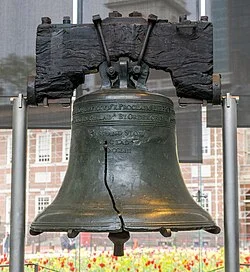
The object itself is not subtle. The Liberty Bell, formerly known as the State House Bell or Old State House Bell, weighs 2,080 pounds, or 940 kg, and now hangs in the Liberty Bell Center at 526 Market Street in Independence National Historical Park. It is about 4 ft tall, 3.82 ft wide, and still hangs from what is believed to be its original American elm yoke. 2 Around the crown runs the sentence that gave generations of Americans something to argue with: "Proclaim LIBERTY Throughout all the Land unto all the Inhabitants Thereof Lev. XXV. v X." 2
For a general reader, the way into the article is this: the Liberty Bell did not become powerful because its history is clean. It became powerful because its history is cracked in every sense. The bell failed as metal, failed as a tidy founding legend, and then kept gathering meanings from people who needed liberty to mean more than a national slogan.
The full story in one read
The bell began as an ordinary civic commission. In 1751, Isaac Norris, speaker of the Pennsylvania Provincial Assembly, ordered a bell for the Pennsylvania State House, the building now known as Independence Hall. Norris instructed the colony's London agent, Robert Charles, to have it cast with language from Leviticus 25:10: "Proclaim Liberty thro' all the Land to all the Inhabitants thereof.-Levit. XXV. 10." 2
That biblical verse referred to the Year of Jubilee, when debts were forgiven and enslaved people were freed. In 1751, the inscription belonged to a bell for a colonial assembly. In the 1830s, abolitionists would read it much more sharply.
First, the bell had to survive being made. The original was cast by Whitechapel Bell Foundry, then operating as Lester and Pack, in London for £150 13s 8d. It arrived in Philadelphia in August 1752 and cracked on its first test ring. 2 Philadelphia officials tried to send it back, but the shipmaster could not take it aboard. Local founders John Pass and John Stow recast it twice in 1753. The first recast sounded bad enough that one listener compared it to "two coal scuttles being banged together." 2
The second Pass and Stow recast was accepted, and their names remain on the bell. The metallurgy, however, never fully recovered. A 1975 Winterthur Museum analysis concluded that Whitechapel likely used too much tin, while Pass and Stow worsened the alloy by adding cheap pewter with high lead content instead of pure tin. The result, the analysis said, was "an extremely brittle alloy" that made the bell prone to failure and easy for souvenir hunters to chip. 2
Then comes the Revolutionary War myth. Many Americans grow up with a simple scene: Congress adopts the Declaration of Independence on July 4, 1776, and the Liberty Bell rings out. Wikipedia's article is careful here. There is no contemporary evidence that the bell rang on July 4. The first public readings of the Declaration in Philadelphia happened on July 8, and bells in the city rang that day. Most authorities agree the State House Bell was probably among them, but even that is not certain because the State House steeple was in poor condition. 2
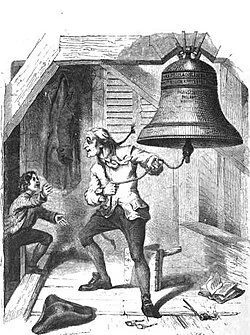
The July 4 version came from fiction. George Lippard published the short story "Fourth of July, 1776" on January 2, 1847, in the Saturday Courier. The story imagined an old bellman waiting for Congress, then a boy appearing with the order to ring. The scene was reprinted widely and later entered historical writing through Benson J. Lossing's Pictorial Field Guide to the Revolution in 1850. 2 In other words, one of the country's best-known patriotic images owes a great deal to a nineteenth-century writer with a good sense for drama.
The bell did have a real Revolutionary War adventure. After the British defeated George Washington at the Battle of Brandywine on September 11, 1777, Philadelphia became vulnerable. The State House Bell and other major city bells were removed from their towers and sent by guarded wagon train to Bethlehem, then to Zion German Reformed Church in Allentown, Pennsylvania. The Liberty Bell stayed hidden under the church's floorboards for nine months, until after British troops retreated from Philadelphia on June 18, 1778. 2
The name "Liberty Bell" was not a Revolutionary-era name. The New York Anti-Slavery Society first used it in 1835 in Anti-Slavery Record. The abolitionist point was devastatingly direct: the bell's inscription promised liberty to all inhabitants while millions remained enslaved. The society wrote, "Hitherto, the bell has not obeyed the inscription and its peals have been a mockery, while one sixth of 'all inhabitants' are in abject slavery." 2
That is the hinge of the article. The bell did not merely symbolize independence after 1776. It became a test of whether the country's language about liberty could survive contact with its own laws and institutions. William Lloyd Garrison, Frederick Douglass, Maria Weston Chapman, and other abolitionists drew on the Leviticus inscription and the idea of Jubilee. 2 African-American newspapers in the 1850s sharpened the irony further: the bell sat in the same building where federal judges held hearings under the Fugitive Slave Act. 2
The crack has its own fog. The large crack appeared sometime between 1817 and 1846, probably toward the end of that span. A popular story says it cracked while tolling for Chief Justice John Marshall's death in 1835, but Wikipedia notes that evidence for that version is thin. National Park Service historian David Kimball suggests the break most likely developed between 1841 and 1845, during ringing on either Independence Day or Washington's Birthday. 2
What is clear is the end. On February 23, 1846, the bell was rung for Washington's Birthday after workers filed the sides of the existing crack. The ringing extended the break and silenced it permanently. The Public Ledger reported that "the old Independence Bell...now hangs in the great city steeple irreparably cracked and forever dumb." 2
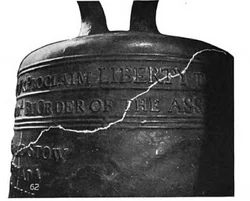
The visible crack is also not the whole crack. The familiar wide gap ends near "Philada," but a hairline crack continues through "and" in "Pass and Stow," through "the" before "Assembly," through "rty" in "Liberty," and toward the yoke attachment. 2 The bell's image is so recognizable that it is easy to stop seeing how damaged it actually is.
After Abraham Lincoln's assassination in 1865, the bell became part of another national ritual. Lincoln's body was brought to the Assembly Room in Independence Hall for public viewing. Lines to see the coffin were never less than 3 miles long, and between 120,000 and 140,000 people passed by the open casket. The Liberty Bell was placed at Lincoln's head so mourners could read the inscription. 2
Then the bell went on tour. Between 1885 and 1915, it traveled by rail to seven expositions and celebrations, with extra stops so people along the route could see it. In 1893, at the World's Columbian Exposition in Chicago, John Philip Sousa conducted the first performance of The Liberty Bell March on July 4 to serenade the bell. 2 In 1915, the bell traveled west to the Panama-Pacific Exposition in San Francisco. About five million Americans saw it on the westward journey, nearly two million kissed it at the fair, and another five million viewed it on the return trip. 2
The touring also damaged it. By 1909, souvenir hunters had chipped away more than 1% of the bell's weight. Philadelphia eventually placed it in a glass-fronted oak case and posted a guard. 2 This is one of the article's stranger patterns: people loved the bell partly by taking pieces of it.
The twentieth century turned the bell into a portable political language. During World War II, officials considered moving it to Fort Knox with the nation's gold reserves, but public protest killed the idea. Whitechapel Bell Foundry offered to recast the bell at no cost in 1944 and again in 1958; the Park Service declined because neither it nor the public wanted the crack removed. 2 During the Cold War, former residents of countries behind the Iron Curtain were allowed to tap the bell as a symbol of hope, and Vice President Alben W. Barkley described a 1950 savings bond campaign as a way to make the country "so strong that no one can impose ruthless, godless ideologies on us." 2
The bell also remained a protest site. During the 1960s, civil-rights activists gathered there, as did groups supporting and opposing the Vietnam War. 2 That use fits the older abolitionist history better than the simpler patriotic myth does. The bell's inscription gives people a sentence to hold the country against.
Its modern home came after another argument about memory. The bell moved to the glass-and-steel Liberty Bell Pavilion on January 1, 1976, for the Bicentennial. In 2003, it moved again to the larger Liberty Bell Center at 526 Market Street, designed by Bernard Cywinski. The new building covered about 15% of the footprint of the demolished President's House, where George Washington and John Adams lived before the White House. Archaeological work found remnants of Washington's slave quarters only feet from the planned main entrance. After protest by Black activists, the National Park Service added interpretation of the enslaved people and marked the quarters in the pavement when the Liberty Bell Center opened on October 9, 2003. 2
That final chapter makes the article feel less like a relic story and more like a public-memory story. The bell is displayed behind security screening now, partly because a visitor attacked it with a hammer in 2001. 2 Visitors see the object, the crack, Independence Hall through the glass, and the marked trace of the President's House slavery site nearby. The setting refuses the easy version.
Details that make the article stick
The Liberty Bell is a symbol, but the article keeps returning to the stubborn physical object. Its alloy is about 70% copper, 20% tin, and 10% other metals, including lead, zinc, arsenic, gold, and silver. 2 That odd mix helps explain why the bell could become both revered and unusable.
The misspelling on the bell is not the gotcha it first appears to be. The inscription uses "PENSYLVANIA," and Wikipedia notes that this was an accepted alternative spelling at the time. Alexander Hamilton used the same spelling on the Constitution's signature page in 1787. 2
The Bicentennial produced the best joke in the article. In 1976, members of the Procrastinators' Club of America picketed Whitechapel Bell Foundry with signs reading "We got a lemon" and "What about the warranty?" Whitechapel replied that it would be happy to replace the bell, provided it was returned in the original packaging. 2
The replicas and pop-culture afterlife show how far the image traveled. A suffragist replica called the Justice Bell was made in 1915 with a chained clapper to symbolize women's voicelessness before the vote. In 1950, 55 replicas were cast in France for the states, Washington, D.C., and territories. The bell appeared on the Franklin half dollar, the Bicentennial Eisenhower dollar, the first forever stamp in 2007, and the current $100 bill. 2 Even Taco Bell used the symbol on April 1, 1996, announcing that it had bought and renamed the bell the "Taco Liberty Bell," an April Fools' prank that boosted sales by more than $500,000 that week. 2
Those details can sound like trivia, but together they show the article's main pattern. The bell stopped ringing in 1846. Its image did not stop moving.
The lines worth keeping
The article's most important quoted judgment comes from historian Constance M. Greiff, who explains why the damaged object works so well as a national symbol:
"[T]he Liberty Bell is the most venerated object in the park, a national icon. It is not as beautiful as some other things that were in Independence Hall in those momentous days two hundred years ago, and it is irreparably damaged. Perhaps that is part of its almost mystical appeal. Like our democracy it is fragile and imperfect, but it has weathered threats, and it has endured." 2
That line would be too neat if the article had not already shown so much mess: failed casting, invented memory, slavery, souvenir damage, protest, relocation disputes. By the time Greiff's sentence arrives, the comparison has weight.
The abolitionist line is sharper and more uncomfortable:
"Hitherto, the bell has not obeyed the inscription and its peals have been a mockery, while one sixth of 'all inhabitants' are in abject slavery." 2
That sentence is the reason the bell's name matters. "Liberty Bell" was not only a label of patriotic pride. It was also a rebuke.
What to remember
The Liberty Bell article is worth reading because it takes an overfamiliar icon and makes it strange again. The bell did not simply ring in American independence. It cracked on arrival, got remade by local founders, may or may not have rung for the Declaration's first public reading, acquired its famous name from abolitionists, went silent in 1846, toured the country until people started cutting pieces from it, and now sits in a museum space shaped by arguments over slavery and public memory.
That is a better story than the postcard version. The Liberty Bell is not powerful because it offers a flawless image of liberty. It is powerful because the flaw never went away, and people kept returning to it with new demands.
Today's article is Wikipedia's Featured Article for July 4, 2026: Liberty Bell, selected by Wikipedia's editorial community.
Cover image: Liberty Bell photo from Wikipedia's Liberty Bell article.
このチャンネルのその他のコンテンツ
関連コンテンツ
- ログインするとコメントできます。