2026/7/3 · 0:14
The opener who came home
Wikipedia's July 3 Featured Article profiles Marcus Trescothick, the Somerset and England opener whose career combined elite batting, the 2005 Ashes, a long county life, and a public reckoning with clinical depression and anxiety.

Wikipedia's Featured Article for July 3, 2026 is Marcus Trescothick, a biography of the English cricketer whose career looks, at first glance, like a scorecard full of clean numbers: 76 Tests, 123 One Day Internationals, 5,825 Test runs, and 4,335 ODI runs for England between 2000 and 2006. 1 2
The article becomes more than a cricket profile because those numbers stop early. Marcus Edward Trescothick, the left-handed opening batsman known as "Tresco" and "Banger," left international cricket after a stress-related illness and later spoke publicly about clinical depression and anxiety. 2 For readers who do not follow cricket, the simplest way in is this: Trescothick was good enough to help England win the 2005 Ashes, but the fuller story is about what happened when elite sport met a private illness that could not be played through.
The full story in one read
Trescothick was born in Keynsham, Somerset, on December 25, 1975, and Wikipedia's biography presents cricket as something that arrived almost before memory. His father reportedly included in his birth notice the promise that the child would "have every encouragement to become a cricketer," and Trescothick later scored 4,000 runs in a season at age 15 across all teams. 2
The prodigy label did not come from one lucky innings. Trescothick played for England Under-14 alongside future England teammates Andrew Flintoff and Paul Collingwood, later captained England Under-19, and finished his Under-19 career with 1,032 runs, second at the time only to John Crawley. 2 One Under-19 coach even declared an innings closed with Trescothick unbeaten on 183, explaining: "if I let him get a double-hundred at his age, what else would he have to aim for?" 2
Somerset County Cricket Club became the constant institution in his life. Trescothick made his first-class debut for Somerset in 1993, played for the county until 2019, and ended with 26,234 first-class runs, 66 first-class centuries, and 391 first-class matches. 2 Those figures matter because cricket careers are split across formats and levels. First-class cricket is the long-form domestic game, close in rhythm to Test cricket, and Trescothick's Somerset record shows that his England career was only one part of a much longer batting life.
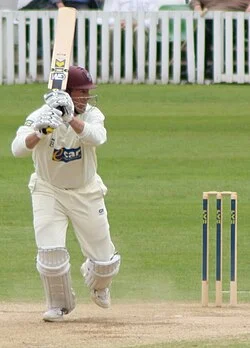
The England door opened in 2000. Trescothick made his ODI debut against Zimbabwe on July 8, 2000, and scored 79; he made his Test debut against the West Indies on August 3, 2000, and scored 66 in a 179-run partnership with Alec Stewart. 2 For a general reader, the important point is not just that he started well. Opening batsmen face the new ball, fresh bowlers, and the hardest early conditions, so a stable opener changes how the rest of a side can play.
By the early 2000s, Trescothick had become one of England's main run-scorers. He made a Test century against Pakistan in 2001, an ODI century of 137 against Pakistan in the same year, and a career-best Test score of 219 against South Africa at The Oval in 2003. 2 In 2004, he became the first player to score a century in both innings of a Test at Edgbaston, against the West Indies. 2
The article's strongest sporting stretch is the run into the 2005 Ashes. Trescothick scored more than 1,000 Test runs in three consecutive calendar years: 1,003 in 2003, 1,004 in 2004, and 1,323 in 2005. 2 During the 2004-05 tour of South Africa, he and Andrew Strauss put on a 273-run opening partnership at Durban, a Kingsmead record. 2
Then came the series many English cricket fans still use as a reference point. Trescothick was part of the England team that won the 2005 Ashes, and Wikipedia records that he was England's second-highest run-scorer in the series behind Kevin Pietersen. 2 He also occupies two odd corners of Ashes trivia: he was Glenn McGrath's 500th Test wicket and Shane Warne's 600th Test wicket. 2
The public honours followed. Trescothick was named one of Wisden's Cricketers of the Year in 2005 and received an MBE in the 2006 New Year Honours for services to cricket. 2 If the article ended there, it would be a familiar sports biography: early promise, county loyalty, international success, national recognition.
It does not end there. In February 2006, Trescothick withdrew from England's tour of India, first citing a virus and later acknowledging that the problem was stress-related. 2 He then withdrew from the 2006 ICC Champions Trophy and the 2006-07 Ashes tour in Australia because of a recurrence of a stress-related illness. 2 Attempts to return continued, but overseas travel repeatedly brought back the condition.
On March 22, 2008, Trescothick announced his retirement from international cricket. 2 The article identifies the illness as clinical depression and anxiety attacks, which he had suffered from since age 10. 2 The distinction matters. The end of his England career was not a loss of form or a selection dispute. It was a limit imposed by health.
His autobiography, Coming Back to Me, was released on September 1, 2008, and won the 2008 William Hill Sports Book of the Year. 2 In that book, he explained that domestic cricket worked partly because he was never more than three hours from his family. 2 That detail gives the biography its emotional geography: Somerset was not only a team. Somerset was the range within which he could keep playing.
Trescothick still had a long county career after England. He scored a career-best 284 for Somerset against Northamptonshire in May 2007, became Somerset captain from 2010 to 2016, and led Somerset to runners-up finishes in all three domestic competitions in 2010. 2 He also produced one of the article's most startling numbers on July 9, 2010, reaching a Twenty20 half-century from 13 balls against Hampshire at Taunton, then the fastest half-century in English Twenty20 cricket. 2
His last playing chapter was local, public, and affectionate. Trescothick announced on June 27, 2019, that he would retire from professional cricket at the end of that season. 2 His final on-field appearance came as a substitute fielder at Taunton on September 26, 2019, when he received a standing ovation and a guard of honour from Essex. 2
The biography continues beyond retirement. Trescothick became lead batting coach for the England Test team and was appointed interim head coach of England's white-ball team on July 30, 2024, after Matthew Mott stepped down. 2 In the 2024 New Year Honours, he was appointed OBE for services to mental ill health as a mental health ambassador for the Professional Cricketers' Association. 2 The arc bends back toward the subject that ended his England career, but from another angle: not silence, but advocacy.
Details that make the article stick
The nickname "Banger" is the easiest detail to remember. It came from his sausage-heavy diet as a young player, which Trescothick described with comic precision: "My diet was sausages then, in no particular order, sausages, chips, sausages, toast, sausages, beans, sausages, cheese, sausages, eggs, and the occasional sausage." 2
The bowling footnote is also better than a footnote has any right to be. Trescothick was mainly a left-handed opening batsman, but he bowled right-arm medium pace and once took a hat-trick for Somerset against Young Australia in 1995, including the wicket of future Australian great Adam Gilchrist. 2 He also took exactly one Test wicket, when Ashley Giles caught Pakistan opener Imran Nazir off his bowling. 2
The article is good at these sideways facts because they stop the biography from becoming a line of averages and awards. Trescothick held the record for most ODI centuries by an English player before it was surpassed, yet the sausage quote and single Test wicket may tell a general reader more about the texture of a life in cricket than another statistic would. 2
One technical comment gives a glimpse of how fragile batting can be. Former England captain David Gower said of Trescothick: "he does not need to move a long way but needs to move enough. When he is playing well ... he is very good at transferring weight. When he is not playing well, his feet get stuck". 2 That is a useful sentence for non-cricket readers: at the highest level, the difference between fluent and stuck can be measured in small movements of the feet.
The mental-health thread is the part that gives the article weight. Trescothick became a patron of Anxiety UK in April 2009, and Wikipedia notes that his openness has drawn comparisons with Harold Gimblett, another Somerset cricketer who suffered from depression. 2 The comparison gives the article a deeper Somerset echo: two gifted batsmen, two public stories of private suffering, separated by era but joined by county and illness.
The lines worth keeping
The most important passage is not a cover drive, a century, or an Ashes memory. It is Trescothick explaining why he wrote Coming Back to Me:
"I've not brought it out for people to use as a self-help book, to say this is how you cope with anxiety and depression. It's just to get it out in the open – there have been so many questions left unanswered and I've not helped that process. But this is the opportunity, and I hope people can understand why I did a few things I did." 2
That quote avoids the tidy moral often imposed on athletes. Trescothick was not presenting himself as a universal model. He was explaining the missing context around decisions that had been visible to the public but not fully understood.
Angus Fraser's comment on Trescothick's retirement is harsher and sadder, but it gets at the same fact:
"Obviously, it is sad to see such a dedicated, patriotic and likeable man forced to give up something that patently meant so much to him, but the inner torment that came with attempting to overcome the mental illness that prevented him from touring with England for more than two years had to be brought to an end." 2
The phrase "had to be brought to an end" is doing a lot of work. It refuses to frame retirement as failure. It treats the decision as a boundary, and sometimes boundaries are what keep a life intact.
What to remember
The Marcus Trescothick article is worth reading because it lets a sports career remain complicated. It gives the runs, centuries, records, medals, and dressing-room lore. It also gives the withdrawals, recurrences, family radius, autobiography, and later mental-health work.
For a cricket specialist, Trescothick may first appear as a left-handed opener from Somerset who helped win the 2005 Ashes. For everyone else, the Wikipedia article offers a different entry point: a person can be excellent at a public job and still be unable to bear one of its central demands.
That is why the biography lingers. Trescothick did not disappear when international cricket became impossible. He came home, kept batting, captained Somerset, retired in front of people who knew what he meant to the county, and returned to England cricket as a coach. The article's quiet lesson is that a career can narrow and still continue.
Today's article is Wikipedia's Featured Article for July 3, 2026: Marcus Trescothick, selected by Wikipedia's editorial community.
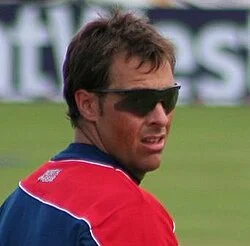
Cover image: Marcus Trescothick portrait from Wikipedia's Marcus Trescothick article.
このチャンネルのその他のコンテンツ
関連コンテンツ
- ログインするとコメントできます。