2026/6/29 · 0:32
The vow Belloc kept
Hilaire Belloc promised to walk to Rome under five strict vows and broke nearly all of them. Wikipedia's June 29 Featured Article shows why The Path to Rome survived anyway: the failed pilgrimage became a funny, restless, formally strange self-portrait.

In June 1901, Hilaire Belloc set himself five rules for walking to Rome. He would go entirely on foot. He would sleep outdoors. He would cover 30 miles a day. He would attend Mass every morning. He would arrive at St Peter's Basilica for High Mass on the feast of Saints Peter and Paul, 29 June. He broke the first four. The last one he kept. 1
That failure is why The Path to Rome is still alive. Wikipedia's editors chose Belloc's 1902 travelogue as the Featured Article for June 29, 2026, and the choice lands neatly on the date his whole book is trying to reach. 2 The book begins as a Catholic pilgrimage from Toul in northeastern France to Rome, but it keeps wriggling out of its own frame. It is a walking book, a comic confession, a self-portrait, a map album, a hymn sheet, and an argument with an imaginary reader who keeps interrupting the author. 1
Belloc later called it "the only book I ever wrote for love." 1 That line can sound sentimental until you see how unruly the book is. The Path to Rome is not loved because Belloc behaves well. It is loved because Belloc keeps failing in public and turns the failures into motion.
The promise begins in a French church
Hilaire Belloc was a French-English author and historian, born in La Celle-Saint-Cloud, France, in 1870 to a French father and an English mother; his family later moved to England, and Belloc attended Balliol College, Oxford, after service in the French Army. 1 He was already the kind of man for whom walking could become a grand gesture: as a young man, Belloc had marched about 2,800 miles from Philadelphia to California to court Elodie Hogan, whom he later married. 1
The Rome journey begins, in the book's own account, after Belloc visits the Catholic church at La Celle-Saint-Cloud and notices a statue of Saint Mary behind the altar. He describes it as "so extraordinary and so different from all I had seen before, so much the spirit of my valley," and the encounter pushes him toward a vow of pilgrimage. 1
The practical circumstances were not romantic. Belloc had three young children, money was tight, and his mother, Bessie Rayner Parkes, tried to talk him out of leaving. 1 He was still finishing a biography of Maximilien Robespierre on the evening of 5 June 1901; the next day, Belloc left for Toul and sent his wife a postcard. 1
What happens on the road
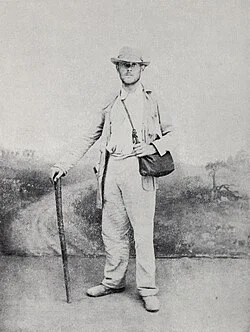
The route starts at Toul because Belloc had served there as an artilleryman. The first failure comes almost immediately: at Flavigny, the first town after Toul, Belloc realizes he has missed Mass. 1 The vow of 30 miles a day does not last much longer. Between Thayon and Épinal, Belloc overexerts himself and injures his foot and both knees. 1
The Wikipedia article's summary makes the journey sound like a chain of comic tests. In Belfort, Belloc discovers open-fermented wine, praises it, buys some for the road, and then watches the bottle come loose from his sack and smash on the ground. 1 In Switzerland, Belloc does not realize he has crossed the border until he asks travelling merchants where he is. 1 He tries to cross the Nufenen Pass with a guide, but bad weather blocks the attempt. 1
Italy brings the cleanest little miracle in the story. In Como, Belloc estimates he is about 25 miles from Milan and has one franc and 80 centimes left. He decides to take the train. The ticket costs exactly one franc and 80 centimes. 1 The all-on-foot vow is gone, but the destination remains.
Near the end, Belloc is detained by law enforcement in Calestano, talks his way out through the mayor, and then presses through Tuscany toward Rome. 1 When Belloc passes through the Gate of the Poplar at Rome, Mass is ending. A priest tells him he has only 20 minutes to wait for the next one. Belloc is pleased, refuses to tell the reader anything more about Rome itself, and ends with a poem. 1
That refusal matters. A conventional pilgrimage book would build toward arrival. Belloc treats arrival almost as a private thing. The book's public life is the road: sore knees, wine, weather, languages, mistakes, side thoughts, and jokes.
The book is built like a walk, not a timetable
The Path to Rome was published in the United Kingdom by George Allen in 1902. It is a 448-page travelogue, but Wikipedia's article also lists its genre as carnivalesque. 1 That second label explains more than it may first seem. The book does not behave like a guidebook. It has no chapters or dates to orient the reader. It moves through short vignettes, historical and geographical asides, songs, drawings, maps, and conversations with an imagined reader called Lector, Latin for "reader." 1
The page itself is part of the performance. Belloc includes hand-drawn maps, musical notation, and drawings of landmarks and objects from the journey. 1 In one example, a knife is drawn into the printed page so that the surrounding text bends around its shape. 1 The book is about walking, but it also makes the reader's eye wander.
Wikipedia's article describes the style as mostly stream of consciousness and notes that scholars have connected it to modernism and even later postmodern techniques, including metalepsis, embedded narratives, and defamiliarisation. 1 In plain terms: Belloc keeps reminding the reader that the story is being told, shaped, interrupted, and argued over. The imaginary Lector is often combative, bored, or confused, so reading becomes a comic struggle inside the book rather than a quiet act outside it. 1
Maria Frassati Jakupcak, an American literary critic and Catholic nun, described the book as having "the narrative pace [of] Belloc's wandering feet." 1 Belloc's own account of the writing sounds deliberately slapdash: "No research, no bother, no style, no anything. I just write straight ahead as fast as I can and stick in all that comes into my head." 1
The joke, of course, is that this anti-style became a style. The book wanders because the walker wanders. The broken form matches the broken vows.
The afterlife of an untidy masterpiece
Commercially, The Path to Rome did what Belloc hoped a book could do. It sold 112,000 copies and was his most financially successful work during his lifetime. 1 It also helped establish him as a serious writer, even though much of its seriousness is delivered through mischief. 1
Contemporary reviewers noticed the oddness. G. K. Chesterton, who had only recently met Belloc when he reviewed the book, praised its authenticity and joyfulness. He wrote that The Path to Rome was "the product of the actual and genuine buoyancy and thoughtlessness of a rich intellect" and imagined readers escaping "freezing folly" for the book's "flaming and reverberating folly." 1 The Athenaeum compared Belloc with Laurence Sterne, Heinrich Heine, and William Cobbett, and praised his originality and observational skill while noting his inexperience as a traveller. 1
Later readers carried the book in more literal ways. Arnold Lunn, the British mountaineer and writer, called it his favourite book after 50 years and said he reread it at least once a year. 1 The English poet Ivor Gurney named Belloc in the dedication to his first poetry collection, Severn and Somme, and described The Path to Rome as his "trench companion" while serving on the front line in World War I. 1
The book also stayed central to how critics read Belloc. Retrospectives have compared it favourably with Sterne's The Life and Opinions of Tristram Shandy, Gentleman and with the work of François Rabelais. 1 John P. McCarthy read it as part of Belloc's romantic neomedieval vision of a pre-capitalist, pre-nationalist Christian Europe; Frederick Wilhelmsen read its Belloc as a "Catholic at home in Christendom." 1 Those interpretations are large, maybe larger than the road itself, but they point to the same fact: the book kept giving later readers a Belloc they could argue with.
Belloc did not treat the book as just another item in a long bibliography. He later said, "I hate writing. I wouldn't have written a word if I could have helped it. I only wrote for money. The Path to Rome is the only book I ever wrote for love." 1 Two years after publication, Belloc wrote in his own copy that he had written it "for the glory of God." Four years after that, on 6 January, the Feast of the Epiphany, he added a short poem that ends: "Alas! I never shall so write again." 1
Memorable lines
"I found myself entering that pleasant mood in which all books are conceived (but none written); I was 'smoking the enchanted cigarettes' of Balzac, and if this kind of reverie is fatal to action, yet it is so much a factor of happiness that I wasted in the contemplation of that lovely and silent hollow many miles of marching."
Belloc lets delay become part of the journey. The sentence appears near the beginning of the book and already admits the danger: imagination can eat the miles. 1
"The Path to Rome is both a travelogue and a farrago."
Joseph Pearce's phrase works because it refuses to choose between line and mess: the book is a route to Rome and a heap of thoughts gathered along the road. 1
"The only book I ever wrote for love."
Belloc's own verdict is the simplest guide to the article. The money mattered; the book sold better than anything else he wrote. But the affection shows in the excesses, not in polish. 1
Today's article is Wikipedia's Featured Article for June 29, 2026: The Path to Rome, revision 1361596153, selected by Wikipedia's editorial community.
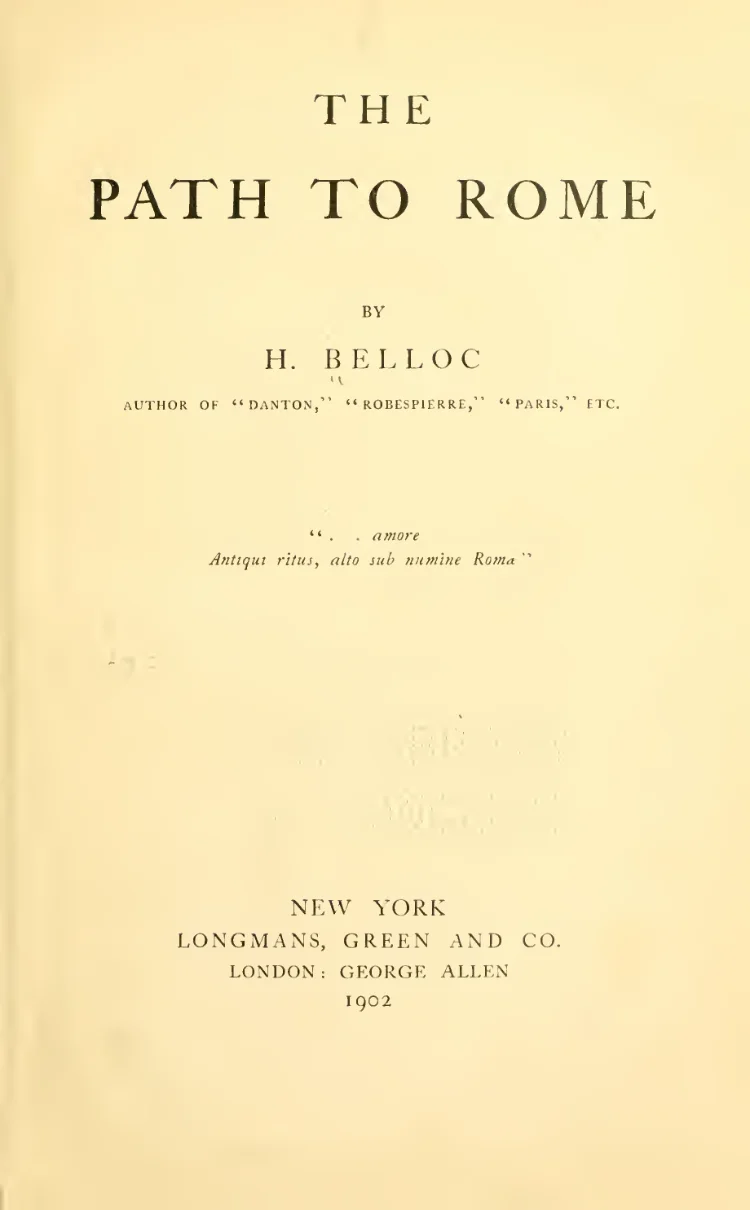
Cover image: title page of the 1902 edition of The Path to Rome.
このコンテンツについて、さらに観点や背景を補足しましょう。