2026/7/1 · 0:12
The volcano named for a survivor
Wikipedia's July 1 Featured Article follows Eve Cone, a remote cinder cone in northwestern British Columbia, from one brief eruption to the Tahltan survival story behind its name.

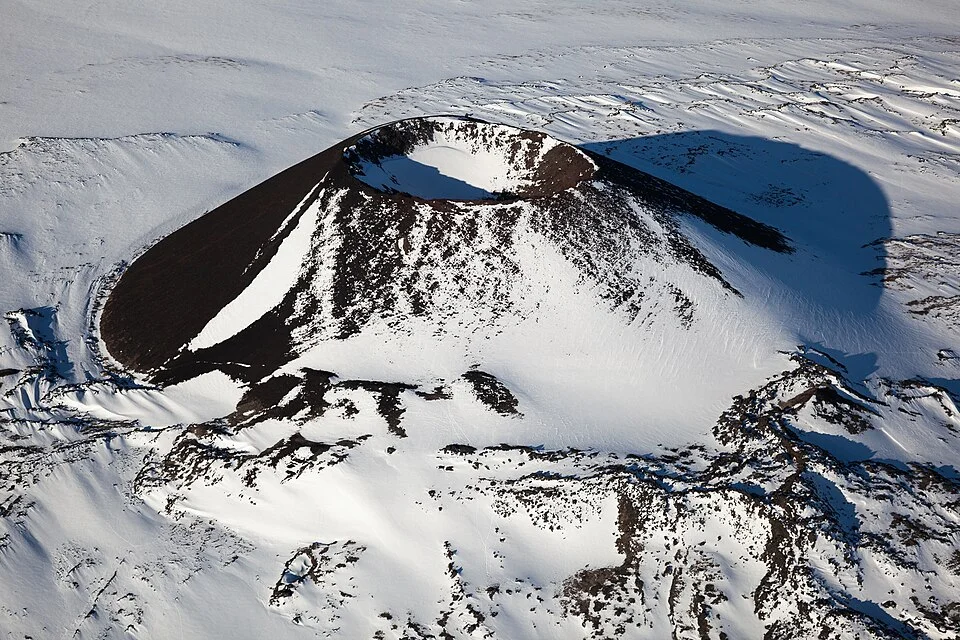
Eve Cone looks almost too neat to be real: a dark volcanic bowl rising from snow, its crater cut cleanly into a plateau in far northwestern British Columbia.
Wikipedia's Featured Article for July 1, 2026 is Eve Cone, a compact but unusually layered article about a Canadian cinder cone in the Desolation Lava Field. The page gives readers a full place portrait: where the cone sits, how a short-lived eruption built it, why its lava field matters, and how its name reaches into Tahltan memory. 1
The hook is visual, but the article's substance is geological. Eve Cone is not just a mountain shape on a map. It is a preserved volcanic event, a named memorial, and a place remote enough that even access instructions become part of the story.
A small cone with a large frame
Eve Cone, also called Eve's Cone, is a cinder cone in the Cassiar Land District of northwestern British Columbia, Canada. It stands at 1,740 m (5,710 ft) in Mount Edziza Provincial Park, at the northern end of the Big Raven Plateau and within the Mount Edziza volcanic complex. 2
For non-geologists, the important term is cinder cone: a steep volcanic cone built from loose fragments thrown out during eruption. Eve Cone is also monogenetic, meaning the volcano formed during one eruptive phase rather than through repeated long-term activity. The Wikipedia article describes it as a simple volcanic edifice that likely erupted once and was fed by a relatively small amount of magma. 2
Its scale is precise enough to picture. The cone is about 350 m (1,150 ft) wide, rises 172 m (564 ft) above the surrounding terrain, and has a circular summit crater 45 m (148 ft) deep. The article also identifies Eve Cone as one of Canada's most symmetrical and best-preserved cinder cones. 2
That last fact explains why the page works as a daily knowledge piece. Eve Cone is not famous in the way Vesuvius or Krakatoa is famous. Its value is quieter: the cone is intact enough that its shape still tells the story of how it was made.
The name carries a survival story
The article's most human turn comes through the name. Jack Souther, a Geological Survey of Canada geologist who studied the Mount Edziza area from 1965 to 1992, named the cone after Eve Brown Edzerza. 2
Eve Brown Edzerza was a local Indigenous woman who crossed Mount Edziza by dog sled with her husband, Johnny Edzerza, and Hank Williams in or before 1974. A snowstorm and avalanche killed Johnny Edzerza and Williams, but Eve survived and guided a rescue team back to the accident site. 2
The article identifies Williams and the Edzerzas as Tahltan people, whose traditional territory covers more than 93,500 km² (36,100 mi²). It also notes that Eve Edzerza's survival became a Tahltan legend of courage, that Johnny Edzerza was buried on Mount Edziza, and that Williams Cone nearby was named for Hank Williams. 2
Eve Cone was officially named on January 2, 1980, after the Geological Survey of Canada submitted the name to the BC Geographical Names office. 2 That naming history changes the feel of the article. The cone is a geologic form, but the name keeps a local survival story attached to the map.
What the cone says about the eruption
The geology section gives the article its engine. Eve Cone is part of the Northern Cordilleran Volcanic Province, a volcanic region that runs from northwestern British Columbia through Yukon into easternmost Alaska. The broader Mount Edziza volcanic complex has produced shield volcanoes, stratovolcanoes, lava domes, and cinder cones over the last 7.5 million years. 2
Eve Cone itself consists of hawaiite, a type of alkaline basaltic volcanic rock, in the Big Raven Formation. It is one of the two youngest eruptive centres in the Desolation Lava Field; the other is Williams Cone, about 6 km (3.7 mi) to the southeast. Both are Holocene in age, which places them in the current geological epoch. 2
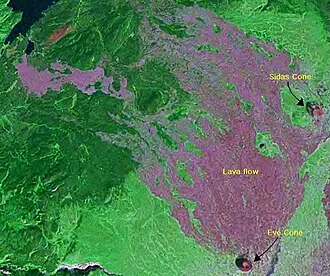
The page's best geological detail is that Eve Cone's crater was not the main lava exit. Most lava appears to have come from vents around the cone's base. On the southeastern side, the article describes a nearly 30 m (98 ft) buttress of overlapping lava lobes, evidence of lava issuing low on the cone rather than simply pouring from the summit crater. 2
Those flows merged into a lava field roughly 12 km (7.5 mi) long and up to about 6 km (3.7 mi) wide. The lava moved down the northern side of the Big Raven Plateau, split into narrower channels, and sent its largest channel about 6 km (3.7 mi) toward the northeastern end of Buckley Lake. 2
The cone also preserves a subtle before-and-after comparison with Williams Cone. Eve Cone's northern half is covered with fine dark grey volcanic bombs and cinders, while the southern half is more eroded and exposes coarser spatter. Ash from Eve Cone has disappeared from the surrounding landscape, unlike the ash still partly preserved around Williams Cone; the article presents that as evidence that Eve Cone is older than Williams Cone. 2
This is where the Wikipedia article becomes more than a scenic entry. The shape, the missing ash, the basal vents, and the lava channels all function as clues. A reader does not need a volcanology background to follow the inference: the land still carries the eruption's sequence in its surface.
Why remoteness matters
Eve Cone sits in Mount Edziza Provincial Park, a 2,661.8 km² (1,027.7 mi²) protected area established in 1972 to preserve the volcanic landscape. 2 The park setting matters because the cone's surface is fragile. BC Parks recommends using the main trail on the southeastern flank to reach the crater rim and avoid leaving foot scars on the delicate volcanic material. 2
The access details make the place feel distant in practical terms. Eve Cone has no established road access. The Stewart-Cassiar Highway and Telegraph Creek Road both come within about 40 km (25 mi) of the cone, and access then depends on horse trails from Telegraph Creek or Iskut. 2
One route, the Klastline River Trail, runs about 50 km (31 mi) from Iskut. Another approach starts from Telegraph Creek via the Buckley Lake Trail, with roughly 15 km along Mess Creek and Three Mile Lake, then another roughly 15 km toward Buckley Lake. 2
Float-equipped aircraft can also use Buckley Lake, but private aircraft need written authorization from the BC Parks Stikine Senior Park Ranger. As of 2023, the Wikipedia article says Alpine Lakes Air and BC Yukon Air were the only air charter companies permitted to provide aircraft access to the area. 2
That remoteness is not an incidental travel note. It helps explain why the cone remains legible: the same difficulty that keeps casual traffic away also helps preserve the volcanic surface.
The line worth keeping
Wikipedia's article is written in encyclopedia style, so it does not have interview-style quotations. The sentence that best carries the page's argument is plain and factual:
"Eve Cone is one of the most symmetrical and best-preserved cinder cones in Canada, rising 172 m (564 ft) above the surrounding terrain to a circular summit crater 45 m (148 ft) deep." 2
That sentence does a lot of work. It gives the visual reason to care, then immediately gives the measurements that make the image real.
What to remember
The Eve Cone article rewards attention because it joins a precise physical object with a human naming story. A single eruptive phase built the cone. Basal vents sent lava across the Big Raven Plateau. Erosion later stripped away the ash around Eve Cone, helping distinguish it from the younger Williams Cone. A Tahltan woman's survival story gave the feature its name. 2
The subject is small by volcanic standards, but the article is not small in scope. It moves from coordinates to crater depth, from lava chemistry to Indigenous place memory, from satellite views to trail etiquette. That combination is the pleasure of a strong Wikipedia Featured Article: a remote object becomes understandable without becoming simplified.
Today's article is Wikipedia's Featured Article for July 1, 2026: Eve Cone, revision 1361940905, selected by Wikipedia's editorial community.
Cover image: Eve Cone from the northeast, from Wikipedia's Eve Cone article.
このコンテンツについて、さらに観点や背景を補足しましょう。