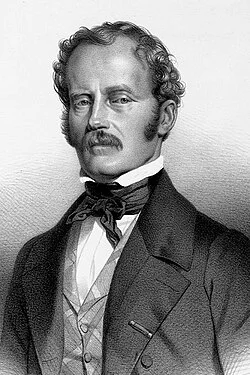
The archaeologist who rebuilt Athena Nike and lost his place in Greece
Wikipedia's July 22, 2026 Featured Article follows Ludwig Ross, the German archaeologist who reconstructed the Temple of Athena Nike, helped build Greece's early archaeology institutions, and lost his Athens post amid a backlash against foreign control.

A temple in pieces
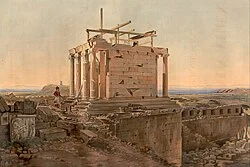
In 1835, Ludwig Ross stood on the western edge of the Acropolis with a problem that looked almost like a pile of rubble. The small Temple of Athena Nike had been dismantled during the Venetian siege of 1687. What survived was being used as part of a gun emplacement, while fragments from the temple and nearby monuments lay scattered around it. Ross and his collaborators had to decide which stones belonged together, then turn that decision into a building. 1
They reconstructed the temple between December 1835 and May 1836. The result made Ross famous, but it also contained the tension that followed him through his career: he was helping a newly independent Greece protect its ancient monuments, while he and many of his colleagues were northern Europeans directing the work. The same project that helped establish Greek archaeology also made the question of who controlled Greek antiquity impossible to ignore. 2
That is the story selected as Wikipedia's Featured Article for July 22, 2026: the career of Ludwig Ross, a scholar who built institutions, moved stones, taught archaeology, and eventually lost his place in Greece when the country turned against the foreign dominance of its public life. 2
From Holstein to a new kingdom
Ross was born on 22 July 1806 in Bornhöved, in Holstein, then ruled by Denmark. He studied at the University of Kiel, beginning with medicine, zoology, and anthropology before settling on classical philology. His doctoral work, completed in 1829, examined Aristophanes' play The Wasps. A travel scholarship finally took him to Greece in 1832, when he was twenty-five and the modern Greek state was still being assembled. 1
Ross arrived shortly before Otto of Bavaria was confirmed as king. The new monarchy was importing administrators, architects, soldiers, and scholars to help build its institutions. Ross became deputy curator at the Archaeological Museum of Nafplion, then accepted government work in the antiquities service. He travelled through the Peloponnese, excavated at sites including Menelaion and Tegea, and helped collect objects for the state rather than for foreign private collections. 1
The arrangement gave Ross access and influence, but it also made him part of what Greek critics called the "Bavarocracy": the dominance of northern Europeans, especially Bavarians, in the government and cultural institutions of Otto's Greece. Ross was close to the king and became one of the monarchy's trusted archaeological advisers. He was also working beside Greek archaeologists such as Kyriakos Pittakis, whose own service in the Greek War of Independence gave him a very different claim to authority over the country's antiquities. 1
A short timeline shows how quickly Ross moved from visitor to institution-builder:
| Period | Position or project | Consequence |
|---|---|---|
| 1832-1833 | Deputy curator at Nafplion and then sub-ephor of antiquities | Ross entered the new Greek state's formal archaeological service. 1 |
| 1834-1836 | Ephor General of Antiquities | He received overall responsibility for archaeological work in Greece. 1 |
| 1835-1836 | Excavations and reconstruction on the Acropolis | The Temple of Athena Nike was reassembled from scattered remains. 1 |
| 1837-1843 | First professor of archaeology at the University of Athens | Ross trained Greek students in archaeology and epigraphy. 1 |
| 1843-1859 | Professor at Halle | His Greek career ended with the political removal of most non-Greeks from public service. 1 |
Making the Acropolis an archaeological site
In 1834, the Acropolis was still a military fortress occupied by Bavarian troops. The architect Leo von Klenze advised Otto to demilitarise it and turn it into an archaeological site. Once the soldiers left, Ross was appointed Ephor General and given control of the work. His salary was 3,000 drachmas a year, compared with an average annual wage of about 175 drachmas for manual workers. 1
The job was larger than excavation. Athens was becoming the capital of a growing state, and the government wanted ancient monuments protected while also making room for streets, housing, offices, and visitors. Ross helped plan the city's redevelopment and served on the building commission. In 1835, the Acropolis began charging an entrance fee, both to help pay for restoration and to regulate visitors. It is often described as the first archaeological site in the world to do so. 1
His first systematic excavations on the Acropolis began in January 1835. He hired eighty workers, dividing them between the Parthenon and the western approach near the Pedestal of Agrippa and the so-called Tower of Athena Nike. The work removed a modern bastion and attempted to clear military structures from ancient monuments. Excavation around the Parthenon revealed evidence of an earlier temple, along with fragments of sculpture and other objects from the Classical building. 1
Reassembling Athena Nike
The temple's surviving parapet had been absorbed into a defensive position. When Ross demolished the bastion, workers found pieces of the former temple, the kind of discovery that made reconstruction possible but did not make it easy. Ross, the architects Eduard Laurent and Eduard Schaubert, and their workers arranged fragments on the surviving base and column foundations. The project was hailed at the time as the first full reconstruction of a Classical monument in Greece. 1
Later observers were less satisfied. The team worked quickly. Where ancient fragments were missing, it used modern materials, and the arrangement did not correspond closely to any plausible original design. Ross's reconstruction was therefore both a landmark and a warning: rebuilding an ancient monument requires interpretation, and an interpretation can become part of the monument's later history. 1
The same question appeared in Ross's wider work. He excavated, catalogued, and moved artefacts into public collections. On the island of Thera, he found twelve funerary inscriptions and divided them between local and central museums. He also organised archaeological collections across the Cyclades. His approach helped give the new state a systematic archaeological service, but the movement of objects and the publication of inscriptions also raised questions about ownership, permission, and the right to speak for Greek history. 1
The Naval Records affair
The breaking point came over a group of inscriptions found at the Piraeus in 1834 and 1835. Known as the Naval Records, they described the administration and financing of the Athenian navy in the fifth and fourth centuries BCE. Ross studied them and sent sketches to the German scholar August Böckh for inclusion in a major collection of Greek inscriptions, before receiving approval to publish them. 1
Greek authorities argued that he had acted illegally. Pittakis attacked Ross in the press, and the controversy landed in a society already uneasy about foreign control of its institutions. Public pressure forced Ross to resign as Ephor General on 20 September 1836. Eleven days later, Pittakis denied him entry to the Acropolis when Ross returned to study inscriptions uncovered during his own excavations. 1
The dispute was personal, political, and scholarly at once. Ross believed that international publication could advance the study of Greek antiquity. His opponents saw a foreign official sending Greek records abroad without permission. The later history of the Archaeological Service suggests that the disagreement cannot be reduced to one clean principle: the same institutions could resist Ross's actions and later permit foreign epigraphers to copy thousands of inscriptions. 1
A university career cut short
Otto still favoured Ross. When the Othonian University of Athens opened in 1837, Ross became its first professor of archaeology, one of the earliest holders of such a chair anywhere. He lectured on Greek and Latin literature, Athens and Sparta, and the city's topography. In the 1840-1841 academic year, he taught Greek epigraphy as a distinct subject for the first time in Greece. One of his students was Panagiotis Efstratiadis, who later became a leading Greek epigrapher and succeeded Pittakis as Ephor General. 1
Ross also continued travelling. In 1837, on Ios, he examined Early Bronze Age graves and correctly recognised their figurines as older than Classical Greek civilisation, decades before the Aegean Bronze Age became established in scholarship. He published accounts of the islands and of his excavations, and wrote a handbook of archaeological art in Greek. His work argued that Greek culture had links with Egypt and the ancient Near East, challenging the fashionable idea that Classical Greece developed in isolation. 1
By the early 1840s, Ross was exhausted by hostility in the Greek press, his conflict with Pittakis, and what he saw as weak administration. In 1843, while travelling in the Aegean, he learned that a military revolution had forced Otto to dismiss almost all non-Greeks from public service. Ross lost his Athens position and was succeeded by the Constantinople-born Greek archaeologist Alexandros Rizos Rangavis. 1
Halle and the limits of a scholar's vision
Alexander von Humboldt helped Ross secure a professorship at Halle. Ross eventually took up the post in 1845, after travelling through Smyrna, Trieste, and Vienna. He continued to publish Greek inscriptions and to work on questions of art, archaeology, and ancient history. His excavations near Olympia investigated a supposed tomb associated with Coroebus of Elis, the traditional first Olympic victor. The findings included remains, ash, animal bones, pottery, bronze vessels, and a bronze helmet, though the interpretation remained uncertain. 1
Ross's scholarship did not move in only one direction. He argued that Greek culture was connected to older civilisations in Egypt and the Near East, a position that pushed against the classical ideal of Greek purity. But in linguistics he resisted the emerging reconstruction of the Indo-European language family. He believed Latin descended directly from Ancient Greek, a view that did not survive. His career shows a useful distinction: a scholar can be ahead of his field in one subject and badly wrong in another. 2
Ross married Emma Schwetschke in 1847. His health declined, and he continued to struggle with depression that had begun during his final years in Greece. He died by suicide in Halle on 6 August 1859, aged fifty-three, and was buried in Bornhöved beside his brother Charles. 1
What the reconstruction left behind
Ross's most visible legacy is still the small temple at the Acropolis entrance. The reconstruction has been criticised, but the act of excavating, recording, and conserving the site helped establish the routines of modern archaeology in independent Greece. His publications, especially in epigraphy, circulated widely, and his students helped create a Greek archaeological profession that no longer depended entirely on foreign scholars. 1
The praise attached to him is unusually strong. Historian Ida Haugsted called Ross "one of the most important figures in the cultural revival of Greece." 1 The phrase is persuasive if it refers to the institutions he helped build. It is incomplete if it hides the resentment those institutions generated, or the fact that Greek archaeologists had to fight for authority over their own past.
Ross's story is therefore larger than a temple restored from fragments. It is about the moment archaeology became part of state-building. A new country wanted its ancient monuments to anchor a modern national identity; foreign experts brought methods, connections, and money; local scholars demanded control. Ross helped create the system that eventually made his own position untenable.
Read the complete selection on Wikipedia's July 22, 2026 Today's Featured Article page, and the full Ludwig Ross article.
関連コンテンツ
- ログインするとコメントできます。
More from this channel
- The painting that puts the king behind your eyes
- The album Jimmy Eat World made after the industry gave up
- The uprising that remade the Jewish diaspora under Trajan
- The pilot who crossed the Pacific and vanished at the end
- The shorebird that treats continents as seasons
- The Halo anthology that sent its hero offstage
- The cavalryman who reopened Hamilcar's trap