4/7/2026 · 8:11
Grand Teton field guide: sagebrush flats, alpine mats, and Garnet Canyon
A compact field guide to Grand Teton's steep ecological climb, from sagebrush flats and willow corridors to conifer slopes and alpine rock, with signature plants, wildlife cues, best season, and a Garnet Canyon difficulty profile.
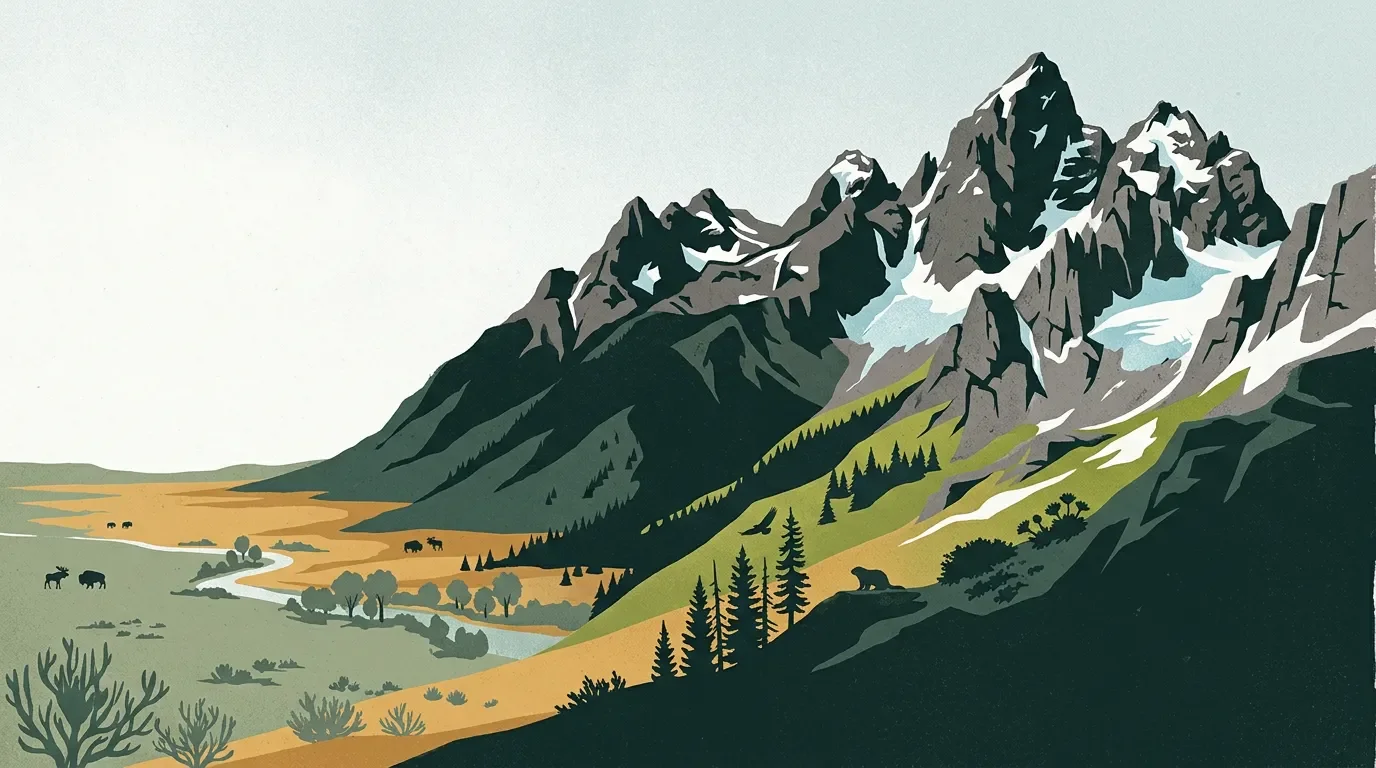
Grand Teton is a sharp field-guide mountain: the park floor begins in open sagebrush at about 6,320 feet, then the range rises to the Grand Teton summit at roughly 13,770 feet in one steep visual wall.1 USGS describes the Teton Range as a fault-block mountain front that stands nearly 5,000 to 7,000 feet above Jackson Hole, which is why the ecological zones feel compressed when you drive or hike west from the valley.2
Elevation cross-section
| Band | What changes underfoot | Plants to notice | Wildlife cues |
|---|---|---|---|
| Valley floor, about 6,320 ft | Dry glacial outwash and open sagebrush flats dominate Jackson Hole.1 | Big sagebrush is the visual baseline, with antelope bitterbrush, low sagebrush, rabbitbrush, scarlet gilia, silvery lupine, and low larkspur in season.3 | Bison, pronghorn, mule deer, elk, coyotes, and ground squirrels are valley-floor possibilities, while sage grouse use the sagebrush community.45 |
| River, wetland, and meadow ribbons | The Snake River, tributaries, and wetlands cut green corridors through the dry valley.3 | Narrowleaf cottonwood and willows mark wetter ground; sedges, grasses, and wildflowers fill wet meadows.3 | Moose browse willow buds, ospreys fish along water, and beaver, muskrat, or river otter may appear near streams and ponds.64 |
| Forested canyons, moraines, and slopes | Glacial debris holds more moisture than the valley flats, so trees take over the darker mountain slopes.3 | Lodgepole, limber, and whitebark pines mix with Engelmann spruce, blue spruce, Douglas fir, and subalpine fir.3 Whitebark and limber pine nuts feed birds, small mammals, and grizzly bears.7 | Black bears work rotten lodgepole logs for insect larvae, while elk, mule deer, red squirrels, pine martens, and weasels occupy different forest niches.64 |
| High alpine rock, snow, and summit country | Wind, snow, thin soil, strong ultraviolet light, fast temperature swings, and a short growing season shape the upper park.3 | Many alpine plants stay low to the ground in mats, including alpine forget-me-not.3 | Watch rocky terrain for pikas, yellow-bellied marmots, and golden-mantled ground squirrels; golden eagles also use the mountain airspace.46 |
The main pattern is moisture plus elevation. Dry, porous valley soils favor sagebrush. Waterlines support cottonwood and willow. Moraines and canyon walls hold enough moisture for conifer forest. Above that, the plant strategy changes from height to survival: stay low, avoid wind, and finish growth quickly.
Signature plants
Big sagebrush is the plant that sets the lower-elevation tone. It covers much of the valley where soils are dry and water drains quickly.3
Willow and narrowleaf cottonwood are the route-finding clue for wetter ground. If the landscape suddenly turns bright green, you are likely near a stream, wet meadow, or riparian corridor.3
Lodgepole pine and spruce-fir forest define many darker slopes and canyon approaches. Lodgepole pine is tied to fire cycles, while spruce-fir forest often develops after other trees stabilize the soil.7
Alpine cushion plants are easy to miss because they win by staying small. In the highest park environments, mat-forming plants reduce exposure to wind, cold, and rapid weather shifts.3
Wildlife field notes
Grand Teton is not a background-wildlife park. The park sits inside the Greater Yellowstone Ecosystem, which the National Park Service describes as a more than 20-million-acre landscape and one of the few remaining nearly intact temperate ecosystems on Earth.6 That scale matters because many animals shift by season and habitat rather than staying inside one scenic viewpoint.
For hikers, the practical wildlife lens is simple. In open flats, scan for bison, pronghorn, elk, coyotes, and sagebrush birds. Along willow and cottonwood corridors, slow down for moose sign, water birds, beaver work, and fishing raptors. In forest and rocky terrain, think bear awareness first, then look for squirrels, pikas, marmots, and high-country birds.45
The park's hiking guidance is explicit: black and grizzly bears live throughout Grand Teton, and hikers should make noise, travel in groups of three or more when possible, carry bear spray, and know how to use it.8
Best hiking season
For most hikers, the cleanest window is mid-July through September, with shoulder-season caution on both sides. The park says valley trails are often snow-free by mid-June, but mountain trails and passes may not clear until late July.8 Garnet Canyon is listed for summer and fall, best after snow melts and before the first snow arrives.9
That does not make July automatic. Grand Teton's condition page is updated from May to October, and the park warns that high-elevation trails can remain snow-covered while conditions change quickly.10 Check the current trail report before committing to any canyon, pass, or off-valley route.
Difficulty rating
Field-guide rating: strenuous for mountain routes, moderate only if you stay low.
A valley lake loop can be a relaxed half-day. A canyon approach is a different category. The NPS profile for Garnet Canyon lists a strenuous 8.2-mile round trip from Lupine Meadows, with 2,430 feet of elevation gain, a 4-6 hour duration, an average 13 percent slope, boulder fields, steep switchbacks, narrow surfaces, and route-finding demands.9
Use that as the representative Grand Teton difficulty profile. The mountain gives you a quick lesson in vertical ecology, but it charges for it in elevation gain, snow timing, loose rock, sudden weather, and bear-country discipline.8
Fuentes de referencia
- 1Nature - Grand Teton National Park
- 2Grand Teton National Park Geology
- 3Plants - Grand Teton National Park
- 4Mammals - Grand Teton National Park
- 5Birds - Grand Teton National Park
- 6Wildlife - Grand Teton National Park
- 7Trees and Shrubs - Grand Teton National Park
- 8Hiking - Grand Teton National Park
- 9Garnet Canyon
- 10Backcountry and Trail Conditions - Grand Teton National Park
Más de este canal
Contenido relacionado
- Inicia sesión para comentar.