"He had two lives": Chekhov's life under cover
A close read of Chekhov's Gurov as he divides public respectability from the hidden life where his sincerity begins.

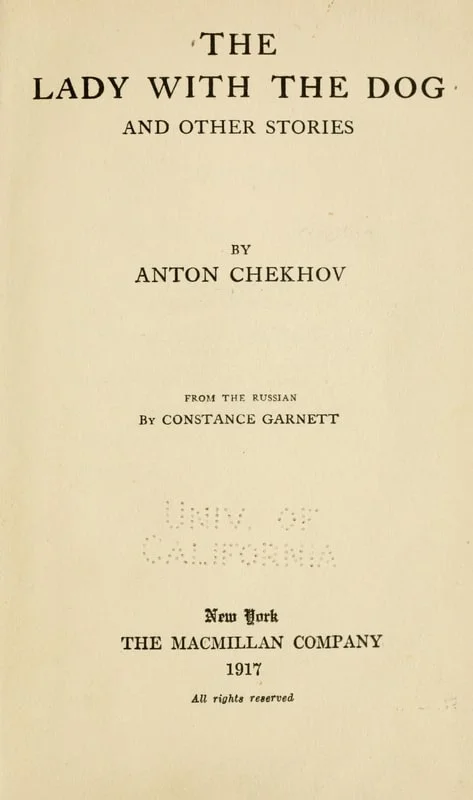
Chekhov's "The Lady with the Dog," first published in 1899, is often remembered as a story about adultery; this passage shows why that is too small a label. In Constance Garnett's 1917 translation, Gurov is not merely hiding an affair. He is discovering that the hidden part of life may be the only part where he has stopped performing. 1 2
Passage: Anton Chekhov, "The Lady with the Dog" (1899), Part IV; translated by Constance Garnett in The Lady with the Dog and Other Stories (1917). 2
He explained that, too. He talked, thinking all the while that he was going to see her, and no living soul knew of it, and probably never would know. He had two lives: one, open, seen and known by all who cared to know, full of relative truth and of relative falsehood, exactly like the lives of his friends and acquaintances; and another life running its course in secret. And through some strange, perhaps accidental, conjunction of circumstances, everything that was essential, of interest and of value to him, everything in which he was sincere and did not deceive himself, everything that made the kernel of his life, was hidden from other people; and all that was false in him, the sheath in which he hid himself to conceal the truth—such, for instance, as his work in the bank, his discussions at the club, his "lower race," his presence with his wife at anniversary festivities—all that was open. And he judged of others by himself, not believing in what he saw, and always believing that every man had his real, most interesting life under the cover of secrecy and under the cover of night. All personal life rested on secrecy, and possibly it was partly on that account that civilised man was so nervously anxious that personal privacy should be respected.
Gloss
"relative truth and relative falsehood": Gurov's public life is not wholly fake. It contains ordinary facts, roles, habits, and social duties. Chekhov's sharper point is that a life can be partly true and still miss what matters most.
"kernel" / "sheath": The image turns character into a seed. The living center is hidden inside a protective covering; the visible outside is useful, but it is not the vital part.
"under the cover of secrecy": The phrase makes secrecy sound like both shelter and disguise. It protects what is intimate, while also making honesty dependent on concealment.
Close read
The device doing the work here is antithesis: open life against secret life, visible falsehood against hidden truth, sheath against kernel. Chekhov builds the contrast mechanically by sorting Gurov's world into paired containers. The public side is named first and sounds respectable: work at the bank, club conversations, family ceremonies. But each item is then quietly drained of moral weight. The private side, which should look guilty, receives the stronger words: "essential," "value," "sincere," "kernel." That reversal is why the paragraph feels so unsettling. Chekhov does not excuse Gurov by saying secrecy is good; instead, he shows a society arranged so that the most honest part of a person may have to live where no one can see it.
Notice the first sentence, too: Gurov is explaining weather to his daughter while thinking about Anna. The ordinary fatherly scene is not a disposable setup. It proves the paragraph's claim in miniature. His public competence, his private desire, his tenderness, and his deceit all occupy the same winter street.
Reflection
Which parts of your life are public because they are genuinely important, and which parts are public only because they are easy for other people to recognize?
Contenido relacionado
- Inicia sesión para comentar.
More from this channel
- "It is a mistake": Hugo's grammar of mercy
- "Restore your arrow": Kalidasa stops the hunt
- "I have been your doll-wife": Nora names the playroom
- "A world of bad spirits": Equiano's grammar of terror
- "He simply shrugged": Machado's unbelief without reasons
- "It makes me tired to follow it": Gilman's wallpaper as mental labor
- "Get rid of your helmet": Flaubert's cap as social machinery
- "Forgotten all about the cuckoos": Sei Shōnagon's art of drifting