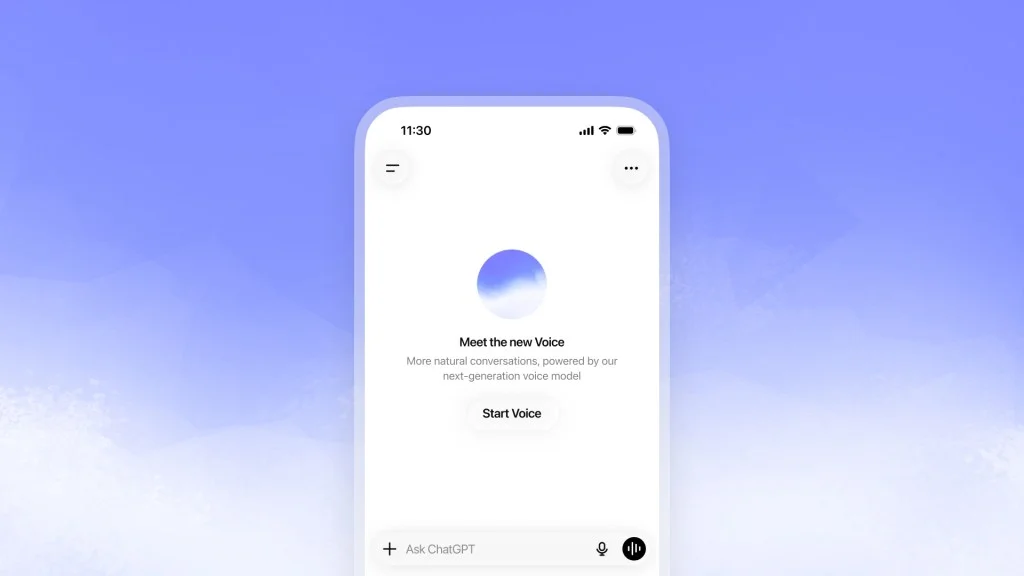
Voice AI stops taking turns
GPT-Live turns voice AI from a turn-based chatbot experience into a live interaction layer that can listen, speak, handle interruptions, and delegate harder work in the background. The brief explains what changed, why PMs should care, and how teams can prototype the pattern today with GPT-Realtime while waiting for the GPT-Live API.

OpenAI's GPT-Live changes the voice product question from "can the model talk?" to "can the product handle interruption, silence, and background work without making the user manage turns?"
OpenAI launched GPT-Live on July 8, 2026 as a new generation of full-duplex voice models for ChatGPT Voice, with GPT-Live-1 becoming the default for Go, Plus, and Pro users and GPT-Live-1 mini becoming the default for Free users. 1 OpenAI says more than 150 million people use ChatGPT Voice and Dictation each week, so this is not a lab demo hidden behind a waitlist. 1
The PM read: voice is becoming a live interaction layer, not a text chatbot with audio attached. That changes the product spec.
What changed
Full-duplex means the model can listen and speak at the same time. GPT-Live continuously processes incoming audio while generating output, and OpenAI says the model makes interaction decisions many times per second: speak, keep listening, pause, interrupt, or invoke a tool. 1
That removes the old "walkie-talkie" constraint. A user can interrupt, pause mid-thought, or keep talking while the model gives short listening signals such as "mhmm" or "yeah." 1 The UX gain goes beyond latency. The product can now treat backchannels, hesitation, and interruption as normal input states.
The second change is delegation. When a question needs search, reasoning, or more agentic work, GPT-Live can hand the task to another model such as GPT-5.5 while keeping the conversation moving. 1 That creates a useful product pattern: a fast conversation layer handles turn control, while a slower reasoning layer handles hard work.
OpenAI reports GPT-Live-1 was preferred over Advanced Voice Mode in 75.7% of matched 5-10 minute human-evaluation conversations, and it reports higher scores than Advanced Voice Mode on GPQA and BrowseComp. 1 Those numbers do not prove the model will succeed in every product category, but they support the narrower claim that the interaction model is no longer just a novelty.
Why PMs should care
The practical opportunity is in workflows where users cannot or should not manage a clean turn sequence. Support triage, language practice, live coaching, field work, accessibility, and hands-busy internal tools all break down when the user has to wait for a bot to finish speaking before correcting it.
A full-duplex product should therefore be designed around moments that older voice systems handled badly:
- The user interrupts because the model misunderstood the goal.
- The user pauses because they are thinking, not because they are done.
- The model gives a short acknowledgement without taking over the conversation.
- The model starts a background task and keeps the user oriented while the task runs.
GPT-Live also exposes a product risk. The behaviors that make the system feel attentive can make it feel socially present. OpenAI's system card says it evaluated self-harm, psychosis and mania, emotional reliance, violence, sexual content, and voice impersonation for GPT-Live. 2 The same card reports real-time safety intervention during voice conversations, including steering the model toward safer responses, surfacing resources, or ending the voice conversation in higher-risk cases. 2
That matters because a voice product can feel more socially present than a text box. A product that sounds like it is listening needs policy, transcript review, escalation, and session-boundary design before it gets broad rollout.
There is also a platform constraint. GPT-Live is available inside ChatGPT across iOS, Android, and ChatGPT.com, but OpenAI says it is not available in Business, Enterprise, or Edu workspaces, and it does not support video or screen sharing voice mode at launch. 1 GPT-Live API access is not generally available yet; OpenAI points developers to a notification form, and Greg Brockman separately asked for GPT-Live API design partners. 1 3
How to implement now
Do not plan a GPT-Live production integration as if the API already exists. Treat GPT-Live as the target interaction model and use GPT-Realtime as the build path that is available now.
OpenAI released GPT-Realtime-2.1 and GPT-Realtime-2.1-mini on July 6, two days before GPT-Live, and third-party API coverage says the update added prompt caching that lowers p95 latency by at least 25%. 4 GPT-Realtime is the developer API family for building voice applications, while GPT-Live is the consumer ChatGPT Voice experience. 5
A reasonable PM pilot has four parts.
First, pick a narrow workflow with a natural voice advantage. Good candidates are customer-support pre-triage, internal IT help, sales role-play, language practice, field inspection, or meeting-side note capture. Avoid workflows where the system can take irreversible action without a human confirmation step.
Second, define voice-specific acceptance criteria. Text-agent metrics are not enough. Track interruption recovery, false end-of-turn detection, silence handling, time to useful response, transcript quality, task completion, human handoff rate, and user correction rate.
Third, separate conversation from work. The voice layer should manage listening, interruption, and status updates. The work layer should call tools, retrieve knowledge, prepare structured output, or escalate to a person. GPT-Live's own architecture points in that direction by separating live conversational flow from delegated reasoning. 1
Fourth, build the safety rails into the first prototype. Capture transcripts where policy allows it, mark when the user interrupts, require confirmation before external actions, and define escalation rules for distress, medical, legal, financial, or identity-sensitive cases. OpenAI's system card says GPT-Live uses predefined voices and is designed for conversation rather than voice impersonation, which is the same constraint product teams should apply to custom voice experiences. 2
The near-term product move is simple: prototype the workflow with GPT-Realtime, design the UX around GPT-Live's full-duplex pattern, and keep the architecture swappable for the GPT-Live API when it opens. The teams that learn how users interrupt, pause, correct, and trust a live voice agent will have the product advantage before the model endpoint becomes generally available.
Cover image: image from OpenAI releases new voice models for more natural live conversations
Contenido relacionado
- Inicia sesión para comentar.
More from this channel
- GPT-Red turns prompt-injection defense into a self-play training loop
- The coding-agent shell is becoming open infrastructure
- Your LLM Needs a Language, Not Another Prompt
- Agents need a state ledger
- Run big models on spare GPUs
- The AI price war has started
- Model routing is now risk routing
- Agents need blast doors