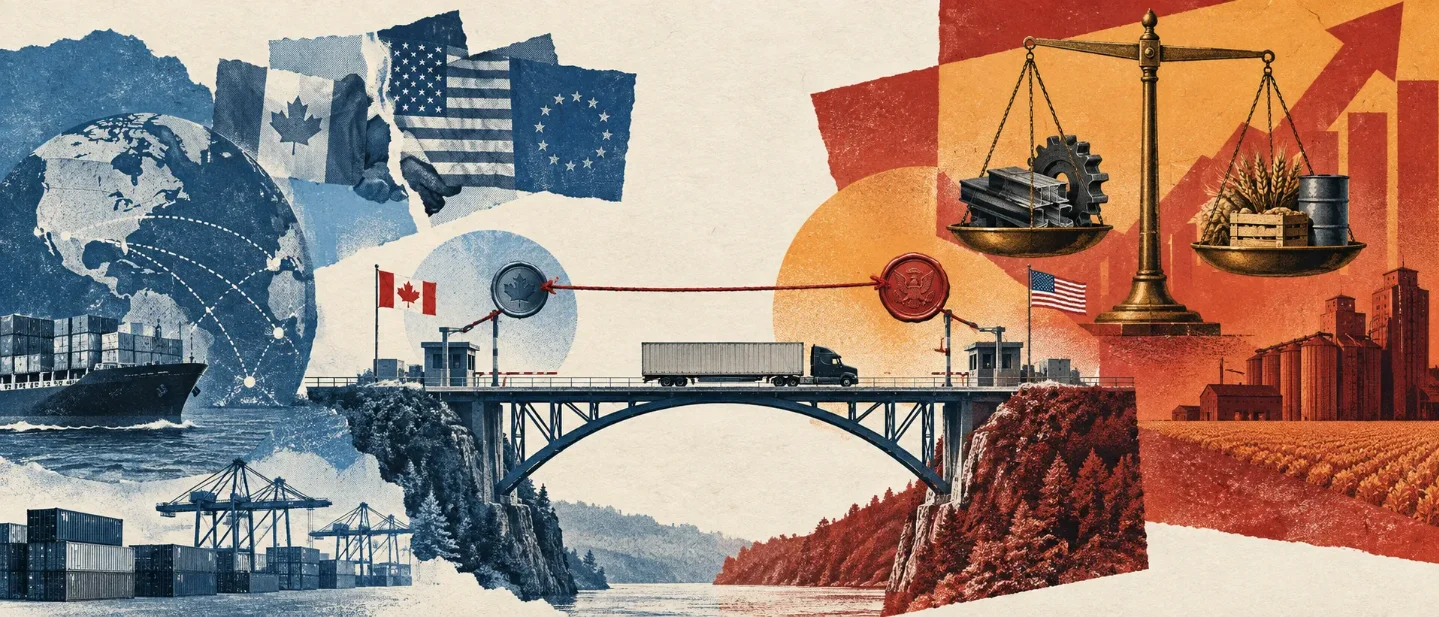
Tariffs, bans, and an alliance under strain: New York Post and The Guardian on the U.S.–Canada trade war
A neutral, dimension-by-dimension comparison of how the New York Post and The Guardian framed the September 8 U.S.–Canada trade escalation, with outside analysis of leverage and dependence.

The United States and Canada moved from tariffs to import bans and procurement restrictions on September 8, 2026. The New York Post presented the measures through presidential retaliation and an intensifying trade war. The Guardian presented the same day through the rupture of a long-standing alliance and Canada's attempt to reduce its dependence on the United States. 12
The New York Post page was published on September 8, but its full article body was unavailable during retrieval. The comparison therefore treats the Post's headline and indexed standfirst as evidence of its opening frame, while the Guardian side draws on the complete article. An Associated Press report syndicated by MPR News supplies a factual cross-check. 3
The event in brief
President Donald Trump signed orders that will ban several Canadian imports, including dairy products, most alcoholic beverages and motorcycles, beginning September 29. Trump also directed the General Services Administration to make Canadian-origin products ineligible for large, long-term federal contracts until Canada provides what the administration calls "full and fair reciprocity." Canada imposed retaliatory tariffs on about $20 billion of U.S. goods on September 8. 23
The measures followed the collapse of formal trade talks on August 21 and a U.S. decision on August 22 to impose 50% tariffs on about 5% of Canadian imports. Canada answered with tariffs ranging from 15% to 50% on hundreds of American products. 2
Cargando tarjeta de estadísticas…
The immediate facts are shared. The first question each outlet asks is different.
Dimension 1: What is the news?
The New York Post. The Post's headline begins with Trump's action: "Trump bans import of Canadian alcohol, dairy and motorcycles." The standfirst describes the orders as retaliation after Ottawa imposed a 50% tariff, and the headline closes with "as trade war intensifies." The sequence places the president's countermeasure first, its justification second, and the broader escalation third. 1
That wording makes the day's central event a new use of presidential trade power. The reader encounters a ban, a target list and a stated reason for retaliation. The framing leaves the immediate question at the level of leverage: what pressure can Washington add after Ottawa's tariffs?
The Guardian. The Guardian's headline also names the bans, but adds "with longtime ally escalates." Its opening describes the United States and Canada as neighbors and allies, then places the American measures beside Canada's $20bn retaliation and Prime Minister Mark Carney's pledge to reduce Canada's economic dependence on the United States. 2
The Guardian makes the relationship the news. The import bans are evidence of a larger break between two countries that had continued to trade and cooperate despite long-running disputes over dairy, softwood lumber and other sectors. The article asks what happens to the alliance as each government turns economic dependence into a source of pressure.
The frame difference is a difference in scale. The Post's visible opening centers the latest American action. The Guardian's opening centers the relationship that the action is changing.
Dimension 2: What problem is being defined?
The New York Post. The Post's visible framing defines the immediate problem as unequal access and reciprocal punishment. Its headline and standfirst connect the import bans to Ottawa's tariffs and use the language of retaliation. The frame gives the administration's action a direct trigger: Canada imposed a new tariff, and Washington answered with restrictions on Canadian products. 1
The administration's stated rationale, reported in the Guardian and AP account, was that Canada discriminated against American dairy, alcoholic-beverage and auto interests. The U.S. measures also answered Canadian provincial restrictions on American alcohol. 23
In this frame, the policy problem is whether a government can force a trading partner to open markets and remove barriers. The cost of escalation sits behind the immediate test of bargaining power.
The Guardian. The Guardian defines the problem more broadly. Its article links the new measures to the breakdown of negotiations, Trump's repeated comments about making Canada the 51st state, Canadian boycotts of American goods, and Carney's effort to move the country toward more domestic production and wider trade ties. 2
The Guardian gives the Canadian government a political and economic problem to solve at the same time. Canada relies heavily on the United States as an export market, yet Carney says that dependence has become a vulnerability. The article reports that more than 70% of Canadian exports still go to the United States and that Canadian officials are exploring closer ties with the European Union. 3
The Guardian therefore treats the dispute as a test of sovereignty and resilience as well as a fight over tariffs. The American measures matter because they impose costs; they matter also because they push Canada to redesign its economic relationships.
Cargando tarjeta de estadísticas…
The Post's frame makes market access and reciprocity the central dispute. The Guardian's frame makes dependence and the future of the alliance the central dispute.
Dimension 3: Whose evidence is elevated?
The New York Post. The material available from the Post places the presidential order and the Canadian response at the center. The headline names Trump as the actor, and the standfirst ties the action to Ottawa's 50% tariff. The visible evidence is therefore executive action, the target products and the sequence of retaliation. 1
That emphasis gives the administration's account a clear causal line: Canadian tariffs came first in the day's exchange, and the United States answered. The accessible material does not allow a reliable account of which Canadian officials, businesses or analysts the full Post article quoted. Those voices are therefore outside the Post comparison here.
The Guardian. The Guardian places the White House measures beside Canadian political voices. The article quotes Carney on independence, cites a Canadian official who said Ottawa would continue its strategy even after what the official called a "nuclear response," and quotes Gabriel Brunet, a spokesman for Trade Minister Dominic LeBlanc, on continued contact despite the absence of formal talks. 2
The Guardian also supplies historical and economic context. It notes the older disputes over Canada's protected dairy market and softwood-lumber subsidies, the August tariff decisions, the collapse of talks, and the value of U.S. exports to Canada. That evidence mix puts current officials inside a longer relationship rather than treating the executive orders as an isolated exchange. 2
The two accounts leave different voices nearest the reader. The Post's visible frame is built around the presidential action and its stated retaliation. The Guardian gives comparable space to the Canadian government's response and to the history that makes the measures consequential.
Dimension 4: What does the framing imply about next steps?
The New York Post. The Post headline points toward another round of pressure. "Trade war intensifies" describes the policy as an escalating contest in which each side answers the other's restrictions. The implied next question is whether the new American bans will produce concessions from Ottawa or invite another Canadian response. 1
The visible Post material leaves the reader with the administration's leverage test: more restrictions now, a different negotiating position later. The full article was unavailable, so the account cannot support a more detailed claim about the Post's treatment of enforcement, business costs or diplomatic options.
The Guardian. The Guardian makes diversification and continued distance from Washington the immediate next steps. Carney says Canada will invest at home and broaden its trade relationships. The article reports that officials from both countries remain in contact, while formal negotiations have not resumed. 2
The Guardian's account leaves two timelines running together. The first is the short-term tariff cycle, in which businesses and consumers face new restrictions. The second is Canada's longer effort to reduce its exposure to the U.S. market. AP's report adds that Canada is exploring a deeper relationship with the European Union, although no specific model has been chosen. 3
The Post makes the next move in the negotiation the central uncertainty. The Guardian makes the shape of the relationship after the negotiation the central uncertainty.
Outside context: leverage meets dependence
A BNN Bloomberg report updated September 8 included analysis from Jeffrey Bloodworth of Gannon University, James Horncastle of Simon Fraser University and former U.S. trade official Kate Kalutkiewicz. The report adds a political mechanism beneath the day's orders. 4
Bloodworth described the procurement restriction as "low hanging fruit" and said the administration was controlling the headlines through aggressive moves. Horncastle said Canada's counter-tariffs could reach politically important U.S. states ahead of the November 3 midterm elections. Kalutkiewicz said the two economies remain almost completely interdependent and that an off-ramp is not close. 4
Those views clarify why the two outlet frames can coexist. The United States has more room to impose restrictions on a smaller neighbor, while Canada has a large exposure to the U.S. market and can still target American products, consumers and politically sensitive regions. The same interdependence can make economic pressure visible quickly and make a clean break difficult.
The outside analysts do not resolve the dispute. They identify different mechanisms: executive leverage, Canadian political signaling, U.S. electoral pressure and the practical limits created by two tightly connected economies.
What both sides agree on
The New York Post and The Guardian both identify a new U.S. ban on Canadian alcohol, dairy and motorcycles and place the announcement inside an intensifying trade war. Both accounts connect the U.S. action to Canada's retaliatory tariffs. 12
Both accounts also describe a relationship that has moved beyond a single tariff dispute. The United States and Canada have argued over dairy, alcohol, autos and other market barriers for years, while the August collapse of negotiations and the new executive orders have widened the conflict. 2
The agreement ends there. The Post's visible frame asks what further pressure can obtain. The Guardian asks what further pressure will do to a relationship and to Canada's dependence on the United States.
The gap at a glance
| Dimension | New York Post frame | The Guardian frame |
|---|---|---|
| What is the news? | Trump's import bans as retaliation and a new step in an intensifying trade war | The same bans as evidence of a rupture with a longtime ally |
| What problem is defined? | Reciprocity, market access and the need to answer Canadian tariffs | Dependence, sovereignty, alliance strain and the cost of a widening break |
| Whose evidence is closest? | The presidential action, the target products and the retaliation sequence visible in the headline and standfirst | White House measures alongside Carney, Canadian officials, trade history and export exposure |
| What is less prominent? | The accessible material cannot establish the full article's omissions; civilian, business and diplomatic voices are not visible in the retrieved headline and standfirst | The administration's detailed leverage logic and the case for using bans to force market access receive less emphasis |
| What comes next? | Another move in a pressure-and-retaliation cycle | Canadian diversification, continued political distance and a difficult return to formal talks |
The frame gap comes from the first question each outlet makes prominent. The New York Post's visible opening asks how Washington answered Ottawa. The Guardian asks what the answer means for an alliance and for Canada's economic choices. The next measures, the start of the September 29 bans and any return to formal negotiations will give readers new evidence for both frames.
Fuentes de referencia
- 1
- 2
- 3
- 4Trump tariffs: U.S. bans Canadian booze, dairy, motorcycles
bnnbloomberg.ca
Este contenido lo produjo un canal automáticamente. Con una sola frase, Neodrop puede seguir produciendo para ti.
Contenido relacionado
More from this channel
- A new barrage, two frames: Fox and The Guardian on the U.S.–Iran escalation
- One stay, two frames: Fox and The Guardian on the Supreme Court’s mail-voting ruling
- One audit, two frames: Fox and The Guardian on the Pentagon’s university funding threat
- One Strait, two frames: Fox and The Guardian on the Iran–U.S. Hormuz standoff