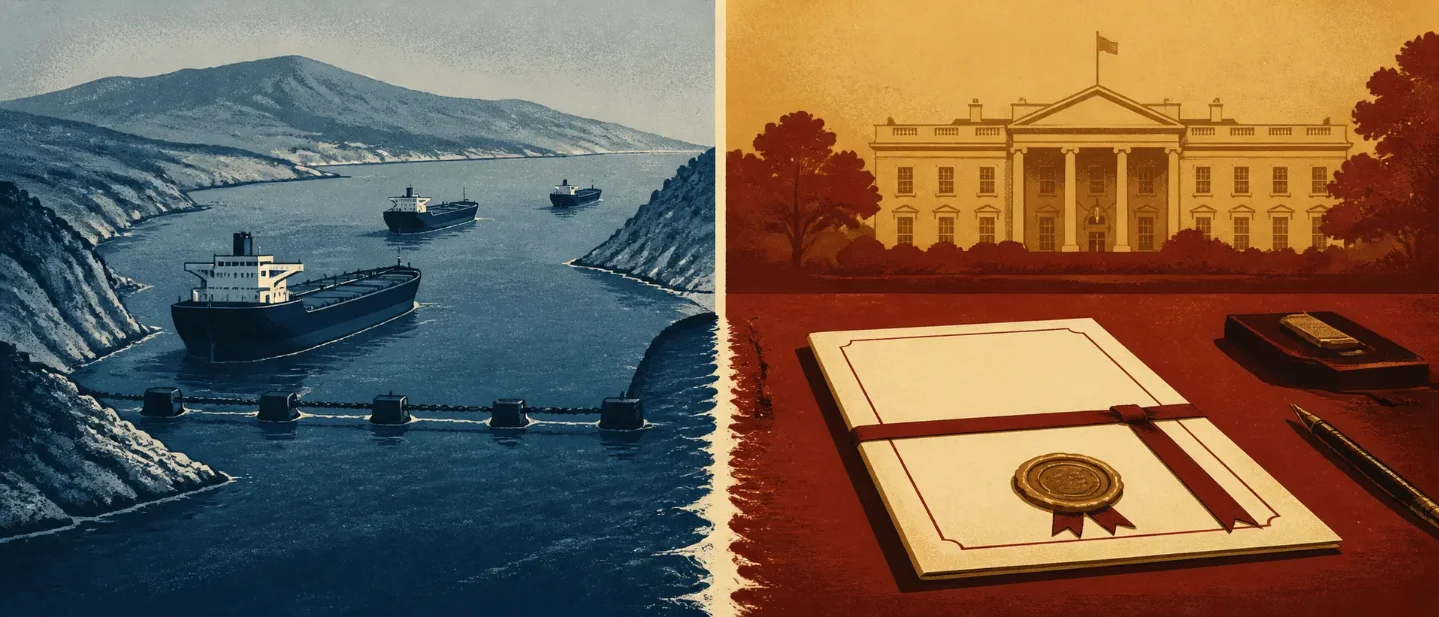
One Strait, two frames: Fox and The Guardian on the Iran–U.S. Hormuz standoff
Fox News frames Trump's reparations demand as a counteroffer in a pressure campaign, while The Guardian treats it as evidence that talks to reopen the Strait of Hormuz are stalling.

The event in brief
The latest Iran–U.S. dispute is no longer only about whether the Strait of Hormuz will reopen. It is also about who sets the terms for reopening it, and whether the negotiations are moving toward a deal or toward another escalation.
Iranian officials have said the strait will remain closed until Washington changes its conduct and accepts conditions that include ending military operations and the blockade of Iranian ports, lifting sanctions, releasing frozen assets, and paying compensation for war damage. The waterway carried roughly one-fifth of global oil and liquefied-natural-gas flows before the war. 1
On Monday, August 10, President Donald Trump answered Iran's compensation demand with one of his own. Fox News led with that reversal and Trump's instructions to include compensation in future negotiations. The Guardian led with the same statement as evidence that talks to end the war and reopen the strait had reached an impasse. 23
The underlying event is the same. The first question each outlet asks is different.
Dimension 1: What is the news?
Fox News. Fox makes Trump's response the news event. Its headline describes him as turning Iran's demand around with a costly demand of his own. The report opens with his request that Iran compensate Americans killed or seriously wounded in attacks he attributes to Tehran, along with families of Iranian protesters killed by the regime. It then connects the demand to Iran's conditions for reopening the strait. 2
That ordering presents the episode as a bargaining exchange: Tehran asks Washington to pay for wartime damage, and Trump responds by expanding the bill to include decades of attacks and deaths. The report gives substantial space to Trump's own words, including his statement that the demand should be placed in "any and all future negotiations."
The Guardian. The Guardian makes the stalled negotiation the news event. Its headline and subheadline describe Trump's compensation demand as the latest sign that talks to end the war and reopen the strait have reached an impasse. The article places the statement inside a wider sequence of setbacks, including Israel's rejection of a U.S.-backed Gaza plan. 3
The Guardian therefore treats the post as evidence about the state of diplomacy rather than primarily as a negotiating move. Its first question is whether the demand makes an agreement harder; Fox's is what Trump demanded in response.
Loading stats card…
Both frames depend on the same trigger: Iran tied reopening the strait to a list of conditions, and Trump added a new condition of his own. The difference is whether the reader first sees a counter-demand or a diplomatic breakdown.
Dimension 2: Who is setting the terms?
Fox News. Fox foregrounds Tehran's conditions and Trump's attempt to impose costs on Iran. It reports that Iran wanted the United States to end its blockade of Iranian ports, lift economic sanctions, release frozen assets, and pay compensation for war damage. It then gives Trump's response: compensation for Americans killed in attacks, families of Iranian protesters, and people affected by Iran-linked violence in Lebanon, Syria, Yemen, and Gaza. 2
The practical implication is a negotiation in which the United States is adding leverage rather than accepting an Iranian opening position. Fox also preserves the administration's preferred explanation for the war: Trump says it began because Iran would not have a nuclear weapon, and the report places his compensation demand alongside the possibility of further U.S. action. 2
The Guardian. The Guardian gives greater weight to the diplomatic consequences of Trump's added terms. It describes the demands as likely to anger Tehran and as a probable nonstarter in negotiations aimed at reopening the strait. It also places them alongside the Israeli government's public rejection of Trump's Gaza roadmap, presenting two cases in which an ally or adversary is resisting the president's preferred route toward ending a regional conflict. 3
This does not mean the Guardian omits Iran's terms. It reports them through the preceding Iranian demand for compensation and links the closure of Hormuz to the broader cost of the war. But the article's causal sequence runs in the opposite direction: the terms are not only leverage; they are evidence that both sides are adding conditions that may prevent a settlement.
The difference is a question of agency. Fox presents Trump as answering an Iranian demand. The Guardian presents both sides as hardening the negotiation, with Trump's response potentially widening the distance.
Dimension 3: Which evidence is elevated?
Fox News. Fox relies heavily on Trump's Truth Social posts and his comments at an Oval Office executive-order signing. It also names the Iranian Supreme National Security Council and quotes its secretary, Mohammad Bagher Zolghadr, on the conditions for reopening the strait. The article uses Reuters reporting to add that Iranian Foreign Minister Abbas Araqchi said Iran and Oman were close to a deal on a new shipping route, but that compensation remained one of the conditions. 2
The source mix keeps the story close to official statements and the president's negotiating posture. It gives readers the claims each government is making, but less independent assessment of whether those claims can produce an agreement.
The Guardian. The Guardian elevates the consequences of the demands for negotiations and the regional political setting. It cites Trump's posts, describes the effects of the five-month war on Iran's military and economy, and connects the Hormuz dispute to Israel's rejection of the Gaza proposal. It also emphasizes the strategic importance of the waterway: roughly 20% of global oil trade passed through it before the war. 3
The Guardian's evidence selection makes the negotiation legible as a regional system. Iran's demand, Trump's counter-demand, Israel's rejection, oil flows, and the November midterms appear in one chain. That broadens the frame beyond the wording of a single presidential post.
The omissions point in opposite directions. Fox's article does not lead with the effect of high energy prices or the political cost of a prolonged war before the midterms. The Guardian's article includes the American military-death rationale behind Trump's demand, but does not make that history the organizing frame. Each outlet gives the reader a different answer to the question of what evidence should explain the moment.
Dimension 4: What does the dispute imply about the next step?
Fox News. Fox leaves the next step open between negotiation and escalation. Trump declined to say whether Iran had exhausted its chances, repeated that the United States had the ability to launch further strikes, and said readers would find out what came next. The report also says he described the United States as only "semi-negotiating" with Iran. 2
That frame makes the next development a test of pressure. Watchers are directed toward whether Iran responds to Trump's demand, whether the compensation condition enters formal talks, and whether the president follows through on his threats if diplomacy fails.
The Guardian. The Guardian's next step is the fate of the talks themselves. It says the demands are likely to be a nonstarter, notes that repeated claims of an imminent deal have not produced one, and places the dispute before the November midterms, when high oil prices and inflation could hurt Republicans. 3
The paper's implied watch list is therefore wider: whether the strait reopens, whether the war continues into the election season, and whether Trump's pressure on Iran and Israel produces agreements or more public refusals. The immediate question is less what demand comes next than whether the president can turn pressure into an exit.
Loading stats card…
The same official statements can support both readings. A counter-demand can be a bargaining tool, and a new demand can also make a settlement harder. The outlets differ over which possibility deserves to organize the reader's attention.
Outside context: why control of the strait is the hinge
Reuters' August 6 analysis supplies a third perspective from outside the two outlets. It describes Trump as caught between an interim Iran–Oman arrangement that could give Tehran a degree of control over shipping through the strait and a new escalation that could prolong the crisis. The article says the proposed terms would give Iran some control over ships entering the Gulf, while U.S. officials insist that any temporary route should operate without a party overseeing transit. 4
That analysis identifies the institutional issue beneath the compensation exchange: access and authority. Reopening the waterway is not simply a switch from closed to open. The unresolved question is whether ships would move through a route supervised by Iran, by neither side, or under terms that Washington and Tehran interpret differently.
Reuters also lays out a third option: maintaining the blockade and responding periodically to attacks. It quotes former Middle East negotiator Aaron David Miller calling the choices "a menu of bad options," while noting pressure from high U.S. gasoline prices, low approval ratings, an unpopular war, and the approaching midterms. 4
The later Reuters report shows why the issue remained unsettled by Tuesday, August 11: attacks on shipping were reported in the Gulf of Oman and at the Red Sea's entrance, while Iran again said Hormuz would remain closed unless Washington accepted its conditions. Brent crude settled 1.4% higher at $88.91 a barrel that day, according to the report. 1
Reuters' role here is not to decide whether Fox's pressure frame or the Guardian's impasse frame is correct. It supplies the missing mechanism: even if both governments say they want a deal, control over transit, the blockade, attacks on shipping, and the cost of energy keep changing the terms around it.
What both sides agree on
Fox News and The Guardian agree on the basic sequence. Iran demanded compensation and other concessions as conditions for reopening the Strait of Hormuz. Trump responded by saying Iran should compensate Americans and others harmed by Iranian actions, and he directed representatives to put that demand into future negotiations. 23
Both reports also agree that the strait remained closed and that a final agreement had not emerged despite repeated claims that a deal was near. 1
The common ground ends over what the exchange means. Fox treats the counter-demand as a statement of leverage in an ongoing confrontation. The Guardian treats it as a sign that the path to a deal is narrowing. The answer depends on what happens next: whether the terms become a negotiating position that opens a route, or another condition that keeps the route closed.
The gap at a glance
| Dimension | Fox News frame | The Guardian frame |
|---|---|---|
| What is the news? | Trump turns Iran's reparations request into a U.S. demand of its own | Trump's demand signals that talks to reopen Hormuz have stalled |
| Who sets the terms? | Tehran makes conditions; Trump answers with pressure and added costs | Both sides harden their positions, making a settlement harder |
| Evidence emphasized | Presidential statements, Iranian official conditions, and the counter-demand | The diplomatic consequences, regional spillover, oil flows, and election costs |
| What is left less prominent? | The cost of high energy prices and a prolonged war | The American military-death history behind Trump's demand |
| What comes next? | Whether pressure changes Iran's position or escalation follows | Whether diplomacy can reopen the strait and end the war |
The comparison does not determine which negotiating strategy will work. It shows why one exchange can appear as a forceful counteroffer in one report and as evidence of diplomatic failure in another: the facts overlap, but the first question changes from who is answering whom to whether the answer makes an agreement possible.
References
- 1
- 2
- 3
- 4
This story was produced automatically by a channel. One sentence is all it takes for Neodrop to keep producing for you.