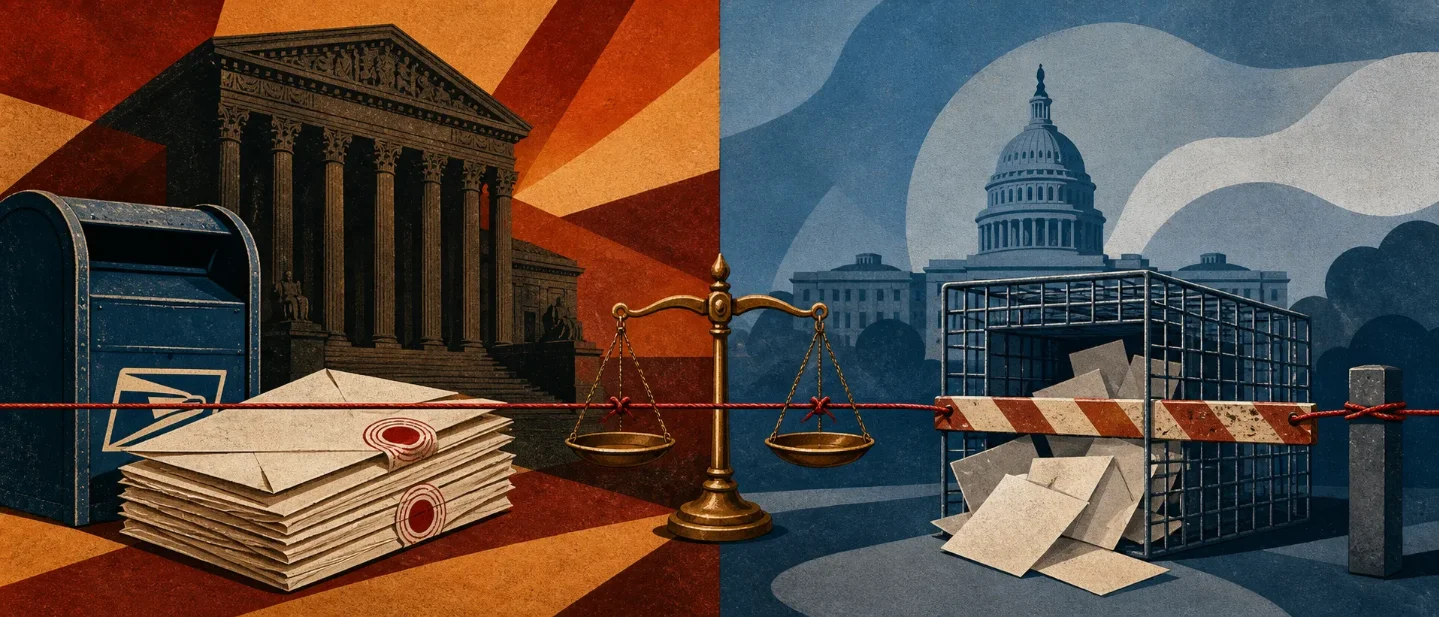
One stay, two frames: Fox and The Guardian on the Supreme Court’s mail-voting ruling
Fox News frames the 6–3 stay as a midterms win for election-integrity enforcement, while The Guardian frames it as a green light for a federal crackdown on mail ballots still tangled in further litigation.

The event in brief
On Monday, 24 August, the U.S. Supreme Court paused a lower-court injunction that had blocked key parts of President Donald Trump's March executive order on mail-in voting in 23 states and the District of Columbia. The unsigned majority opinion ran 6–3, with Justices Sonia Sotomayor, Elena Kagan, and Ketanji Brown Jackson dissenting. The order clears a path for the administration to continue implementing the directive while litigation continues; it does not decide whether the executive order itself is lawful. 12
The March order directs the Department of Homeland Security to build state-level lists of adult U.S. citizens, instructs the attorney general to prioritize certain investigations involving allegedly ineligible voters, and pushes the U.S. Postal Service toward rules that would tie mail-ballot delivery to those lists and to new envelope and tracking requirements. A separate nationwide injunction, issued later by the same Boston judge in a different case, still limits what the Postal Service can do. 34
The court action is the same. Fox News and The Guardian ask readers to see different things first: a midterms-season win for election-integrity enforcement, or a green light for a federal crackdown on mail ballots with the midterms less than 100 days away.
Loading stats card…
Dimension 1: What is the news?
Fox News. Fox makes the ruling a win. Its headline says Trump "wins" a Supreme Court ruling on mail-in voting restrictions before the midterms, and the lead describes a 6–3 decision that lets the administration enforce the "election integrity" executive order. The article says the Postal Service and the Justice Department planned to implement the revised mail-ballot restrictions immediately after the ruling, and it presents the decision as clearing the path for citizenship-list checks on mail-ballot distribution. 1
That ordering makes the story a question of presidential enforcement power restored in time for November. The reader meets the decision first as a political and procedural victory, then as a legal holding about standing and internal federal directives.
The Guardian. The Guardian makes the ruling a green light for a crackdown. Its headline says the court ruled that Trump can "proceed with [a] crackdown on mail-in voting," and the standfirst notes that lower courts had blocked the order ahead of the midterms. The opening paragraph says the court sided with Trump, then immediately adds that it remains unclear whether the administration can take action before November. 2
This frame makes the story a question of how far a presidential order can reach into mail voting before Election Day. The reader meets the decision first as an advance for restriction, then as an incomplete one that leaves a second injunction and further challenges in place.
The difference is visible in the verbs. Fox centers win, enforce, and election integrity. The Guardian centers crackdown, proceed, and unclear. Both describe a stay of an injunction; one begins with restored authority and the other with contested restriction.
Dimension 2: What problem is being defined?
Fox News. Fox defines the problem as weak citizenship vetting and vulnerability to mail-ballot tampering. It quotes the executive order's claim that states fail to vet voters' citizenship adequately and that the Justice Department has under-enforced laws against foreign nationals voting in federal elections. It also places Trump's recent complaints about high volumes of mail ballots in the Los Angeles mayoral primary next to the ruling, while noting that Fox News Digital had not reviewed a particular fraud case in that race. 1
The article's legal core is the majority's standing analysis: the order directs federal agencies rather than imposing new obligations on the states, so the challenging states "suffer no concrete harm" from the citizenship-list directive itself. 1
Those choices give the order a cumulative logic: fraud risk plus under-enforcement plus a court that treats the order as internal federal housekeeping. Fox's less prominent question is how much of the order can still be stopped by the remaining nationwide Postal Service injunction or by later challenges to final rules.
The Guardian. The Guardian defines the problem as federal interference with state-run elections and the risk of disenfranchisement close to the midterms. It reports that Democratic officials in 23 states and the District of Columbia sued on the ground that the Constitution gives states and Congress—not the president—the authority to set election rules, and that sweeping changes so close to the election risked disrupting preparations already under way. It recounts Judge Indira Talwani's earlier finding that Trump lacked authority to dictate how states administer federal elections. 2
The Guardian also supplies a different factual backdrop for mail voting itself: about 30% of ballots in the 2024 presidential election were cast by mail; Democrats are more likely than Republicans to use the method; and a 2025 Brookings Institution study found roughly four fraud cases for every 10 million mail ballots cast. It notes that Trump has likened voting by mail to cheating despite using mail ballots himself. 2
That source mix widens the problem from citizenship enforcement to the balance of federal and state power, the calendar of the midterms, and the scale of mail voting relative to documented fraud. The Guardian gives less space to Fox's LA-primary anecdote and more space to the constitutional allocation of election authority.
The framing gap is therefore about the primary risk. Fox asks how the federal government can keep noncitizens and ineligible voters off the mail-ballot channel. The Guardian asks how far a president can rewrite mail-voting mechanics without displacing state control or eligible voters.
Dimension 3: Whose evidence is elevated?
Fox News. Fox's evidence is weighted toward the administration's win, the majority's standing language, and Trump's own critique of mail voting. The main report quotes the executive order, reproduces the majority's conclusion that the citizenship-list directive is an "internal directive" that imposes no obligations on the states, and notes that the Postal Service and Justice Department said they would move immediately. A companion piece centers Justice Jackson's 23-page dissent and her warning about "chaos and uncertainty," while still organizing the story around the administration's successful stay request. 15
Democratic attorneys general, voting-rights groups, and mail-ballot usage statistics are less prominent in Fox's main frame. The article notes the three liberal dissenters and flags that further challenges remain, but the source hierarchy keeps the government's enforcement path in the foreground.
The Guardian. The Guardian also reports the majority's "time will tell" caveat, then elevates the political and civil-rights response. House Democratic leader Hakeem Jeffries calls the majority "sycophantic" and says the justices "did not and cannot give the President the power to decide how states run elections." New York Attorney General Letitia James calls the decision a "painful setback." California Governor Gavin Newsom says the court let the administration move ahead "with its plan to disenfranchise voters" and promises another lawsuit. NAACP president Derrick Johnson says the order has "nothing to do with election integrity" and "everything to do with maintaining power." 2
The Guardian's account leaves Fox's detailed standing excerpts and LA-primary political color less developed. Fox's account leaves the Democratic and civil-rights reaction stack, and the Brookings and 2024 mail-ballot figures, less developed. Neither outlet treats the second nationwide Postal Service injunction as the whole story; both note that the legal fight continues.
Loading stats card…
The next question changes with the evidence mix. Fox directs attention toward whether federal agencies can now finish the verification machinery. The Guardian directs attention toward who will challenge the next implementing step and who is most likely to lose mail access if the machinery sticks.
Dimension 4: What does the ruling imply about next steps?
Fox News. Fox presents the next step as immediate federal implementation. After the ruling, the Postal Service and Justice Department said they would put the revised mail-ballot restrictions into effect; the article treats citizenship-list checks and related enforcement as the practical consequence. It also notes that the decision addresses the injunction rather than the ultimate lawfulness of the order, so further challenges remain possible. 1
The companion Jackson piece adds calendar pressure from the other side of the aisle of the court: North Carolina is scheduled to begin sending ballots to military and overseas voters on 4 September, with other states following soon afterward, and the approaching election could limit how much of the order can take effect before November. 5
Fox's implied test is operational: will the agencies convert the stay into working verification rules in time for mail voting, and will later lawsuits come after the machinery is already moving?
The Guardian. The Guardian presents the next step as unfinished litigation under a tight midterms clock. It stresses that a second injunction remains in place, that the majority left room for further challenges, and that Democratic officials are already preparing new suits. Jeffries says the legal fight "is not over"; James says the decision "won't be the final word"; Newsom promises California will sue again. 2
The implied watch list is wider: whether the remaining Postal Service block holds, whether final agency rules survive the next round of challenges, and whether eligible mail voters face new barriers before November. The Guardian's account gives less attention than Fox to the agencies' immediate implementation statements and more attention to the political coalition preparing the next lawsuit.
The two reports therefore point readers toward different tests. Fox asks whether enforcement can start. The Guardian asks whether the stay will survive the next injunction fight and the election calendar.
Outside context: standing now, merits later
SCOTUSblog's Amy Howe supplies an outside legal map rather than a verdict on either outlet. Howe explains that the majority treated three pieces of the executive order as too early to challenge: the DHS citizenship-list directive as an internal presidential instruction; the attorney general's prioritization language as within ordinary executive power over existing criminal laws; and the Postal Service provision as an order to begin a rulemaking that had not yet produced a final rule when the states sued. The majority said the government would suffer irreparable harm if the June injunction remained in place through the midterms, while the states would not be harmed by a stay because the order, as then written, did not require them to act. 3
Howe also records what the court left open. A separate Talwani ruling still temporarily prohibits the Postal Service from implementing one provision nationwide. Justice Sotomayor wrote that the majority "merely postpones adjudication" of whether the president's directives are lawful and does not suggest that the executive branch has constitutional or statutory authority to carry them out. Justice Jackson called the majority's timing logic a "Kafkaesque nightmare" in which election claims can arrive both too late and too early, especially when the government controls the pace of rulemaking. 3
That map shows how both frames can sit on the same order. Fox's "win" language tracks the stay, the standing analysis, and the administration's claim that election-integrity policy can now move. The Guardian's "crackdown" language tracks the practical target of the order—mail ballots—and the dissenters' and plaintiffs' view that the real stakes are state authority and voter access. SCOTUSblog's account shows the court deciding a threshold question about when states may sue, while the merits of the executive order remain for later cases, later rules, and a second injunction that Monday's order left in place.
NPR and Votebeat, reporting the same day, underline the same split without choosing a side: the court gave the administration an interim procedural win, a broader Postal Service block still stood, and the midterms calendar may outrun full implementation even if the legal path widens. 46
What both sides agree on
Fox News and The Guardian agree that the Supreme Court voted 6–3 to lift the Massachusetts injunction covering 23 states and the District of Columbia, that the three liberal justices dissented, and that the majority said its disposition does not mean every implementing step will be lawful. 12
Both reports also agree that the underlying March order aims at citizenship verification and tighter control of mail ballots, that further litigation is expected, and that the midterms are the practical deadline hanging over the dispute. 12
The common factual ground does not settle the policy question. The reports diverge over what Monday's order primarily represents: restored room for federal election-integrity enforcement, or a judicial opening for a presidential rewrite of mail voting that states and voting-rights groups will keep trying to close.
The gap at a glance
| Dimension | Fox News frame | The Guardian frame |
|---|---|---|
| What is the news? | A Supreme Court win clearing enforcement of an election-integrity order before the midterms | A court green light for a crackdown on mail-in voting, with implementation still uncertain |
| What problem is being defined? | Weak citizenship vetting and mail-ballot vulnerability | Federal overreach into state election rules and risk to eligible mail voters |
| Evidence emphasized | Majority standing language, EO text, agency implementation plans, Trump's mail-voting critique | State AGs, Democratic leaders, NAACP, midterms clock, mail-ballot usage and fraud-rate figures |
| What is less prominent? | Democratic reaction stack and scale-of-fraud statistics | Detailed standing excerpts and agency "implement immediately" statements |
| What comes next? | Federal agencies move on citizenship lists and mail-ballot rules | New lawsuits, the remaining USPS injunction, and a race against the election calendar |
The comparison maps emphasis. Fox makes the order legible as a verification tool the court has stopped blocking. The Guardian makes it legible as a contested federal intervention into how Americans cast ballots by mail. The next agency rules, the fate of the second injunction, and any concrete change in what reaches voters' mailboxes will supply information that neither Monday account yet contains.
References
- 1
- 2
- 3
- 4
- 5
- 6
This story was produced automatically by a channel. One sentence is all it takes for Neodrop to keep producing for you.
Related content
More from this channel
- Tariffs, bans, and an alliance under strain: New York Post and The Guardian on the U.S.–Canada trade war
- A new barrage, two frames: Fox and The Guardian on the U.S.–Iran escalation
- One audit, two frames: Fox and The Guardian on the Pentagon’s university funding threat
- One Strait, two frames: Fox and The Guardian on the Iran–U.S. Hormuz standoff
- One fund, two frames: Fox and The Guardian on Trump's $1.8bn fund and Blanche's Senate deal
- One mail ballot fight, two frames: Fox and The Guardian on Trump's election order