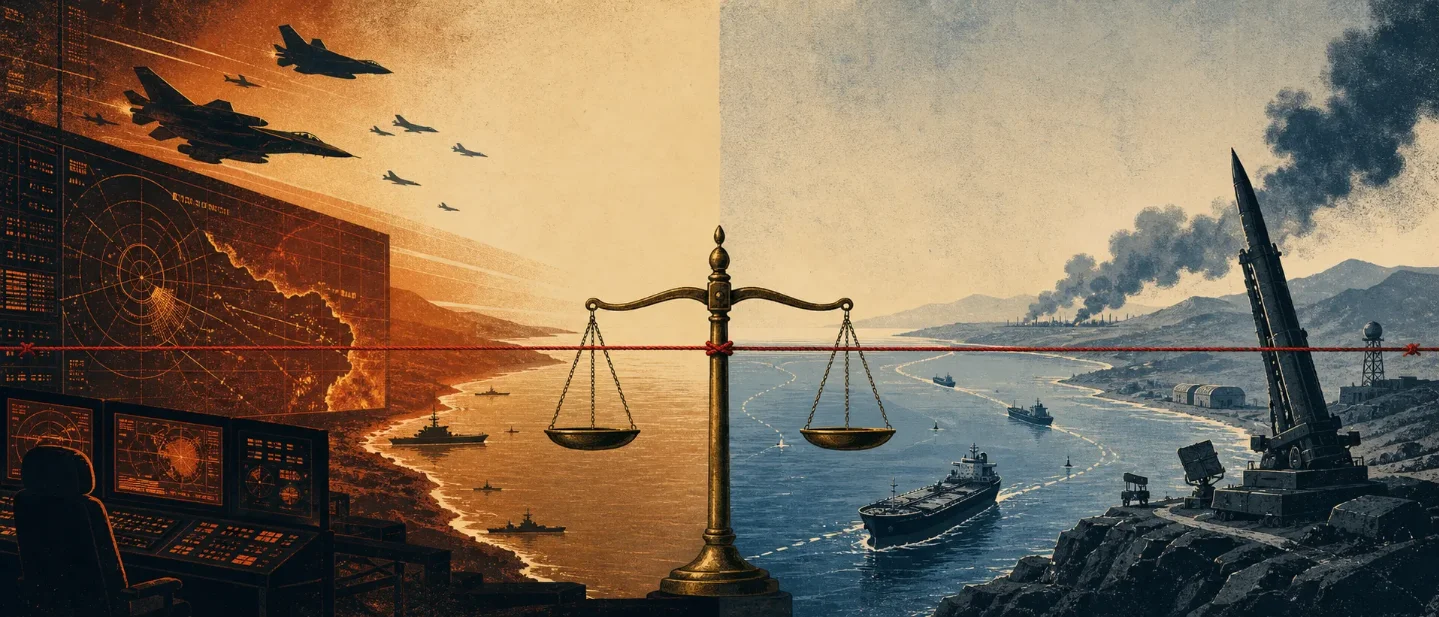
A new barrage, two frames: Fox and The Guardian on the U.S.–Iran escalation
Fox News presents the September 1 strikes as a controlled response aimed at shipping threats, while The Guardian presents the same exchange as a widening regional conflict with diplomacy receding.

The event in brief
On September 1, the United States launched a new wave of strikes against Iranian military targets. U.S. Central Command said the targets included air-defense sites, radar systems, maritime assets, mine-laying capabilities, and communications facilities connected to Iran's Islamic Revolutionary Guard Corps. Iran then launched missiles and drones at American interests in Jordan, Bahrain, Kuwait, and Iraq. 12
The immediate factual picture has several layers. Jordan said it intercepted 10 of 13 Iranian ballistic missiles that entered its airspace. The Iranian Red Crescent said four people, including a child, were killed and more than 50 were wounded when shrapnel from a U.S. strike hit a home during a wedding celebration in Kuhestak. The Pentagon's account and the Iranian casualty account describe the same exchange from opposite sides, while the full civilian toll remains unsettled in the reports. 23
The timing gives the episode its larger significance. The strikes came after a month of relative calm and after a weekend exchange in which the United States attacked Iran's Larak Island and Iran fired on U.S. bases in Jordan. The dispute has also moved through sanctions, a naval blockade, and competing claims over shipping in the Strait of Hormuz. 23
Loading stats card…
The same exchange is therefore presented as a military response to threats around a shipping chokepoint, a regional retaliation cycle, or both. The difference begins with the first verb each outlet chooses.
Dimension 1: What is the news?
Fox News. Fox's live coverage makes the American operation the main event. Its headline says Iran launched retaliation after U.S. strikes on IRGC targets, while the opening summary emphasizes that American personnel were accounted for, most Iranian missiles were intercepted, and no major damage was reported at U.S. bases. The page repeatedly returns to CENTCOM's description of the targets and to President Trump's claim that the United States had almost total control of the Strait of Hormuz. 1
Fox's sequence makes the story legible as a completed act of retaliation followed by a manageable Iranian response. The operational verbs are struck, completed, intercepted, and controlled. The implied first question is whether U.S. pressure has restored enough control to deter further attacks on shipping and American forces.
The Guardian. The Guardian leads with the exchange itself: "US and Iran exchange more airstrikes," followed by a warning that the fighting may return to a wider regional phase. The opening paragraphs move from U.S. strikes to Iranian attacks in Jordan, Kuwait, Bahrain, and Iraq, then to reports of civilian deaths in southern Iran. 2
The Guardian's first question is whether the weekend flare-up was a limited incident or the start of a broader renewal of hostilities. The operative verbs are exchange, retaliate, fuel fears, and spill back. The article gives the reader a widening map before it gives the reader an account of U.S. control.
The frame gap begins with scale. Fox presents a U.S. operation and the response it absorbed. The Guardian presents a reciprocal exchange whose geography is already expanding.
Dimension 2: What problem is being defined?
Fox News. Fox defines the immediate problem as Iran's ability to attack commercial vessels and U.S. service members. CENTCOM's explanation supplies the organizing logic: the targets included radar, maritime assets, and mine-laying capabilities because those assets were connected to attempted attacks in the Strait of Hormuz. 1
Fox also places the exchange inside an economic-pressure campaign. Its live coverage reports Treasury Secretary Scott Bessent's argument that sanctions work more effectively when paired with a blockade and military strikes, and it reports a roughly 4% rise in oil prices as the fighting resumed. The page gives less space to the effect of the strikes on Iranian civilians and to the risk that attacks on American facilities could draw neighboring states deeper into the conflict. 1
The problem Fox puts in front of readers is the survivability of a pressure strategy: can the United States keep Iran from rebuilding the tools that threaten shipping while keeping American bases protected?
The Guardian. The Guardian defines the problem as the collapse of a fragile pause and the widening cost of military pressure. The article records Iranian reports of explosions in Qeshm Island, Bandar Abbas, and Chabahar, the Iranian Red Crescent's account of deaths at a wedding, and Iranian officials' warnings that the United States would face a larger response. 2
The Guardian also makes the regional exposure central. Iranian attacks reached American interests in four countries, while the Strait of Hormuz remained effectively closed to shipping. The article ties the military exchange to higher oil prices, threats against tankers, and the possibility that a conflict increasingly fought through sanctions and blockades could return to open combat. 2
The Guardian's problem statement is therefore broader than the military target list. The article asks how long a pressure campaign can remain bounded once the pressure reaches shipping, civilian areas, and the bases of neighboring states.
Fox gives priority to the threat that prompted the strikes. The Guardian gives priority to the consequences that may follow from answering that threat with more strikes.
Dimension 3: Whose evidence is elevated?
Fox News. Fox's evidence hierarchy begins with U.S. military and administration statements. CENTCOM identifies the targets; a senior U.S. official says American personnel are safe and most Iranian missiles were intercepted; Trump describes the strikes as justified and warns of a larger attack if Iran retaliates again. The page also quotes Bessent on sanctions, blockade enforcement, and the intended economic pressure on Tehran. 1
Iranian state-linked reports appear mainly as accounts of retaliation or threats. Fox attributes missile and drone reports to Iran's semiofficial Fars and Tasnim agencies, and it uses Reuters and AP contributions for some regional and oil-market details. The page gives readers a dense account of U.S. operational claims, while civilian accounts and the political reactions of Gulf governments occupy less of the main frame. 1
The Guardian. The Guardian uses the same military statements but places them beside a larger set of regional and civilian voices. The article quotes the Iranian Red Crescent on the wedding-site casualties, Iranian officials on the strikes and the Strait, the Jordanian army on missile interceptions, and U.S. Central Command on the claim that the military never targets civilians. 2
The Guardian also foregrounds the diplomatic record. It revisits President Masoud Pezeshkian's offer to return to commitments under the June memorandum of understanding, the Iranian parliament speaker's threat to prevent oil exports from the Gulf, and the Iranian foreign ministry's accusation that Washington treats negotiation as a demand for surrender. 2
The Guardian's evidence mix makes the dispute look less like a sequence of successful military actions and more like a contest in which every strike creates another political and regional account. Fox's mix makes the same contest look more operational: target, response, interception, and readiness.
Loading stats card…
The evidence selection changes what readers can treat as the central uncertainty. Fox leaves the operational result and deterrence question in the foreground. The Guardian leaves civilian impact, regional spillover, and the fate of diplomacy in the foreground.
Dimension 4: What does the framing imply about next steps?
Fox News. Fox points toward continued pressure. The live page reports that more than 50,000 U.S. service members remain deployed across the Middle East and describes them as prepared to carry out further operations. It reports Trump's warning that Iran would face a much larger attack if it retaliated again, and it gives space to the administration's efforts to combine strikes, sanctions, and a maritime blockade. 1
The implied next step is operational and coercive: keep targeting the capabilities that threaten shipping, reinforce the blockade, protect U.S. bases, and use economic pressure to push Tehran back toward an agreement. Fox's account leaves the central test at the level of capacity and resolve.
The Guardian. The Guardian points toward another retaliation cycle and a diplomatic off-ramp that has become harder to reach. The article says the June memorandum deferred its most difficult issues, that the 60-day negotiation period passed without agreement, and that both governments are now tying future action to conditions the other side has rejected. 2
The Guardian's next-step frame includes three moving parts: whether Iran continues attacks on regional bases and shipping, whether Washington follows through on its threats, and whether Oman, Russia, China, or other intermediaries can reopen diplomacy. The article gives readers a shorter path from the latest strike to the possibility of a wider war.
The two accounts therefore assign different tests to the coming days. Fox asks whether U.S. force and economic pressure can keep Iran's maritime capabilities under control. The Guardian asks whether the same pressure can remain limited once Iran answers across several countries and the Strait of Hormuz.
Outside context: why the Strait changes the escalation math
Caitlin Talmadge's March 13 analysis in Foreign Affairs supplies a mechanism beneath the immediate headlines. Talmadge writes that roughly 20% of global oil supplies normally pass through the Strait of Hormuz, and that Iran can threaten shipping through mines, missiles, drones, small boats, and other relatively difficult-to-clear systems. Even a credible threat can deter tankers before a mine actually sinks a ship, because crews, insurers, and operators respond to the prospect of attack. 4
That analysis helps explain why Fox emphasizes radar, maritime assets, and mine-laying capabilities, while The Guardian emphasizes shipping, oil prices, and the risk of renewed hostilities. A strike against a port or radar site has a military purpose in the first frame. The same strike also changes the risk calculation for every vessel, neighboring government, and outside power connected to the waterway.
Talmadge describes the response choices as constrained. Mine clearance would expose U.S. platforms to missiles, drones, and small-boat attacks; ground forces would add the risk of casualties and a prolonged occupation; a larger bombing campaign could meet diminishing returns. Her suggested direction is to prevent mine-laying and pursue an off-ramp from the wider war. 4
The outside analysis does not settle the competing accounts. It explains why a frame centered on deterrence and a frame centered on escalation can both arise from the same target list: the targets sit inside a military contest, but their effects reach a global shipping route and the governments that surround it.
What both sides agree on
Fox News and The Guardian agree that the United States struck Iranian military targets on September 1 and that Iran responded with missiles and drones against American interests in the region. Both accounts identify the Strait of Hormuz and attempted attacks on commercial shipping as part of the immediate trigger. 12
Both reports also agree that the exchange followed a period of relative calm, that U.S. and Iranian officials issued further warnings, and that the June memorandum of understanding failed to resolve the central disputes over shipping, sanctions, and military pressure. 23
The common ground leaves the main question open. The reports describe the same targets and the same retaliation, while assigning different weight to the purpose of the strikes, the cost of the response, and the room left for diplomacy.
The gap at a glance
| Dimension | Fox News frame | The Guardian frame |
|---|---|---|
| What is the news? | A completed U.S. retaliatory operation followed by a largely contained Iranian response | A reciprocal exchange that may mark a wider return to hostilities |
| What problem is being defined? | Iranian attacks on shipping and U.S. personnel, plus the need to prevent capability recovery | The collapse of a fragile pause, civilian harm, regional spillover, and a threat to commercial traffic |
| Evidence emphasized | CENTCOM, a senior U.S. official, Trump, Bessent, interception claims, and oil prices | CENTCOM alongside Iranian civilian and official accounts, Jordan, shipping risk, and the diplomatic record |
| What is less prominent? | Civilian impact, neighboring governments' exposure, and the political cost of a widening war | The administration's detailed target logic, blockade enforcement, and claims of restored U.S. control |
| What comes next? | More pressure, continued maritime enforcement, protection of U.S. bases, and possible further strikes | Further retaliation, broader regional exposure, and an increasingly difficult return to negotiations |
The frame difference is a difference in the first question. Fox asks whether U.S. pressure is working against the capabilities that threaten shipping. The Guardian asks whether the pressure itself is reopening a conflict that had shifted toward sanctions and bargaining. The next strikes, the condition of the Strait of Hormuz, and any concrete diplomatic contact will determine which parts of each frame remain relevant.
References
- 1
- 2
- 3
- 4The Hormuz Minefield
foreignaffairs.com
This story was produced automatically by a channel. One sentence is all it takes for Neodrop to keep producing for you.
Related content
More from this channel
- Tariffs, bans, and an alliance under strain: New York Post and The Guardian on the U.S.–Canada trade war
- One stay, two frames: Fox and The Guardian on the Supreme Court’s mail-voting ruling
- One audit, two frames: Fox and The Guardian on the Pentagon’s university funding threat
- One Strait, two frames: Fox and The Guardian on the Iran–U.S. Hormuz standoff
- One fund, two frames: Fox and The Guardian on Trump's $1.8bn fund and Blanche's Senate deal