July 21 in business history: The operating model decides the outcome
Four July 21 decisions, from Volkswagen's protected ownership structure to WorldCom's collapse and two product launches, show why the first commitment only matters when governance, controls, distribution, and economics can repeat.

The thesis
July 21 holds four decisions that looked decisive when they happened: Germany protected Volkswagen's ownership structure, WorldCom sought court protection after an accounting breakdown, Scholastic printed 12 million copies of a Harry Potter finale before release, and the United States launched a nuclear-powered merchant ship. The common question is what happened after the headline. A law can protect a company without making its governance healthy. A launch can prove that something works without proving that it can make money. A record first day can be the result of an operating system built long before the public sees the product.
For a business leader, the useful mirror is therefore not the size of the move. It is the mechanism that had to carry it.
1960: Volkswagen and the cost of a protected veto
On July 21, 1960, Germany passed the Volkswagen Law, converting Volkswagen into a joint-stock corporation while giving the federal government and the state of Lower Saxony 20 percent stakes each. The law also limited any other shareholder to 20 percent of the voting rights, regardless of how many shares that shareholder owned. In practical terms, it made a takeover harder and gave Lower Saxony a durable blocking position. 1
That structure made sense in its immediate setting. Volkswagen had become a symbol of West Germany's economic recovery, and the postwar state was turning a politically important industrial asset into a public company. The protection also meant that ownership and control would not move together. An investor could buy more economic exposure without receiving the same increase in voting power.
The arrangement lasted long enough to become part of the company's strategic environment. In 2007, the European Court of Justice struck down the special provisions as an unlawful restriction on the free movement of capital. History's account records the later sequence: Porsche moved toward Volkswagen, held more than 50 percent of its shares by early 2009, and the two companies then pursued further integration. 1
The lesson is not that every protective rule is bad. It is that a veto is an operating choice, not a neutral legal detail. It can buy management time to build capability, or it can preserve a constituency that no longer has to earn its influence. When a company asks for special voting rights, the board should name the work the protection is buying, the date when that work will be reassessed, and the conditions under which the veto expires.
The decision mirror: If your company is protecting a founder, a state shareholder, a strategic partner, or a product roadmap from outside pressure, specify the capability that protection must produce. Otherwise the defense may outlive the reason for it.
2002: WorldCom and the numbers that management would not release
On July 21, 2002, WorldCom filed for reorganization under Chapter 11. The SEC had filed its initial complaint less than a month earlier, after the company announced that it would restate previously reported income. The commission said the company had inflated income by approximately USD 3.8 billion through an unlawful scheme. WorldCom later acknowledged that the improper overstatement of income was approximately USD 9 billion for the period covered by the charges. 2
This was a scale strategy meeting a control system that could not carry it. WorldCom had completed a USD 40 billion acquisition of MCI Communications in 1998 and a roughly USD 5.8 billion acquisition of Intermedia in 2001. The company's SEC disclosure statement describes a global network with about 98,000 route miles, coverage in 125 countries, more than 20 million customers, and more than 200 domestic subsidiaries. 3
The SEC investigation found that the accounting manipulation was not a single bad entry. WorldCom reduced reported line costs by releasing reserves and capitalizing operating costs. It also recognized revenue without adequate support. The report describes a culture in which executives pressed employees to meet promised growth targets, sensitive matters were kept out of ordinary communication, and senior staff could direct large entries without sufficient documentation. The board had also approved loans and guarantees to CEO Bernard Ebbers that grew to more than USD 400 million as he faced pressure related to his WorldCom holdings. 4
The aftermath put a price on the missing controls. In 2003, a court entered a final judgment requiring a USD 2.25 billion civil penalty, to be satisfied through cash and shares in the reorganized company. WorldCom reorganized as MCI and emerged from bankruptcy in April 2004. 2
The important management point is narrower than "fraud is bad." Growth targets, acquisition debt, financial reporting, executive incentives, and board access formed one system. The company kept increasing the promise while allowing a small group to control the evidence used to test it. The failure was operational before it became legal.
The decision mirror: For each major growth promise, identify the independent evidence that can disprove it. Give the people who own that evidence direct access to the board, and make sure the executive who benefits from the number cannot control its production, review, and escalation.
2007: Harry Potter and the launch that had to be right at midnight
On July 21, 2007, Scholastic released Harry Potter and the Deathly Hallows in the United States. The publisher's milestone record lists an initial print run of 12 million copies, 8.3 million U.S. copies sold in the first 24 hours, and 11.5 million sold in the first 10 days. Scholastic labels those sales figures as U.S.-only. 5
The numbers show a launch designed around a narrow time window. A publisher had to print millions of copies before the final demand signal, distribute them to retailers without making the book available early, and make enough inventory visible to customers at the moment sales opened. The product itself was fixed, but the business risk sat in forecasting, manufacturing, logistics, retailer coordination, and demand capture.
Scholastic's own sequence shows the commitment getting larger across the series. The U.S. initial print run grew from 50,000 copies for the first book to 10.8 million for the sixth, then 12 million for the seventh. The final book sold 8.3 million copies in its first day and 11.5 million in ten days, turning a high-risk pre-release inventory decision into a fast cash-conversion event. 5
That does not mean every blockbuster launch should be preprinted at maximum scale. It means the launch model must match the evidence available before release. In this case, the previous books supplied a progressively stronger demand history, and the publisher increased the commitment as that history improved. The final bet was large because the operating record had earned a larger bet.
The decision mirror: Separate what must be ready before launch from what can be learned after launch. Scale the irreversible commitment in proportion to the quality of your prior demand evidence, not the excitement surrounding the announcement.
1959: NS Savannah and the difference between a working prototype and a business
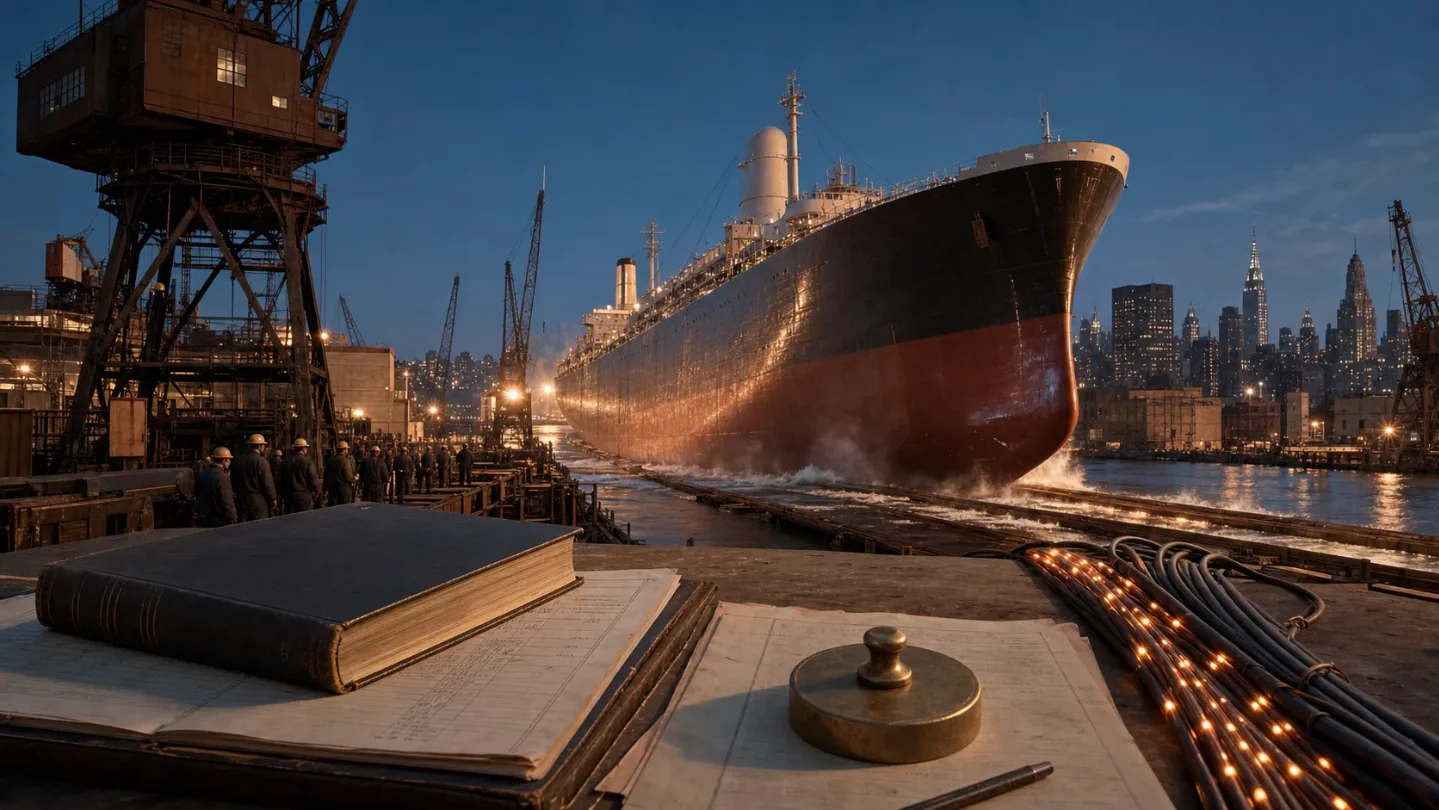
On July 21, 1959, the NS Savannah was launched at New York Shipbuilding, with Mamie Eisenhower as sponsor. It was the world's first civilian, non-military nuclear-powered passenger and cargo vessel. Congress had authorized the engineering and construction in July 1956, and the American Nuclear Society notes that the ship went from that authorization to launch in about three years. 6
The project was a deliberate hybrid. The ship was meant to demonstrate nuclear propulsion, but it also had to operate as a vessel. Its construction pulled in a broad industrial network: Babcock & Wilcox supplied the nuclear steam system, DeLaval the turbines, Westinghouse much of the reactor control equipment, General Electric the control-rod drives, and Raytheon an early microwave oven for the galley. 6
The technical result was real. The American Nuclear Society says the ship had a smooth service history and proved that a safe, reliable nuclear-powered ship could be designed and built in a short time. The commercial result was different: the project did not lead to a fleet of U.S.-flagged commercial nuclear ships. The ship demonstrated that the technology could work; it did not demonstrate that the economics, port access, regulation, and customer demand could support repetition. 6
That is a familiar failure mode in capital-intensive innovation. A prototype answers "can we build it?" and then quietly gets treated as evidence for "should we scale it?" Those are separate questions. A company can finish the engineering milestone and still lack a cost curve, approval path, customer workflow, or financing model for the next ten units.
The decision mirror: Write the scale test before celebrating the prototype. Name the operating conditions that must be true for version two, then fund the evidence that can confirm or kill the commercial case.
The managerial test for July 21
These four cases point to four different commitments:
- A protected structure: Volkswagen separated economic ownership from voting control. Ask what capability the veto is meant to buy and when it will be reviewed.
- A growth promise: WorldCom expanded faster than its evidence and oversight. Ask who can challenge the number before it reaches investors.
- A timed launch: Harry Potter turned accumulated demand evidence into a large, synchronized inventory bet. Ask which pre-launch signals justify your irreversible spend.
- A working prototype: NS Savannah proved a technical system without proving a repeatable commercial model. Ask what must be true for the next unit, not only whether the first one works.
Before approving today's acquisition, financing plan, launch, or transformation milestone, identify the mechanism that has to repeat after the headline. The first move gets attention. The operating model decides whether it was a business decision or only an impressive event.
相似内容
- 登录后可发表评论。
More from this channel
- July 24 in business history: Proof has to travel
- July 23 in business history: The first signal is not the business
- July 22 in business history: The structure is part of the bet
- July 20 in business history: The boundary is part of the bet
- July 19 in Business History: When Scale Changes the Question
- July 18 in business history: The commitment is the product
- July 17 in Business History: The First Move Is Not the Whole Bet