July 24 in business history: Proof has to travel
Four July 24 decisions, from Hoe's rotary press to AMD's ATI acquisition, show why a breakthrough only matters when it can move through the operating system around it.

Proof has to travel
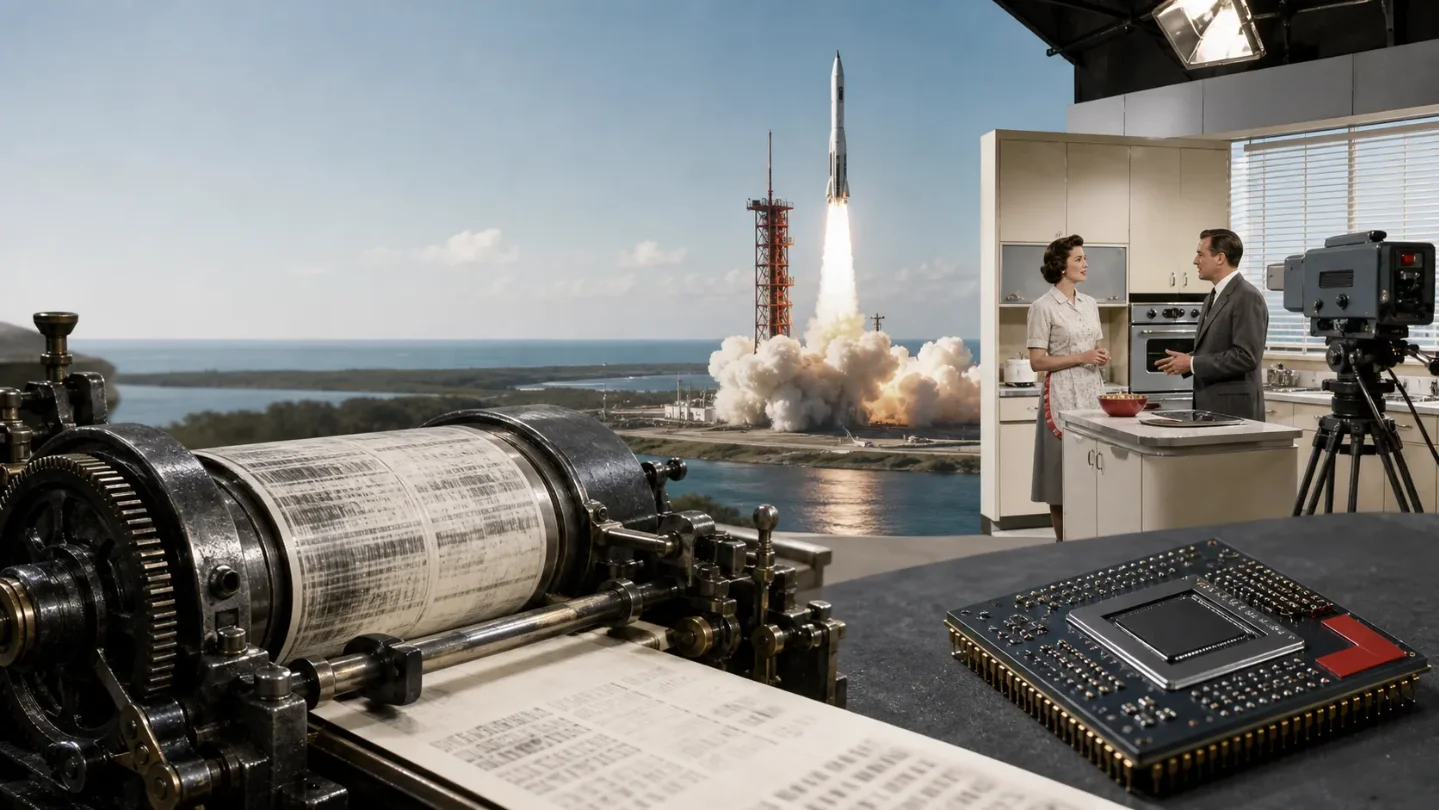
July 24 puts four different kinds of proof on the same calendar page. Richard March Hoe filed a rotary-press patent that addressed newspaper throughput. Cape Canaveral opened with a rocket test that exposed the limits of a new launch site. Richard Nixon and Nikita Khrushchev argued over household technology in a Moscow showroom, turning product demonstration into political theater. AMD announced a $5.4 billion acquisition of ATI to move from processors toward integrated computing platforms.
The common question is operational: after the first proof, where does the result have to travel next? Through a factory, a site, a market, a media channel, or an acquired organization? A decision that cannot make that journey is still a demonstration, however impressive the first result looks.
1847: Hoe put throughput inside the product
On July 24, 1847, Richard March Hoe submitted a patent application for a four-cylinder rotary press, patent no. 5,199. Hoe came from a New York printing-press manufacturing family and ran the business after his father's death. His rotary design placed type on a rotating cylinder rather than a flat bed, allowing a much faster press. 1
That change mattered because newspapers were becoming mass products with a brutal production constraint. A daily paper did not merely need a good story. It needed tens of thousands of pages printed quickly enough to reach readers while the news was still fresh. Linda Hall's account says Hoe's firm later built a six-cylinder press for the New York Sun in 1850 that, according to Hoe's claims, could produce 50,000 pages an hour. The later press also moved toward continuous rolls of newsprint and simultaneous printing on both sides. 1
The business move was easy to miss if the invention were described only as better machinery. Hoe was selling a way for publishers to expand the product itself. More pages at a lower time cost supported faster news cycles, larger circulations, and a different relationship between a newspaper and its advertisers. The machine did not create the newspaper market by itself, but it removed a bottleneck that limited the market's reach.
For a company deciding whether to invest in a new manufacturing process, data pipeline, or AI-enabled workflow, the Hoe test is direct: which constraint does the new capability remove, and what new volume or customer promise becomes possible when it does? If the answer is only that the technology is more elegant, the investment may still be a laboratory result. The useful proof is a changed unit of output.
1950: Cape Canaveral began with a test that failed in public
On July 24, 1950, Bumper 8 became the first rocket launched from Cape Canaveral. The two-stage vehicle paired a German V-2 first stage with a U.S. Army WAC Corporal second stage. NASA's history of the program explains why the site mattered: earlier facilities could support vertical tests, but the Army, Air Force, and Navy needed an over-water range for flights with a horizontal component. Cape Canaveral offered low population density, an existing nearby base, and a launch range that could grow from 500 miles to 5,000 miles. 2
The first launch was not a clean product demonstration. The V-2 lifted off, but the vehicle tilted to 10 degrees instead of the planned 22 degrees. The WAC Corporal separated and failed to ignite. Engineers tried again with Bumper 7 on July 29. The second attempt achieved only part of its target, yet the Corporal fired for 40 seconds, reached more than 3,200 miles per hour, and traveled 150 miles downrange. The Bumper program ended, but Launch Complex 3 remained in service for later rockets. 2
That sequence is a better business story than a simple first-launch milestone. The site was valuable before the prototype was reliable. Cape Canaveral was an operating asset designed around the next set of tests, not a stage built to make one launch look successful. NASA's later account notes that the facility went on to support thousands of rockets, but the path began with a failed second stage and a usable range. 3
The mirror for today's infrastructure decision is to separate the performance of the first unit from the value of the environment around it. A data center, factory, distribution hub, or test facility may be worth building because it makes the next ten iterations cheaper and safer, even when the first product misses its target. Ask what the site lets the organization learn, how quickly it can be reused, and whether the failure leaves behind an asset that supports the next attempt.
1959: The product demo became the product
On July 24, 1959, Vice President Richard Nixon took Soviet Premier Nikita Khrushchev through the American National Exhibition in Moscow. The exhibition was meant to show American life and technology. In a model kitchen filled with the latest appliances, the tour became the Kitchen Debate, an argument about the relative merits of American capitalism and Soviet communism. The National Archives records that the exchange moved from washing machines to nuclear warfare, while cameras captured part of it for broadcast. 4
The setting did more work than the speakers' titles. The kitchen translated an abstract economic argument into a visible claim about daily life: what a household could buy, how much work an appliance could remove, and which system could make that standard ordinary. The exhibition also included an Ampex VR1000 videotape recorder. The Archives describes it as an early color videotape system that could record a live program and make it available for rapid broadcast. The debate therefore demonstrated a product while using another product to distribute the demonstration. 4
The outcome was mixed. The National Archives account says Nixon's television performance strengthened his standing at home, but it also notes that the confidence he gained from the exchange did not transfer to his televised debate with John F. Kennedy in 1960. The State Department's historical record describes the 1959 encounter as an impromptu debate over the merits of each nation's economic system, not simply a disagreement about kitchen appliances. 4 5
The lesson for a product launch is uncomfortable: the demonstration is part of the product's meaning. Buyers do not evaluate a new capability in isolation. They see the interface, the setting, the comparison, and the channel through which the claim reaches them. A strong demo can clarify a new category, but it can also create confidence that the underlying organization cannot sustain. Before launch, decide what the demonstration promises and whether the operating model can deliver that promise after the cameras leave.
1969: Apollo 11 sold the return trip
On July 24, 1969, Apollo 11 splashed down in the Pacific Ocean. NASA's mission record gives July 16 as the launch date and identifies the mission's primary objective as completing the national goal of a crewed lunar landing and a safe return to Earth. The return was therefore not a footnote to the moonwalk. It was part of the deliverable. 6
This distinction matters in business because organizations often define success at the moment of release. Apollo 11 had to include navigation, communications, crew procedures, mission control, recovery, and quarantine. The public saw the moon landing, but the program's credibility depended on the full loop closing nine days after launch. NASA's page records the successful splashdown and the mission-control celebration that followed. 6
The practical mirror is a release criterion that includes the customer's next state. For a software launch, that may be migration, support, rollback, or security response. For an acquisition, it may be the first integrated product and the first customer renewal. For a capital project, it may be maintenance and utilization after the ribbon-cutting. A launch metric that stops at adoption can hide the cost of bringing users, systems, or employees safely back into an operating rhythm.
Apollo's historical value here is not that every business should pursue a moonshot. It is that a high-stakes promise must be designed around completion, not spectacle. The last handoff is part of the product.
2006: AMD bought a capability, then inherited the integration
On July 24, 2006, AMD announced plans to acquire ATI Technologies for approximately $5.4 billion. The proposed consideration was $4.2 billion in cash plus 57 million AMD shares, valuing ATI at a roughly 24 percent premium to its prior closing price. AMD's stated logic was to combine processors, graphics chips, and chipsets into more integrated platforms and to close ground on Intel. 7
There is a small date detail worth preserving. The acquisition agreement filed with the SEC was dated July 23, while the filing itself was published on July 24 and later company materials describe the proposed acquisition as announced on July 24. The public decision belongs to July 24; the legal agreement carried the prior day's date. 8
The deal closed on October 25, 2006. AMD's 2008 annual report says the company entered the graphics-processor business through the ATI acquisition and describes a broader portfolio covering x86 microprocessors, graphics and multimedia products, and technology for consumer electronics. The same filing lists the conditions that could prevent the expected benefits from arriving: cost savings and synergies might take longer than expected, product launches might slip, and manufacturing capacity or components might not keep up with demand. 9
That is the part of the story that matters for an M&A committee. AMD did acquire the capability it wanted. The acquisition also changed the operating problem from competing with a processor portfolio to managing a wider product set, supply chain, technology roadmap, and integration agenda. A deal thesis that names only the strategic capability is incomplete. The integration thesis must name the first products, customers, teams, and manufacturing decisions that prove the capability is usable inside the buyer.
The managerial test for July 24
Four questions carry the date into today's decisions:
- What bottleneck does the investment remove, and what measurable output becomes possible afterward?
- Is the surrounding site or operating environment reusable when the first attempt fails?
- What does the launch demonstration promise, and can the organization deliver that promise without the audience watching?
- Where is the return trip in the plan: the handoff, integration, recovery, or support work after the headline event?
Hoe turned machinery into newspaper capacity. Cape Canaveral turned a failed test into a durable launch environment. The Kitchen Debate showed how a product can carry an argument, and Apollo 11 made recovery part of mission success. AMD's ATI deal made the same point in corporate form: acquiring a capability is the beginning of the operating work, not its conclusion.
Related content
- Sign in to comment.