The coffee that climbed out of Grade C
A deep read of Wikipedia’s July 14, 2026 Featured Article on Maraba coffee: how a Rwandan cooperative moved from below-Grade-C beans to Fairtrade markets, specialty-coffee awards, and a World Beer Cup-winning coffee beer.

Wikipedia's Featured Article for July 14, 2026 is Maraba coffee, the story of a Rwandan specialty coffee that moved from unsellable beans to Fairtrade shelves, Cup of Excellence awards, and even a prize-winning coffee beer. 1 2
The subject begins small: coffee cherries on steep hillsides in southern Rwanda. The article gets larger because every improvement in the cup carries a human consequence. Better washing changed the price. A cooperative changed who could negotiate. A supermarket deal in Britain and a roaster contract in Louisiana changed what a farmer in Maraba could afford. 2
That is the real pull of the article. It treats coffee as agriculture, as engineering, as trade, and as recovery after violence.
The full article in one read
Maraba coffee, called Ikawa ya Maraba in Kinyarwanda and Café de Maraba in French, is grown in the Maraba area of southern Rwanda. 2 The coffee is a Bourbon variety of Coffea arabica, grown on volcanic soils at roughly 1,700 to 2,100 metres above sea level. 2 The article places Maraba about 12 kilometres from Butare and about 150 kilometres from Kigali, in what is now Huye District in Rwanda's Southern Province. 2
Those facts explain the taste before the article ever reaches a cup. High altitude lowers the temperature, and slower cherry maturation can produce more complex flavours. 2 The region receives about 115 centimetres of rain a year, mostly during the March to May rainy season, which is also the main harvest window. 2
The human story starts in a much harsher place. Rwandans had grown coffee since colonial times, but Maraba's crop was still classed below Grade C before 1999, which meant it could not be sold on global markets. 2 Farmers lacked the equipment to wash and prepare cherries quickly enough, and buyers paid only US$0.33 per kilogram. 2
In 1999, 220 growers formed Abahuzamugambi in the former Maraba District of Butare Province. 2 The name is a Kinyarwanda word meaning "people who work together to achieve a goal." 2 Many members had lost relatives in the 1994 Rwandan genocide, while others had husbands in prison accused of taking part in the killings and awaiting gacaca court trials. 2
The cooperative's first economic idea was directness. The farmers wanted to sell to exporters in Kigali rather than through intermediary transport companies, then use profits for tools, fertilisers, and seeds. 2 That plan still left one technical problem. Coffee cherries had to be processed quickly, and the farmers did not yet have the infrastructure to make export-grade coffee.
The first outside turn came through the National University of Rwanda, a Rwandan public university usually abbreviated as UNR. 2 In 2000, Maraba's mayor requested development aid from UNR, and the next year UNR helped found PEARL, the Partnership for Enhancing Agriculture in Rwanda through Linkages. 2 The article lists the United States Agency for International Development (USAID), Michigan State University, Texas A&M University, UNR, and Rwandan research institutions among PEARL's supporters. 2
PEARL began working with Abahuzamugambi in February 2001 to raise coffee quality for the United States specialty market. 2 The first washing station opened in the Cyarumbo sector in July 2001, but it arrived late in the harvest season and processed only 200 kilograms that year. 2 In March 2002, a mineral water pipeline from Mount Huye supplied the upgraded station, and a certification system for the 2002 harvest helped separate higher-quality beans from the rest. 2
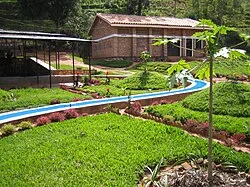
The article's first market breakthrough came quickly. PEARL brought in a specialty coffee expert who connected Abahuzamugambi with Community Coffee, a Louisiana-based roaster. 2 In June 2002, a Community Coffee representative visited Maraba while Rwandan President Paul Kagame was personally present, a detail that shows how closely the government watched the project. 2 Community Coffee bought 18,000 kilograms of Maraba beans at US$3 per kilogram, and the article identifies that deal as the first direct contract between an American roaster and an African coffee cooperative. 2
The British route opened through Comic Relief, the UK charity associated with Red Nose Day. 2 Comic Relief became involved after learning that many Maraba smallholders belonged to AVEGA, an association for widows of the genocide. 2 Comic Relief contacted Union Coffee Roasters, a UK roaster, and representatives from Union Coffee Roasters and Fairtrade Labelling Organisations visited Maraba in 2002. 2 Maraba then became the first Rwandan cooperative to gain Fairtrade status. 2
The supermarket moment was almost cinematic. Union Coffee Roasters bought the remaining 2002 harvest and distributed it in early 2003 through all 350 Sainsbury's stores for Red Nose Day. 2 The roaster described the coffee as having "sparkling citrus flavours complemented by deep, sweet chocolate notes." 2
The money changed the cooperative's options. In 2003, Abahuzamugambi made US$35,000 in net profits, and 70 percent was divided among farmers at US$0.75 per kilogram. 2 The article says that rate was more than three times what other Rwandan growers received, and it was enough for health care and education that had previously been unaffordable. 2 The remaining 30 percent was reinvested, including in agricultural lime to reduce soil acidity. 2
By 2003, PEARL considered the operation self-sufficient and reduced financial support. 2 A cooperative bank opened in March 2003, which let farmers manage funds locally rather than travel to Butare. 2 More washing stations followed at Kabuye in 2004, Sovu in 2005, and Kibingo in 2007. 2
The article then takes an unexpected detour into beer. In late 2004, Meantime Brewing of London began offering a coffee beer made from Maraba beans. 2 The beer was originally 4 percent alcohol, had the same caffeine content as coffee, and was intended as an alcoholic iced cappuccino or digestif. 2 The article says Meantime Coffee Porter was the only coffee beer available in the British Isles at launch, and it won the gold medal for coffee-flavoured beer at the 2006 World Beer Cup. 2
The awards story returned to coffee itself in 2008, when Rwanda became the first African country to host a Cup of Excellence competition. 2 The event was held at Maraba's laboratory in Kizi, and coffees from 24 farms received Cup of Excellence awards. 2 Three of those farms belonged to the Maraba cooperative. 2
Rwanda hosted the competition again every year from 2010 to 2015 and again in 2018. 2 Abahuzamugambi ba Kawa farms were among the winners every time the competition was held in Rwanda during that span. 2 By the cooperative's tenth anniversary in 2012, it had 1,400 growers and assets of 250 million Rwandan francs, roughly US$400,000. 2
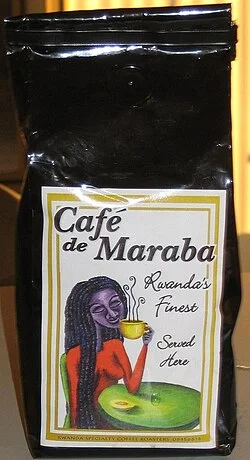
The article's present-day endpoint is no longer a rescue story. By 2026, the cooperative produced about 115,200 to 192,000 kilograms of green coffee a year, and the coffee was Fairtrade and organic certified. 2 Its buyers and products included Union Coffee's Maraba Bourbon coffee, Community Coffee blends, Rwanda Roasters' Café de Maraba, Meantime's coffee beer, and Intelligentsia blends. 2
Why the washing station mattered
The most useful part of the article is its explanation of how a coffee cherry becomes export coffee. The production cycle makes the economics feel less magical. The farmers did not simply "find a market." They changed what happened to the fruit during the hours after picking.
The main harvest falls during the March to May rainy season, and farmers hand-pick cherries through the day. 2 In the evening, farmers carry the cherries in traditional banana-leaf baskets to washing stations, sometimes after several hours on foot. 2 Technicians then hand-select deep red cherries and return rejects to growers for sale at lower prices on the domestic market. 2
The clock matters because the sugary outer coating must be removed within 12 hours of picking, or fermentation damages the flavour. 2 The best cherries sink in a density tank and go to a de-skinning machine, while floating cherries are processed separately for the domestic market. 2 A vibrating colander separates Grade A beans from Grade B beans, and a water chute with about 15 capture tanks sorts the beans further. 2
The best beans ferment under water for two days, while lesser beans ferment for 15 to 20 hours. 2 Workers then rinse the beans, dry them first on shaded racks and then in the sun for up to two weeks, and reduce their water content from 40 percent to 12 percent. 2 Machines at the Kizi technical centre remove the parchment layer, and experienced women complete the final hand sorting before the beans are bagged and labelled by quality. 2
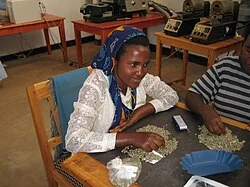
This section is where the article earns its specificity. A reader can see why the first Cyarumbo station mattered so much. The station was not a symbolic development project. It was the place where timing, water, labour, sorting, fermentation, and buyer standards met.
The details that make the article stick
The first detail is the cooperative's name. "People who work together to achieve a goal" could sound like a slogan, but the article gives it weight by placing it beside the 1994 genocide, the imprisoned husbands awaiting gacaca trials, and the shared need for cash income. 2 The name works because the article has already shown what the goal cost.
The second detail is the price jump. A crop that had drawn US$0.33 per kilogram before 1999 reached US$3 per kilogram in Community Coffee's 2002 purchase. 2 The cooperative's 2003 farmer payment of US$0.75 per kilogram was still far below the roaster contract price, but the article says it was more than three times what other Rwandan growers received. 2
The third detail is President Kagame's presence during the Community Coffee visit. 2 The article does not need to add a speech about national recovery. A sitting president attending a coffee-buyer visit says enough about how much the project meant to Rwanda's post-genocide economic story.
The fourth detail is the coffee beer. Meantime's brewer chose Maraba after tasting coffees from around the world because he found vanilla and chocolate hints more suitable than nuttier or more bitter South American coffees. 2 The beer later lost Fairtrade status after its alcohol content was raised to 6 percent, which reduced the coffee proportion, but it still used Maraba beans. 2 That odd afterlife gives the article a second market story: the same beans that entered Sainsbury's as ethical coffee also entered pubs as a specialty drink.
The fifth detail is the Cup of Excellence record. Rwanda was the first African host country in 2008, and Maraba farms kept appearing among the winners whenever the competition returned to Rwanda through 2018. 2 The repetition matters. The article is not describing a one-season charity success. It is describing a cooperative that learned how to compete on quality.
The lines worth keeping
The strongest phrase is the translation of Abahuzamugambi: "people who work together to achieve a goal." 2 It gives the whole article a plain title sentence hiding inside the subject.
Union Coffee Roasters' tasting note is the article's best sensory line: "sparkling citrus flavours complemented by deep, sweet chocolate notes." 2 The phrase matters because the article has already explained the infrastructure behind that taste. The citrus and chocolate notes are not decorative language. They are the market's way of rewarding better picking, washing, drying, and sorting.
Meantime's description of its coffee beer as having a "silky, velvety character" gives the article its strangest texture. 2 It is hard to imagine that phrase near the opening image of farmers stuck at US$0.33 per kilogram. That distance is the point. The article's arc runs from an undervalued hillside crop to a beer style judged on mouthfeel at the World Beer Cup.
What to remember
Maraba coffee is a strong Featured Article because it never lets the product float away from the system that made it possible. The coffee is grown on volcanic highlands, but the story depends just as much on a cooperative, a washing station, a water pipeline, quality sorting, foreign buyers, Fairtrade certification, and repeated competition results. 2
The article also avoids the easy version of a development story. Maraba's rise was not only a matter of good intentions. It required a better process for cherries, a direct contract with a roaster, supermarket distribution, reinvestment, local banking, and years of quality control. 2
The coffee that began below Grade C became a product with buyers in the United Kingdom, the United States, and Rwanda, plus a beer that won World Beer Cup gold. 2 That is why the article stays with you. It makes one cup of coffee carry a whole chain of decisions.
Wikipedia's July 14, 2026 Featured Article is Maraba coffee, selected through Wikipedia's editor-curated Featured Article process. 1
Cover image: Bag of Maraba coffee, shown in Wikipedia's Maraba coffee article.
相似内容
- 登录后可发表评论。