The bank that put its vault in the window
A deep read of Wikipedia’s July 13, 2026 Featured Article on the Manufacturers Trust Company Building: a modernist experiment in visible trust, glass walls, a street-level vault, and a later preservation fight.

Wikipedia's Featured Article for July 13, 2026 is Manufacturers Trust Company Building, the story of a glass-walled bank at 510 Fifth Avenue in Midtown Manhattan. 1 2
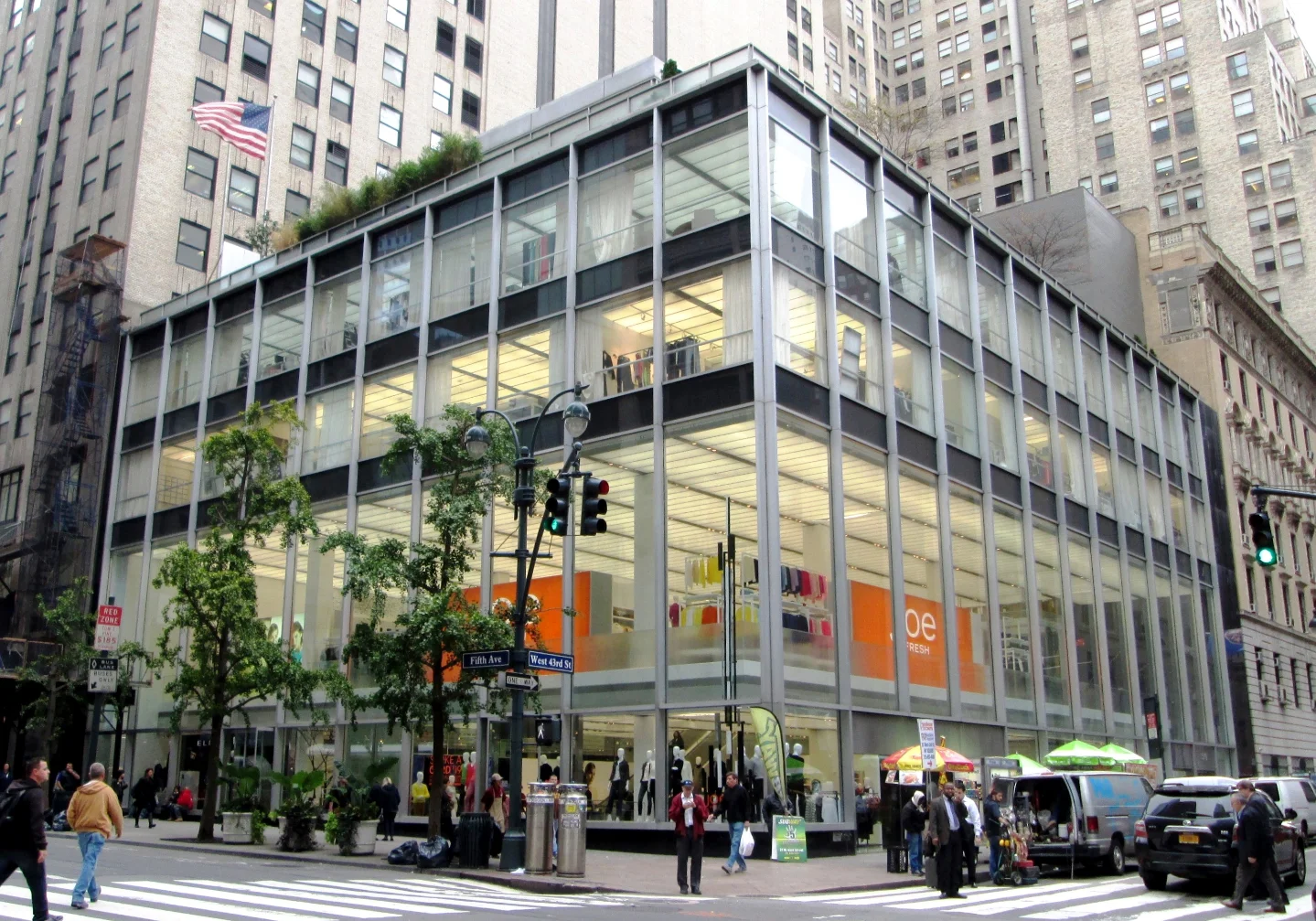
The subject sounds narrow: one low building, one corner, one former bank. The article turns that corner into a small history of American confidence. When the Manufacturers Trust Company Building opened on October 5, 1954, it offered a public version of banking that had almost nothing to do with marble columns or guarded darkness. 2 The bank put glass, light, art, escalators, and a 30-ton vault door where pedestrians could see them. 2
That is the article's real hook. The building did not hide trust in a basement. It staged trust in the window.
The full article in one read
The Manufacturers Trust Company Building, also known as 510 Fifth Avenue, stands at the southwest corner of Fifth Avenue and West 43rd Street. 2 It was designed by Charles Evans Hughes III and Gordon Bunshaft of Skidmore, Owings & Merrill, the architecture firm usually abbreviated as SOM. 2 Eleanor H. Le Maire designed the interior, and the artist Harry Bertoia made two major sculptural works for the space. 2
The building was modest in height but aggressive in argument. It had four full stories, a penthouse, one basement, and a height of 74 feet including the penthouse roof. 2 Its floor area was about 65,000 to 70,000 square feet. 2 Wikipedia's article identifies it as the first bank building in the United States built in the International Style, the modernist vocabulary of glass, steel, open plans, and stripped ornament. 2
That first matters because banks had long sold permanence through weight. They leaned on stone, columns, high counters, and sealed rooms. Manufacturers Trust chose the opposite pose. Its glass curtain wall covered about 13,000 square feet and was held by horizontal rails and vertical aluminum mullions. 2 The second-floor panes measured 9 feet 8 inches by 22 feet, weighed 1,500 pounds each, and were described in the article as the largest ever constructed for a building at the time. 2
The glass was also practical. A thin gold layer reduced glare, and black granite strips formed the building's pedestal. 2 The mullions projected 10 inches from the glass, and the joints were left exposed rather than hidden by decorative molding. 2 The result was a bank whose structure read less like a fortress than like a display case.
A constraint helped create the effect. Walter J. Salmon Sr.'s air-rights lease for the neighboring 500 Fifth Avenue limited the Manufacturers Trust site to 63 feet, which kept the building low among taller Midtown neighbors. 2 Lewis Mumford, the architecture critic, compared the building to a lantern; Horace C. Flanigan, Manufacturers Trust's president, said the design was meant to convey "a sense of stability and security" through modern materials. 2 Those two readings fit together. The building tried to make security bright.
The vault was the advertisement
The article's most memorable object is not the facade. It is the vault door. Henry Dreyfuss of the Mosler Safe Company designed a circular steel door 7 feet across, 16 inches thick, and 30 short tons in weight. 2 The vault sat on the first floor, where people on Fifth Avenue could see it through the glass wall. 2
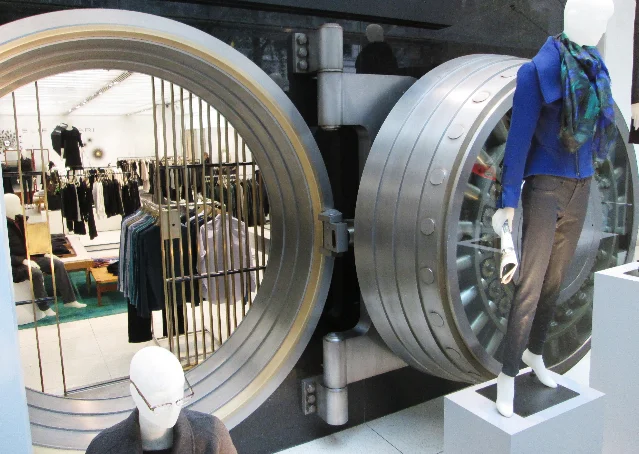
The decision reversed the usual logic of bank architecture. Vaults traditionally belonged below ground, invisible and implied. Manufacturers Trust made the vault a street-level object. Architectural Record wrote that the door could "be swung by one finger" because its bolt wheel and hinge were "so delicately balanced." 2 Behind it was a steel grille and a vault measuring 60 feet by 20 feet, with 6,000 safe deposit boxes. 2
The article is careful about motive. SOM's architects said the visible vault was an aesthetic choice rather than a security measure. 2 The public meaning was still hard to miss. If older banks said, "Your money is safe because you cannot see where it goes," this one said, "Your money is safe because we can show you the door."
The detail also had an afterlife. The article says the exposed vault helped deter theft and that later banks copied the practice. 2 During the building's conversion to retail, the vault walls were removed, but the door remained. 2 It later became a backdrop for clothing displays, which is both funny and exact: the building's most theatrical bank object survived because it could become theater for something else.
The interior made money feel airborne
The building's interior carried the same argument as the glass. Eight columns clad in white Vermont marble stood 11 feet behind Fifth Avenue, leaving the street edge open and legible. 2 A freestanding pair of escalators ran parallel to Fifth Avenue, with backlit aluminum panels in a straw-gold finish. 2
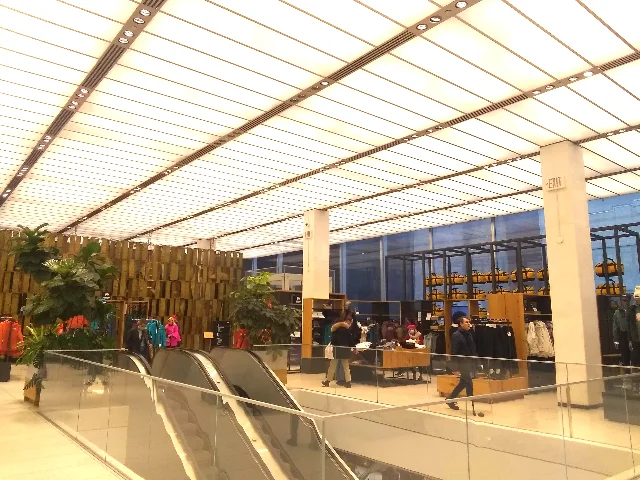
The ceiling did more than brighten the room. The second floor used cathode-ray tubes behind vinyl dropped ceilings, a system meant to reduce reflection from the enormous windows. 2 Light was part of the building's mechanics and part of its message.
Bertoia's work gave the room its most delicate drama. He created an unnamed cloud-like sculpture suspended by wires above the escalators. 2 He also made "Golden Arbor," a floating second-floor screen 70 feet long and 16 feet tall, weighing 5.25 short tons and made of about 800 intersecting brass, copper, and nickel panels. 2
The reviews were not all reverent. One reviewer called the cloud sculpture "breath-taking," while others compared it to a "flying bedspring" and "broken egg crates." 2 That split is useful because it keeps the building from becoming a frozen icon. In 1954, this was strange commercial space. Some people saw liberation. Some people saw hardware in the air.
The bank worked, then the bank disappeared
The opening was a public event. The building had a media preview on September 22, 1954, then officially opened on October 5 with 15,000 visitors on its first day. 2 Manufacturers Trust's deposits tripled within nine months, and the branch produced the most new accounts of any Manufacturers Trust branch in a single year. 2 The wider bank reported a 31 percent increase in account holders and a 200 percent increase in profits. 2
Those numbers make the architecture harder to dismiss as style alone. The building sold a public feeling of modern finance, and customers came through the doors. By 1960, it had recorded 100,000 visitors, excluding clients, with an average of 400 visitors a month. 2
Then the institution changed names around the building. Manufacturers Trust merged with Central Hanover Bank & Trust in 1961 to form Manufacturers Hanover Corporation. 2 Manufacturers Hanover merged with Chemical Bank in 1991, and Chemical Bank merged into Chase Bank in 1996. 2 The New York City Landmarks Preservation Commission, the city agency that designates protected landmarks, gave the exterior landmark status in 1997 after earlier failed attempts. 2
The ownership chain also moved. Chase sold the building to Tahl-Propp Equities for $24 million in 2000 while keeping air rights and a branch tenancy. 2 Vornado Realty Trust bought the building for $57 million in 2010, and the Chase branch closed the same year. 2 When Chase removed Bertoia's artworks after the closure, preservationists reacted sharply. 2
The fight that followed is one of the article's strongest sections because it tests the building's original idea. Vornado hired SOM, the same firm behind the 1950s design, to renovate the building for retail. 2 The plan included new Fifth Avenue entrances, rotated escalators, and a reduced vault wall. 2 Joe Fresh signed a retail lease in January 2011. 2
The Landmarks Preservation Commission designated the first- and second-story interior as a landmark on February 15, 2011, partly in response to the removal of the Bertoia pieces. 2 Preservationists sued, and the New York Supreme Court issued a temporary restraining order in July 2011 that later became an injunction. 2 The World Monuments Fund added the building to its 2012 watch list of endangered buildings. 2
Ada Louise Huxtable, writing in The Wall Street Journal, called the renovation a "travesty" and a "conversion to generic commercial space." 2 The legal settlement in February 2012 brought the Bertoia works back for public display, restored the interior with glass partitions, relocated the escalators, removed the vault walls, replaced the luminous ceiling with a replica, and restored the facade and columns. 2 The renovation was completed by the end of 2012 and later won design awards from AIA New York and Architectural Record. 2
Retail then took over the plot. Joe Fresh opened a 14,000-square-foot store in 2012 and closed in March 2016. 2 The North Face opened a flagship store in October 2016, subleasing 20,000 square feet across the basement, first floor, and second floor. 2 The Reuben Brothers acquired the building for $50 million in August 2023, The North Face closed after its lease expired in 2025, and Uniqlo opened its Bryant Park flagship at 510 Fifth Avenue in March 2026. 2
The Uniqlo fact completes the odd arc. A bank once used retail visibility to sell safety. Retail now uses the remains of that bank to sell clothes.
The details that make the article stick
The first detail is the old plan that did not happen. Manufacturers Trust first moved toward the site in the 1940s, and Walker & Gillette designed a four-story Federal Classic-style bank at an estimated cost of $850,000 to $1.2 million. 2 That proposal was canceled in 1948 after difficulty clearing the site, and Korean War material restrictions delayed a later Walker & Poor revision. 2 The glass bank was not inevitable. It emerged after failed conventional plans.
The second detail is SOM's internal competition. Charles Evans Hughes III won with a design that used glass walls and a visible vault, and Bunshaft then revised the design. 2 That origin matters because the vault was not an accessory added after the serious architecture was done. The vault was central to the idea from the competition stage.
The third detail is how quickly the building became a model. Its success led Manufacturers Trust to retrofit other branches with modern designs, and by the 1960s many American banks had adopted the International Style. 2 The article links that spread to other examples, including Emigrant Bank's 42nd Street branch and Chase Bank at 28 Liberty Street. 2
The fourth detail is the language later critics used to remember it. The 2010 edition of AIA Guide to New York City called the building "a glass-sheathed supermarket of dollars" and said it "led the banking profession out of the cellar and onto the street." 2 The World Monuments Fund called the glass design a "metaphor for honesty and transparency in banking" and a "symbol of a self-confident era." 2 Those phrases are memorable because they do not treat the building as a pretty box. They treat it as an argument about public trust.
The fifth detail is Wikipedia's own structure. The article moves from site to architecture, then from planning and bank use to commercial use, preservation disputes, awards, and impact. 2 That order lets a reader see the building three times: first as an object, then as a working bank, then as a contested landmark after its original function disappeared.
The lines worth keeping
Flanigan's phrase, "a sense of stability and security," is the cleanest statement of the bank's ambition. 2 It is also a useful reminder that modernism did not always sell itself as rebellion. In this case, glass and aluminum were supposed to reassure people.
Architectural Record's line that the vault door could "be swung by one finger" gives the article its best physical surprise. 2 A 30-ton door should feel immovable. The article's detail makes it feel almost graceful.
The AIA Guide's phrase, "led the banking profession out of the cellar and onto the street," is the strongest summary of the building's influence. 2 It catches the literal movement of the vault and the broader cultural movement toward transparent commercial space.
Huxtable's "travesty" lands because the article has already shown what preservationists feared losing. 2 If the building's meaning came from the unity of glass, vault, art, light, and public access, then a retail conversion could not be judged only by whether the exterior still looked familiar.
What to remember
Manufacturers Trust Company Building is a good Featured Article because it makes a single address feel like a living argument. The building began as a bank that rejected the old architecture of secrecy. It became a commercial success, a copied model, a landmark, a lawsuit, and finally a retail shell that still carries the signs of its banking past.
The article's deepest subject is visibility. The glass showed the people. The vault showed the money. The art showed that a bank could present itself as modern culture as well as financial machinery. When the banking function left, those visible pieces became the parts worth fighting over.
Today's selection is Wikipedia's Featured Article for July 13, 2026: Manufacturers Trust Company Building, selected through Wikipedia's editor-curated Featured Article process. 1
Cover image: Manufacturers Trust Company Building exterior, shown in Wikipedia's Manufacturers Trust Company Building article.
関連コンテンツ
- ログインするとコメントできます。
このチャンネルのその他のコンテンツ
- The object we learned to see by what it hides
- The billion-dollar Holden that had to be three cars at once
- The mind that edits reality before you notice
- The coffee that climbed out of Grade C
- Liverpool had to survive itself
- The king hidden in the charters
- The thing at the edge of life
- The princess history tried to erase