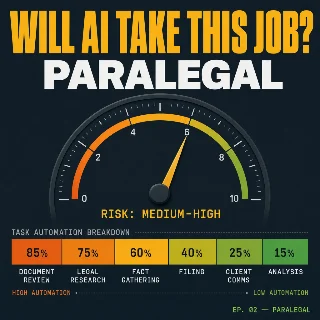
A task-by-task breakdown of the paralegal occupation — what AI tools can already do, where human judgment still dominates, what the actual employment numbers say, and a realistic 3-10 year verdict.
The BLS just published zero percent employment growth for paralegals through 2034 — and explicitly attributed it to AI. Not a crash, but a suppression. The profession that handles document drafting, legal research, and client coordination faces productivity tools that can already do the bulk of its most billable work. So what actually happens to 376,000 jobs?
Key findings:
The Clio 2024 Legal Trends Report: 69% of paralegal hours could be automated with current tools — but automatable is not the same as automated
BLS (Feb 2025): among all legal occupations, paralegals face the strongest employment impact from GenAI productivity gains; projected growth of 1.2% vs. 4.0% average
Document review and legal research are heavily exposed; contract review AI (Kira, Harvey, CoCounsel) and research tools (Westlaw AI, Lexis Plus AI) are deployed and working now
Legal secretaries are projected to decline; paralegals are not — the BLS is already distinguishing roles that mix transactional work with substantive judgment
Four real barriers to substitution: professional liability rules, hallucination risk in legal settings, client trust in high-stakes matters, and implicit jurisdiction-specific expertise
The squeeze is also coming from above: junior associates are losing billable work to AI first, compressing the pipeline that feeds paralegal demand at the entry level
Eloundou et al. (2023): legal occupations have roughly 44% task exposure to LLMs — high, but not total, and the residual is the judgment-heavy work
Verdict: The job survives. The shape of it changes. Less drafting and research, more review, judgment, client work, and specialized domain expertise. The version of the paralegal role that holds its value in 10 years looks different from the one most people are doing today.
Chapters
0:08 — Opening: the zero-percent projection
1:32 — The job and its task structure
2:30 — AI capability by task (documents, research, investigation, coordination, client comms, analysis)
7:00 — The employment signal: BLS numbers, the secretary/paralegal split, the squeeze from above
9:31 — What is protecting the job: liability, hallucination risk, client trust, implicit domain knowledge