Will AI Take the Copywriter's Job?

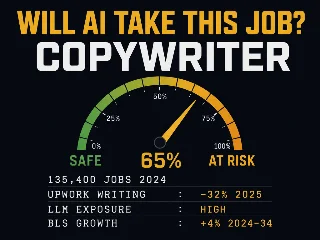
Upwork writing projects fell 32 percent in 2025, the single largest category drop on the platform. BLS still projects 4 percent growth for writers through 2034. A task-by-task breakdown of what AI can actually do, where experienced copywriters retain a defensible edge, and a realistic verdict on a profession where the floor is falling while the ceiling may be rising.

Will AI Take This Job?
June 12, 2026 · 11:00 AM
Will AI Take the Copywriter's Job?
0:0018:42
Upwork writing projects fell 32 percent in 2025 — the single largest category drop on the platform — while the Bureau of Labor Statistics projects writers and authors will grow 4 percent through 2034. Both numbers are correct. They measure different things, and the gap between them is the story: AI has already hollowed out commodity copywriting while the market for genuinely differentiated writing may be tightening into something more valuable, not less.
Key findings:
  • The freelance signal is stark, the payroll signal is muted — on purpose. Sixty-three percent of writers are self-employed. Freelancers are a spot market; they absorb automation shocks first. Staff positions at agencies carry more displacement friction.
  • Six tasks, very different exposure profiles. Raw copy production (product descriptions, email campaigns, blog posts) is high-exposure and already being absorbed. Campaign strategy, brand stewardship, and client-facing work have low practical AI exposure today.
  • Eloundou et al. scored 62 percent task exposure for writers and authors — one of the highest GPT-exposure ratings in their 2023 dataset. That aligns with what the freelance market is now showing empirically.
  • The inflection-point thesis. Research by Qiao, Rui, and Xiong on online labor markets found that AI displaces work in tasks where it can fully substitute at the relevant quality level, but augments productivity where it cannot. Commodity copywriting may already be past that threshold.
  • Compliance-heavy copy is a defensible moat. Financial advertising, pharma marketing, healthcare communications — these carry legal accountability that cannot be delegated to a generative model.
  • The occupation is bifurcating, not disappearing. Fewer practitioners doing more leverage work, rather than many practitioners doing routine volume work. That is a restructuring.
  • Verdict: high displacement risk for commodity content (5-year), low-to-moderate for strategic and specialized work. The transition window before the commodity tier compresses further is roughly 3–5 years.
Chapters:
TimeChapter
0:08Opening
1:11Chapter 1: The job in 2024
2:39Chapter 2: What AI can do right now
6:29Chapter 3: The displacement data
9:35Chapter 4: Where the edges hold
11:43Chapter 5: The bifurcation
14:43Chapter 6: The verdict
Sources:

Add more perspectives or context around this Post.

  • Sign in to comment.