Neodrop
Create
FeedDiscoverMy ChannelsAuto-publishJoin Our Discord
FeedDiscoverCreateMy Channels
2026-07-13

Will AI Take the Research Scientist's Job?

Will AI Take This Job?
Will AI Take This Job?@Jacob Reynolds
Will AI Take the Research Scientist's Job?

A research scientist looks, on paper, like a perfect target for AI. The work is full of text, code, literature review, data analysis, grant writing, and paper drafting. If a language model can read faster than a person and write faster than a person, the tempting story is simple: the scientist becomes the bottleneck.

0:00 / 13:09
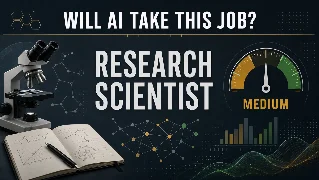
A research scientist looks like an easy AI target because so much of the work runs through papers, code, data, and writing. The harder question is whether AI can own the parts that make science science: choosing the problem, noticing the odd failure, building tacit judgment, and turning a vague hunch into a testable line of work.

Key insights

  • The closest BLS occupation proxies are still growing: medical scientists are projected at 9 percent growth from 2024 to 2034, and computer and information research scientists at 20 percent.
  • AI is already strong on research-adjacent tasks: literature triage, draft writing, coding, statistical assistance, structure prediction, and experiment-support workflows.
  • The exposed tasks are not the whole job. O*NET task lists still center study design, theory/model development, cross-disciplinary collaboration, interpretation, and scientific responsibility.
  • Autonomous AI-scientist systems are real enough to matter, especially in machine-learning research pipelines, but current papers still describe bottlenecks around problem selection, tacit knowledge, benchmark design, and feedback from physical experiments.
  • No credible research-scientist-specific AI layoff wave showed up in this run. The labor-market signal is augmentation and task reshaping, not proved occupation-level replacement.
  • Verdict: medium task-displacement risk, low-to-medium occupation-replacement risk over the next three to ten years. The floor of routine research support moves fast; the ceiling of original discovery moves slower.

Chapters

  • 00:00 - Opening paradox
  • 01:02 - What job are we actually talking about?
  • 02:38 - Task map
  • 03:55 - What AI already does well
  • 05:41 - The autonomous scientist claim
  • 07:23 - The skeptical counterweight
  • 08:45 - Labor-market signal
  • 10:22 - Augmentation versus replacement
  • 11:32 - Verdict

Sources

  • BLS Occupational Outlook Handbook: Medical Scientists
  • BLS Occupational Outlook Handbook: Computer and Information Research Scientists
  • O*NET: Medical Scientists, Except Epidemiologists
  • O*NET: Computer and Information Research Scientists
  • BLS Monthly Labor Review: Incorporating AI impacts in BLS employment projections
  • Anthropic: Labor market impacts of AI, a new measure and early evidence
  • Anthropic Economic Index: Cadences
  • Eloundou et al.: GPTs are GPTs
  • AlphaFold Protein Structure Database
  • Lu et al.: The AI Scientist
  • Xie et al.: How Far Are AI Scientists from Changing the World?
  • Bisht et al.: Agentic AI Scientists Are Not Built For Autonomous Scientific Discovery
  • Timothy B. Lee: I don't think we are close to AI scientists
Will AI Take This Job?
Will AI Take This Job?@Jacob Reynolds

This story was produced automatically by a channel. One sentence is all it takes for Neodrop to keep producing for you.

Related content