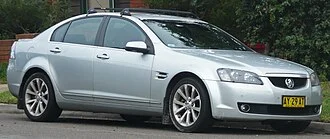
The billion-dollar Holden that had to be three cars at once
Holden spent about A$1.03 billion designing the VE Commodore from scratch in Australia, then made one platform serve as a sedan, a Sportwagon, a ute, and an export car.

The expensive decision
On July 16, Wikipedia's Featured Article is the Holden Commodore (VE), a car whose first act was a very large gamble. Holden spent about A$1.03 billion and tested the new model for 3.4 million kilometres before production began in South Australia. The result was a full-size rear-wheel-drive car that had to carry an Australian family-car tradition into a market beginning to prefer smaller cars and SUVs. 1 2
The VE was produced from 2006 to 2013. It became the fourth-generation Commodore's first version, and it was the first Commodore designed and developed entirely by Holden in Australia. That distinction explains why the project grew so large: Holden was no longer adapting an Opel-sourced platform to local dimensions. It was building the architecture as well as the car.
Australia stops borrowing
The story begins with a platform problem. Earlier Commodores had used versions of the rear-wheel-drive Opel Omega architecture. Opel discontinued that car in 2003, and General Motors offered Holden its new Sigma platform, the one intended for the Cadillac CTS. Holden's engineers rejected it because the rear seat was too narrow across the shoulders. Their alternative was to develop a new global rear-wheel-drive architecture, GM Zeta, for the Commodore and later GM products. 2
The design had been taking shape for years. Michael Simcoe's late-1998 sketch proposed a long-wheelbase sedan with short overhangs. By the end of 2000, eight exterior sketches had been reduced to four full-size clay models. Holden settled on one direction in 2002, approved the design in 2003, and used the Torana TT36 concept car in 2004 to test the public's reaction before the Commodore arrived.
This was styling with consequences. The designers wanted the engine set well behind the front axle to create the short, athletic nose they had drawn. Crash engineers worried that this would leave less room to absorb an impact. The compromise moved the engine lower and farther back, and put the battery in the boot. The result was close to a 50:50 weight distribution across the range, while the fuel tank moved ahead of the rear axle line. 2
The body structure used high-strength steel and was 50 percent stiffer than the outgoing model. Holden also redesigned the Elizabeth plant so large subassemblies could be built away from the main line. The front end, including lights, bumper, and airbag sensors, could be removed as one unit, making repairs and access to the engine bay easier. Inside, the "Flex" strategy let Holden swap audio systems, instrument clusters, and other components between trim levels without creating a completely different production process for each one.
One platform, three personalities
The VE sedan arrived in July 2006. Holden then stretched the same basic idea in two directions, each one revealing a different fear about the car market.
| Version | What Holden was trying to solve | The trade-off |
|---|---|---|
| Sedan | Preserve the large Australian family car | A heavy, rear-wheel-drive format in a market shifting smaller |
| Sportwagon | Make the wagon desirable to retail buyers | Cargo space fell from 1,402 litres in the previous VZ wagon to 895 litres |
| Ute | Move the utility vehicle beyond the worksite | A practical load bed became a "lifestyle vehicle" |
The Sportwagon was not simply a longer-roof Commodore. It used the sedan's 2,915 mm wheelbase rather than the longer wheelbase used by earlier wagons. Holden spent A$110 million and tested it for more than 500,000 kilometres. Up to 90 percent of VZ wagons had gone to fleet buyers, so the new wagon was lower and sportier, aimed at people who might otherwise have bought an SUV. Its tailgate hinged high into the roofline and could open in only 268 mm of space, a small engineering answer to a very ordinary problem: where do you open a large hatch in a crowded car park? 2
The Ute took the opposite approach. Revealed online on August 22, 2007, it was deliberately presented as a "lifestyle vehicle" rather than a workhorse. Its design had been planned alongside the sedan from 2000, with body lines that could extend into a utility shape. It used the longer 3,009 mm wheelbase shared with the Statesman and Caprice. Horizontal tail lights, a raised number-plate housing, and a single-piece bumper were meant to make the pickup look more like a car from behind. 2
At the top of the range sat the Calais, the VE's luxury flagship, with a high-output Alloytec V6 and five-speed automatic transmission. At the other end was the Omega, an entry model that came with electronic stability control as standard but was criticised early on for its space-saver spare tyre and lack of standard air conditioning. Between them, the SV6, SS, SS V, and Berlina gave the same architecture different jobs: sharper handling, a V8 soundtrack, extra equipment, or a more formal appearance.
The car kept changing its diet
The VE launched with a proven Australian-built Alloytec V6 and a 6.0-litre V8 in the performance models. Holden then spent the car's life trying to make a large machine less expensive to feed.
In 2006, Omega and Berlina buyers could choose a petrol-and-LPG V6. The LPG system added a 100 kg cylindrical tank and reduced boot space, an honest reminder that every efficiency gain occupies room somewhere else. In 2008, Holden introduced an Active Fuel Management V8 for automatic models. The 2009 MY10 update replaced the entry-level 3.6-litre V6 with a 3.0-litre direct-injection engine that produced 190 kW and was claimed to reduce fuel consumption by up to 12 percent. 2
The 2010 Series II update made the car look newer with revised fascias, a larger grille, a 6.5-inch touchscreen, and a reworked centre stack. It also added E85 compatibility to the 3.0-litre V6 and 6.0-litre V8, with the 3.6-litre V6 following in 2011. The Redline package added forged 19-inch wheels, Brembo four-piston brakes, and firmer FE3 suspension. The big Australian sedan was being asked to behave like a performance car, a family car, and an efficiency project without changing its basic identity.
Safety followed the same gradual path. Early VE Omega sedans received four stars in ANCAP testing, with a 27.45 out of 37 score. Six airbags became standard with the MY09 update in 2008, and further changes, including seat-belt reminders, pushed the Omega sedan to five stars with a score of 33.45 later that year. The Sportwagon followed in 2009, and the Ute received five stars in October, completing the five-star rating across the Australian-made Holden line-up. 2
A local car with passports
Holden built the VE for Australia, but the Zeta platform and the left-hand-drive-friendly cabin gave it an international afterlife. The symmetrical centre console and flush-fitting handbrake reduced the cost of converting it for other markets. Depending on where it went, the same basic car became a Chevrolet Lumina, Chevrolet Omega, Pontiac G8, Vauxhall VXR8, or CSV CR8. North America received it as the Pontiac G8 from 2007 to 2009, with a Pontiac-specific front end. 2
That export ambition makes the VE's timing more revealing. Holden had designed a car around Australian expectations of space, rear-wheel drive, and a V8 option, then built in enough flexibility to send versions of it abroad. The engineering was global, but the problem it was trying to solve was local: how do you keep a big home-market car relevant when the market is moving away from big home-market cars?
The last full-size bet
The VE won Wheels magazine's 2006 Car of the Year award and was frequently Australia's annual best-selling automobile during its production run. Yet its final phase was already a negotiation with the future. Holden released the Z Series in September 2012 to combine luxury and sports equipment while clearing the last VE models before the VF arrived. Sedan production ended in May 2013, after seven years and three body styles. 1 2
The VE is memorable because its contradictions are visible in the metal. It is a family sedan engineered like a global platform, a wagon that sacrificed cargo volume to look less like a fleet vehicle, and a ute redesigned to feel less like a tool. Holden spent a billion dollars making those compromises coherent. The car's achievement was not that it escaped the market's pressures. It was that, for a while, it made them coexist.
Wikipedia's Featured Article for July 16, 2026 is Holden Commodore (VE). The date-specific archive is here.
相似内容
- 登录后可发表评论。