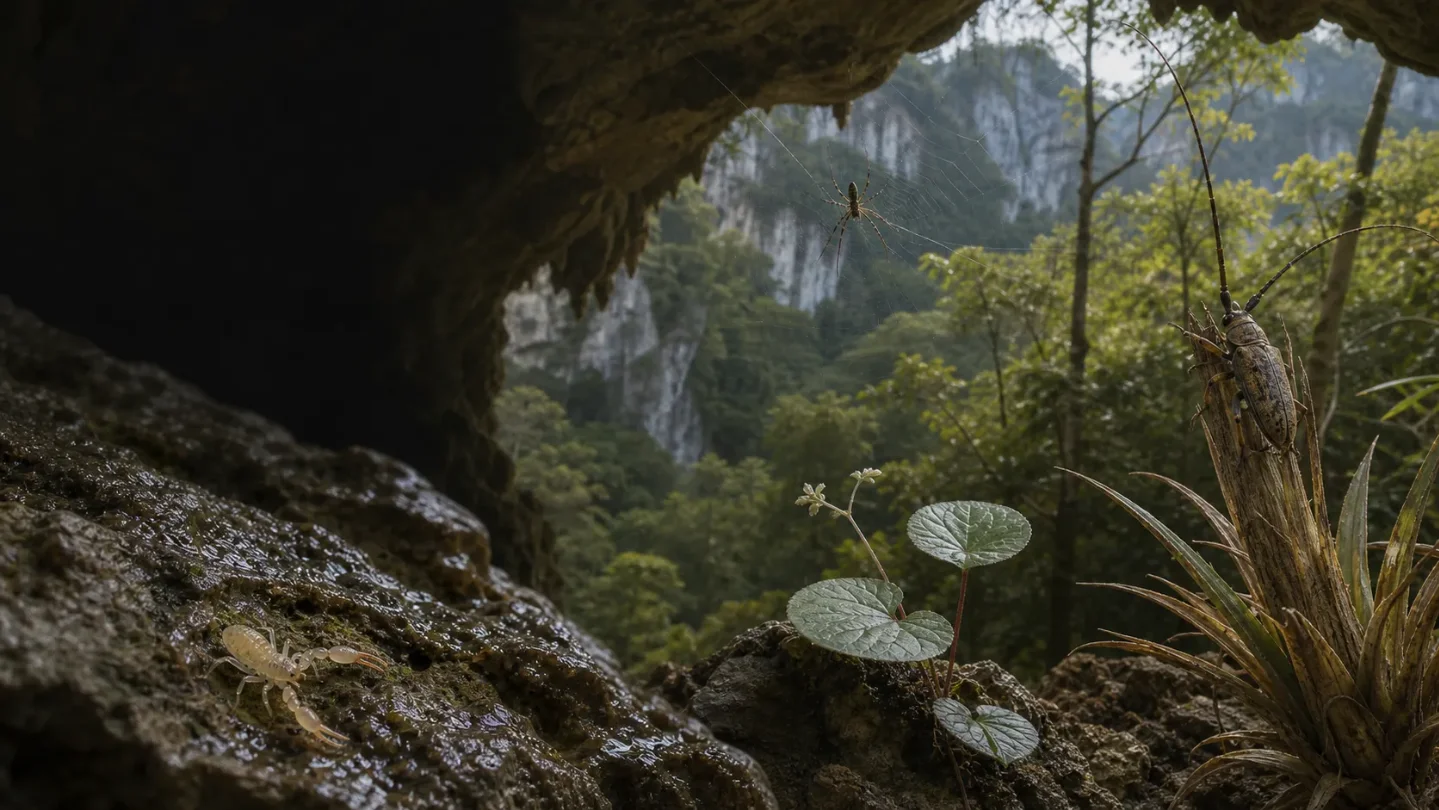
16 species named this week: cave pseudoscorpions, Yunnan spiders, and a frog-bladder ciliate
A representative July 17-24 digest of 16 formally published species, led by eight cave-restricted Brazilian pseudoscorpions and four Yunnan lace-sheet spiders, with two Chinese plant assessments and a frog-bladder ciliate.

Sixteen species from caves, mountains, wetlands, and one frog bladder
Sixteen species-level novelties in six papers fall inside the 17–24 July 2026 window. Eight are cave-restricted pseudoscorpions from Brazil, four are lace-sheet spiders from Yunnan, and the rest range from Brazilian scarab beetles and Chinese plants to a ciliate living in a frog's urinary bladder. This is a representative set of dated journal publications, not a claim that 16 was the worldwide total.
The week's clearest biological pattern is narrow distribution. Several names are tied to one cave, one karst outcrop, or one small population. That makes the distinction between a formal threat assessment and an absence of assessment especially important.
Eight cave-restricted pseudoscorpions from Bahia
The paper describes eight Pseudochthonius species from the Serra de Iuiú karst landscape in Bahia's São Francisco River basin. Their shared placement is Animalia > Arthropoda > Arachnida > Pseudoscorpiones > Chthoniidae > Pseudochthonius. Before these additions, the genus had 44 known species worldwide and 23 in Brazil; the paper places 18 Brazilian species in cave environments. Lucas Guimarães and Rodrigo L. Ferreira, of the Centro de Estudos em Biologia Subterranea, Departamento de Ecologia e Conservacao, Universidade Federal de Lavras, described all eight. 1
The authors do not assign an IUCN category to any of the eight. They do document threats around the cave systems, including pasture expansion, deforestation, charcoal production, sediment entering caves during rainy periods, reduced organic matter reaching underground habitats, and mining.
- Pseudochthonius celestialis sp. nov. was found in Toca Fria Cave and Urubu-Jatobá Cave in Iuiú, in humid, hidden parts away from the entrances. It differs from P. tuxeni by having eyespots, a more pronounced toothed epistome, a more slender chela, a longer movable chelal finger, and 32–34 teeth on that finger. The surrounding landscape has been heavily converted to pasture, which the authors identify as a potential threat; no formal conservation category was given.
- Pseudochthonius caritas sp. nov. is known from Tabocas Cave in Malhada, a winding cave about 1.2 km long. Its fixed chelal finger has 34–35 teeth, its ist–est / ist–esb ratio is 1.45, and its movable cheliceral finger has 14–15 teeth. It occurs in the cave's front section, with the cave interior described as well preserved, although some nearby land has been converted to pasture. No formal category was given.
- Pseudochthonius patientia sp. nov. also comes from Tabocas Cave, but from deeper habitat beyond a narrow section. It is separated from P. biseriatus by the toothed anterior margin, a single larger apical epistome projection, 14 teeth on the movable cheliceral finger, seven blades on the rallum, and male genital chaetotaxy. Its full cave distribution is unknown and no formal category was given.
- Pseudochthonius temperantia sp. nov. was collected deep inside Imbé Cave, a roughly 300 m cave with several entrances in the Serra de Iuiú limestone. It is closest to P. lubueno but differs in the anterior-margin dentition, the 13 / 17 fixed and movable cheliceral-finger tooth counts, and the male genital setae. Pasture conversion affects parts of the surrounding area; no formal category was given.
- Pseudochthonius diligentia sp. nov. is known from Olho d'Água do Aylton Cave, a short cave of about 40 m with an underground stream. The holotype came from a damp, elevated area deep inside the cave. It differs from P. biseriatus in having 15 teeth on the movable cheliceral finger, seven rallum blades, and a different setal pattern on coxae I–IV. The exterior is severely degraded and the species may be highly restricted; no formal category was given.
- Pseudochthonius castitas sp. nov. was found beneath rocks in the wet deep zone of Lapa do Baixão Cave, where seasonal groundwater fluctuations can flood passages. It is closest to P. aware but has a more rectangular carapace, a more curved movable chelal finger, a different start point for fixed-finger variation, and an ist–est / ist–esb ratio of 2.8. The paper gives no formal category.
- Pseudochthonius humilitas sp. nov. comes from Tapera d'Água Cave, where a subterranean stream raises the water level seasonally. It lacks eyespots, has a more pronounced epistome, and differs from P. gracilimanus and P. caritas in chelal teeth, chaetotaxy, galea, and male genital structures. The cave is described as being in good condition after earlier logging and water extraction ceased; no formal category was given.
- Pseudochthonius benignitas sp. nov. is known from the humid aphotic zone of Toca do Belarmino Cave in Iuiú. It has eyespots, an ist–est / ist–esb ratio of 0.6, and seven teeth on the fixed cheliceral finger, separating it from P. maquinensis and P. celestialis. Selective logging and exposed soil affect the surrounding landscape, while the paper calls mining a serious risk. No formal category was given.
Four lace-sheet spiders from Yunnan
The four new spiders belong to Animalia > Arthropoda > Arachnida > Araneae > Psechridae > Psechrus. The authors describe Psechrus as a tropical and subtropical Asian genus that builds broad, slightly domed sheet webs in shaded forest, rock crevices, roadsides, and sometimes buildings. Run Chen and Zi-Zhong Yang, both at the Yunnan Provincial Key Laboratory of Entomological Biopharmaceutical R & D, Dali University, described the species. The paper provides no IUCN or equivalent assessment, but identifies habitat loss and degradation from urbanization, forest fragmentation, and agricultural expansion as general threats. 2
- Psechrus mingshengi sp. nov. is distributed across Lüchun, Jinping, Yuanyang, and Shizong counties in Yunnan, with the holotype from a cemetery in Lüchun at 1,821.67 m. Its male palp has an ear-shaped anterior conductor projection, a broad flat embolus pressed against the conductor, and a straight sperm duct. Females have a nearly rectangular median septum, large transverse copulatory openings, a dorsal atrial chamber, and elongated spermathecal heads.
- Psechrus luopingensis sp. nov. comes from Jiulong Waterfall in Luoping County at 1,221 m, with additional material from Qiubei County. A conical projection on the male sperm duct and a large triangular projection at the embolus base separate it from close relatives. The female has a short, broad bottle-shaped median septum, copulatory ducts that do not turn backward, widely separated spermathecae, and heads arising near their mid-basal region.
- Psechrus cornutus sp. nov. was collected along the Xi-jing Line in Wuliangshan Town, Nanjian County, at 1,946.2 m, with another record from Chuxiong. Its male embolus base has a quadrangular posterior projection and a toothed projection behind it, while the conductor ends in one rounded tip. The female median septum is longer than wide and the anterior copulatory ducts are narrow and widely separated.
- Psechrus cordatus sp. nov. is known from Laifeng Mountain National Forest Park in Tengchong at 1,850 m and from two sites in Weishan County. The male embolus is heart-shaped, with trapezoidal and small conical projections at its base; the conductor wraps around the embolus tip. Females have nearly round spermathecae and small, nodular spermathecal heads.
Two long-antenna scarab beetles from Brazil
The two beetles sit in Animalia > Arthropoda > Insecta > Coleoptera > Melolonthidae > Dynastinae > Cyclocephalini > Cyclocephala. The genus has more than 350 valid species. Paulo R.M. Duarte, Paschoal C. Grossi, and Fernando Z. Vaz-de-Mello, from the Universidade Federal de Mato Grosso and Universidade Federal Rural de Pernambuco, described the pair. Neither paper treatment includes an IUCN or equivalent assessment. 3
Both species belong to the paper's "machadoi" group, whose most conspicuous shared character is a very long antennal club with dense sensory spots on the distal lamellae.
- Cyclocephala catimbauensis sp. nov. comes from Catimbau National Park, Buíque, Pernambuco, within the Caatinga biome. The type landscape has xerophilic vegetation, rocky outcrops, and sandstone walls. The pale brown beetle has a complete frontoclypeal suture, a three-toothed outer fore tibia with a strong basal tooth, and hook-shaped terminal lobes on the male parameres. It is known only from the type locality; no formal category was given.
- Cyclocephala nhumirim sp. nov. comes from Fazenda Nhumirim in the Pantanal da Nhecolândia subregion near Corumbá, Mato Grosso do Sul, a landscape of brackish lakes and grassland. The holotype is 7.7 mm long and 3.3 mm wide. It is almost entirely pale brown, has an antennal club about three times the head length, two slanting teeth on the outer fore tibia, and a hooked, downward-folded paramere tip. No formal category was given.
Two Chinese plants with different evidence for risk
Mitreola brachypoda
Mitreola brachypoda W.W. Pan, F.G. Deng & C. Xiong belongs to Plantae > Tracheophyta > Magnoliopsida > Gentianales > Loganiaceae > Mitreola. The authors are affiliated with Lishui Vocational & Technical College, South-Central Minzu University, Yunnan Xianghao Agricultural Technology, Guilin University of Technology, the Guangxi Institute of Botany and Chinese Academy of Sciences, and the Gesneriad Conservation Center of China at Guilin Botanical Garden. 4
The type locality is Kashang Village, Maguan County, Yunnan, in karst habitat at about 1,450 m; the material was collected on 8 March 2026. Compared with M. bullata, the new plant has a 0–5 mm petiole, obovate to spatulate leaves, a dense umbellate panicle, and a white or pale-purple bell-shaped corolla with a roughly 1 mm tube and 2.3–2.5 mm lobes. The genus contains about 22 species worldwide, 15 recorded in China, including 13 Chinese endemics, and is concentrated in limestone karst areas.
Only one population of about 30–40 mature individuals is confirmed at the type locality. The authors therefore provisionally assess it as Data Deficient (DD), not as secure and not as a formal IUCN Red List listing.
Campylotropis anningensis
Campylotropis anningensis L.S. Jiang, E.D. Liu & Bo Xu bis belongs to Plantae > Tracheophyta > Magnoliopsida > Fabales > Fabaceae > Campylotropis. The author group spans the Chengdu Institute of Biology and Kunming Institute of Botany of the Chinese Academy of Sciences, the University of Chinese Academy of Sciences, Xishuangbanna Tropical Botanical Garden, Southwest Forestry University, South China Botanical Garden, South China National Botanical Garden, and Ningbo Botanical Garden. 5
The type material was collected in grassland on hillsides in Xianjie Subdistrict, Anning City, Yunnan, at 2,035 m. The species has ascending white-pubescent branchlets; narrowly elliptic leaflets with appressed white-sericeous hairs underneath; axillary and terminal racemes with white-pubescent and glandular hairs; longer standards and wings; and obliquely ovate legumes densely covered in ascending hairs. Phylogenomic analysis based on 1,233 single-copy nuclear genes supports its separation from similar species.
The genus has about 40 species and 11 infraspecific taxa, with 35 species in China, 20 of them endemic. Field surveys found C. anningensis frequently along mountain ridges, forest margins, valleys, and slopes in Anning City, supporting an assessment of Least Concern (LC) under IUCN criteria.
A ciliate from a frog's urinary bladder
Trichodina pelophylacis sp. nov. belongs to Eukaryota > Ciliophora > Spirotrichea > Mobilida > Trichodinidae > Trichodina. Peter Vďačný, Ivan Rurik, and Tomáš Obert, all at the Department of Zoology, Comenius University in Bratislava, described it. 6
The type locality is a small pond Malé Rusovské jazero in Rusovce, Bratislava, Slovakia. The type host is the edible frog Pelophylax esculentus, and the ciliate lives in its urinary bladder. It measures 66–82 micrometres high in life, with an adhesive disc 36–47 micrometres across. Its denticle ring has 26–31 teeth, each with six to eight radial pins; the oral ciliary spiral extends about 405 degrees, and the macronucleus is C-shaped. Those micrometre-scale structures are the species' working field marks, even though they are far removed from the scale at which the frog is seen.
No conservation assessment is provided for the ciliate or its host association.
What the threat column can and cannot say
Only two selected species receive explicit category labels in the papers: Mitreola brachypoda is provisionally DD, based on a single known population of 30–40 mature plants, while Campylotropis anningensis is assessed as LC because field surveys found it repeatedly across Anning City. The cave-pseudoscorpion paper supplies a detailed threat picture without assigning categories, and the spider, beetle, and ciliate papers do not provide equivalent assessments. "Not assessed" therefore means that the status is unresolved, not that the species is safe.
The six papers above are a representative journal-based sample. A complete synchronized weekly export from WoRMS, GBIF, and Zoological Record was not available for this run, so the 16-species count should not be read as the full number of database registrations worldwide.
参考来源
- 1Guimarães and Ferreira, "Remarkable micro-endemism and high congeneric richness"
- 2Chen and Yang, "Four new species of the genus Psechrus"
- 3Duarte, Grossi and Vaz-de-Mello, "Two new species of Cyclocephala"
- 4Pan et al., "Mitreola brachypoda, a new species from south-eastern Yunnan"
- 5Jiang et al., "Campylotropis anningensis, a new species from Yunnan"
- 6Vďačný, Rurik and Obert, "Evolution of mobilid ciliates in space and time"
相似内容
- 登录后可发表评论。