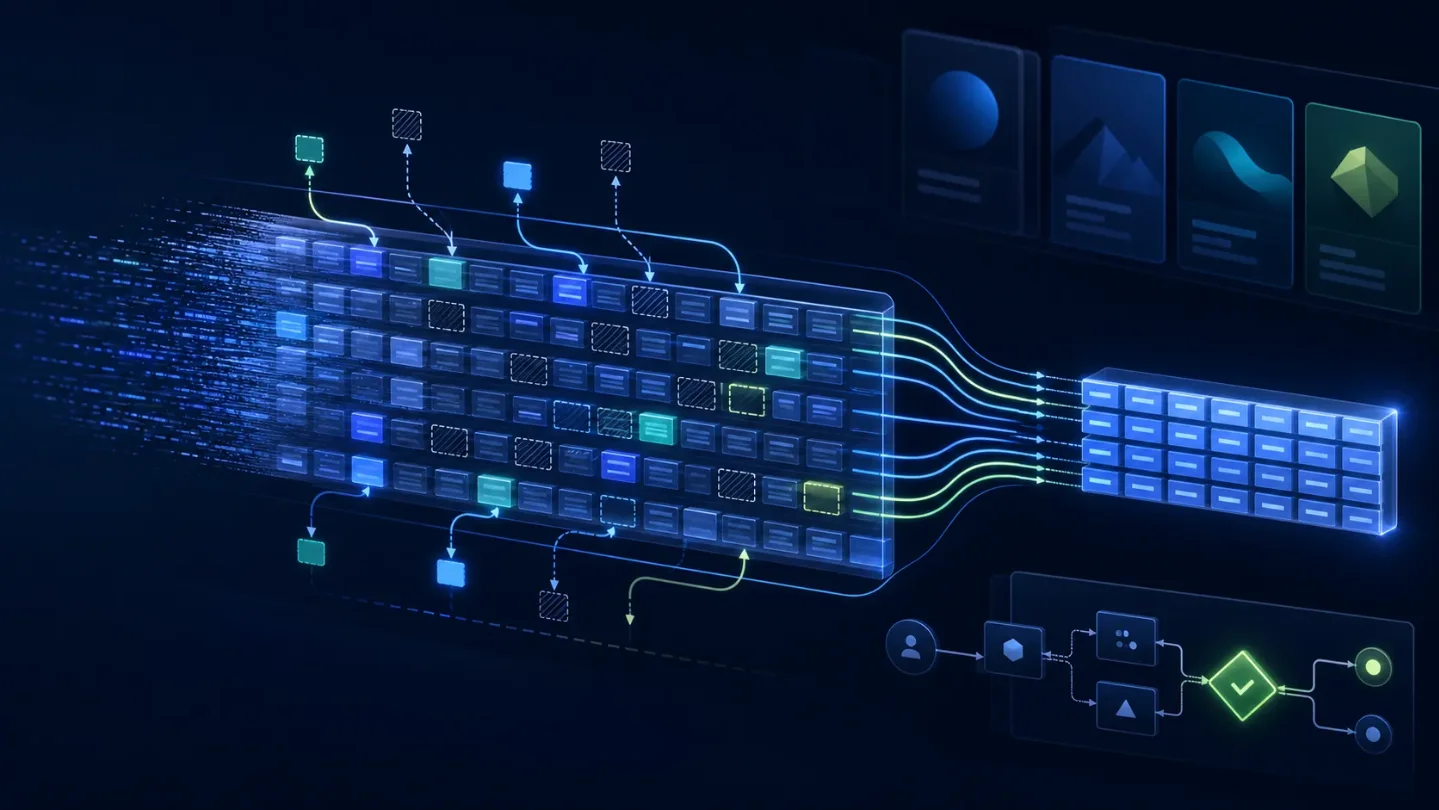
Diffusion LLMs make revision a product primitive
DLMRec and LLaDA2.2-flash show where diffusion language models fit: structured outputs that can be revised, validated, and rolled back rather than emitted once.

The product implication
Diffusion language models are becoming interesting for PMs for a reason that is easy to miss if the story stays at "more tokens per second": they can revise a whole structured output instead of committing to it one token at a time.
Two July 23 releases show the product split. Tencent researchers' DLMRec applies discrete diffusion to recommendation, where the order of a user's past clicks is a noisy trace rather than the thing the product wants to reproduce. InclusionAI's LLaDA2.2-flash applies the same family of ideas to 128K-context tool use, adding explicit insertion and deletion operations for agent outputs. 1 2
The practical conclusion is narrower than "replace autoregressive LLMs": test diffusion where the output has global constraints, can be checked after each draft, and benefits from correction. Keep autoregressive generation as the default for open-ended conversation until the quality, serving, and fallback story is equally clear.
What changed
The generation unit is becoming editable
An autoregressive model emits a sequence from left to right. A discrete diffusion model starts with a masked or noisy sequence, predicts many positions together, then revises the sequence over several rounds. In the common masked version, training teaches a bidirectional transformer to fill missing tokens; production-oriented variants add remasking or random-token noise so previously filled positions can change. 3
That difference matters when the output is a slate, a tool plan, or a code edit. The model can use information from later positions to repair an earlier choice. It also creates a new control surface: the product can trade more refinement steps for quality, rather than choosing only between a larger model and a longer left-to-right decode.
This is not automatic. The Kuleshov Group's engineering guide says a simple masked diffusion model is not production-ready because it is fixed-length, lacks built-in iterative correction, and needs post-training to become fast. Its suggested stack is more specific: block diffusion for variable length, KV caching for prior blocks, an encoder-decoder split for cheaper repeated denoising, and distillation or other post-training to cut sampling steps. The same guide warns that parallel generation can create local inconsistencies unless the noise process lets the model correct them. 3
DLMRec tests the fit in recommendation
DLMRec's core claim is about structure, not speed. A recommendation slate is a set of related choices; the exact left-to-right order in an interaction log is not necessarily a semantic dependency. The paper replaces the usual next-token objective with a denoising process that can see the full target sequence and refine it.
The adaptation is substantial. A collaborative-aware stochastic tokenizer turns multi-hop user-item graph signals into discrete tokens. Curriculum training first aligns item-level semantics, then moves to token-level preference recovery. At inference, a stability-aware voting mechanism keeps confident token positions and revisits unstable ones instead of resetting every position at every step. 1
On LastFM, MovieLens-1M, and Amazon-Beauty, with full-ranking Recall and NDCG at 10 and 20 averaged over five runs, DLMRec reports average gains of 6.75% in Recall and 5.19% in NDCG over LLaRA. Against a discrete-diffusion baseline, the reported gains are 11.83% and 6.37%. These are offline preprint results, not evidence of a production recommender lift. The paper also says its best setting used two refinement steps on LastFM and three on the other two datasets; at a matched three-token setting, it was faster than the autoregressive TokenRec baseline at one to three sampling steps, while continuous-token recommenders were faster than both. 1
The PM interpretation is useful: diffusion fits recommendation when the model is recovering a preference structure from incomplete evidence, not merely predicting the next event in a log.
LLaDA2.2 adds edit operations to agent output
LLaDA2.2-flash takes the correction idea into agentic workloads. Its ModelScope card describes a 100B non-embedding-parameter MoE diffusion model with a 128K context window,
DELETE and INSERT control tokens, block-level routing, and L-EBPO training for tool-use environments. Levenshtein Editing gives the decoder a way to change sequence structure, not only replace masked tokens. 2The card reports five-run averages under a 128K context, block length 32, temperature 1.0, threshold 0.5, and editing threshold 0.0. On its listed comparison, LLaDA2.2-flash scores 80.33 versus 76.36 on τ²-Bench, 81.66 versus 81.30 on PinchBench, and 46.21 versus 41.12 on MCP-Atlas against Ling-2.6-flash. Its SWE-bench Verified score is lower, 49.28 versus 61.20. The throughput table reports 519.0 versus 303.2 tokens per second on SWE-bench Verified and 592.8 versus 334.9 on τ²-Bench. 2
Those numbers need careful reading. The card says some Ling results come from a separate technical report and were run with the OpenHands scaffold, while other comparisons use Claude Code. The release is a strong pilot signal for long-context tool use, not a clean head-to-head verdict.
Why PMs should care
The two examples point to a practical selection rule:
| Good diffusion pilot | Poor first diffusion pilot |
|---|---|
| The output has a known shape or validator | The output is unconstrained conversational prose |
| Later fields can correct earlier fields | Early tokens must stream with no revision |
| Quality improves when the whole object is reconsidered | The product only measures first-token latency |
| A decoder can run a small, bounded number of refinement steps | Every request has unpredictable length and no fallback |
For a PM, the new unit of evaluation is therefore model plus decoder plus validator. A faster raw decode is not enough if the service spends the saved time on repeated full-sequence passes, or if a corrected answer cannot be committed safely.
Track these measures in the same experiment:
- accepted-output rate after validation;
- correction rate, including how often a later pass fixes a wrong early field;
- p50 and p95 end-to-end latency, not only token throughput;
- cost per accepted recommendation or completed tool action;
- constraint violations and invalid edit operations;
- fallback rate to an autoregressive model or human review.
Social attention is pointing at the same implementation shift, but it is not independent validation. Cornell professor and Inception AI chief scientist Volodymyr Kuleshov shared a high-engagement overview on July 8 that groups current work around masking, iterative refinement, variable-length generation, controllability, fast samplers, and RL post-training. 4 ModelScope's July 23 post promoted LLaDA2.2-flash's agent benchmarks and throughput, while a Meta senior ML engineer's July 23 local-time post circulated the DLMRec paper and code. Those posts are useful launch and attention signals; the paper and model card carry the technical claims. 5 6
For a quick primer, Jia-Bin Huang's 12-minute explainer covers autoregressive versus diffusion generation, masked diffusion, and scaling laws. It was published on August 3, 2025 and had 35,781 views when checked. No accessible explainer from the past two weeks surfaced for this specific LLaDA2.2/DLMRec release, so treat the video as background, not evidence of current adoption or product readiness. 7
How to implement now
- Choose a revisable object. Start with a recommendation slate, a structured tool plan, or a code patch with a deterministic checker. Do not begin with a general chat endpoint.
- Keep the autoregressive baseline. Use the same task distribution, context, validator, and serving hardware. Compare accepted quality, p95 latency, cost, and fallback rate. Do not import the LLaDA2.2 benchmark numbers into a roadmap target; the scaffolds and evaluation sources are not identical.
- Expose revision as a contract. Define which fields may be inserted, deleted, or rewritten. For each refinement pass, record the changed positions, confidence, validator result, and final committed version. A user should be able to see the last valid object, not just the model's latest draft.
- Bound the compute loop. Sweep block size and one through a small number of refinement steps. Stop when the validator passes and the changed-token count stabilizes. Preserve a fallback path when the model oscillates, exceeds the latency budget, or produces an invalid edit.
- Roll out behind a reversible gate. Use shadow traffic first, then read-only recommendations or tool-plan suggestions. Allow writes only after correction, validation, and recovery metrics beat the baseline on the same workload.
The near-term PM bet is not "diffusion everywhere." It is one workflow in which the product can profit from reconsidering the whole answer. If a three-step refinement loop produces a more accurate, valid, and cheaper object than a one-pass baseline, the architecture has earned a larger pilot. If it only produces attractive throughput numbers while validators, latency tails, or fallback rates get worse, keep the autoregressive path and improve the control plane first.
相似内容
- 登录后可发表评论。