
Gene Editing Weekly — June 12–19, 2026
2026/6/19 · 9:40

Gene Editing Weekly — June 12–19, 2026

The week's lead story is the full Phase 3 HAELO readout for Intellia's lonvo-z — 87% HAE attack reduction, 62% attack-free at six months in 80 patients, no serious adverse events, simultaneous NEJM publication — the first in vivo CRISPR therapy to complete Phase 3. On June 18, Beam Therapeutics received FDA IND clearance for BEAM-304 (PKU base editing) and Prime Medicine received New Zealand's first-ever clinical authorization for in vivo prime editing (PM577a, Wilson disease), both citing FDA's June 2 platform-knowledge guidance. UniQure's AMT-130 FDA reversal marks the third documented CBER flexibility case. Two SCD gene editing papers (risto-cel + reni-cel) appeared in NEJM. Research highlights include the Doudna lab's 49% in vivo liver prime editing efficiency (Nature Nanotechnology) and LEAPER 2.0's 1.5-year DMD NHP durability and first-in-human data (Cell). The EU Parliament passed a gene-edited crops fast-track law.

Phase 3 data arrived. For years, every in vivo CRISPR program came with an asterisk: biomarker shifts, small Phase 1/2 cohorts, follow-up too short to anchor a regulatory story. The HAELO trial's full readout, presented June 13 at the European Academy of Allergy and Clinical Immunology (EAACI) congress in Istanbul and simultaneously published in NEJM, removes that asterisk for lonvoguran ziclumeran (lonvo-z). Eighty patients, 87% attack reduction, 62% attack-free at six months, no serious adverse events — and a rolling BLA already with FDA. The week also delivered two first-ever regulatory clearances for next-generation editing modalities and a third documented case of CBER reversing its prior position under the post-Makary/Prasad leadership transition.

DateEntity / ProductModalityEvent
Jun 13Intellia / lonvo-z (lonvoguran ziclumeran)In vivo CRISPR-Cas9Full Phase 3 HAELO data at EAACI 2026; simultaneous NEJM publication; rolling BLA ongoing
Jun 17uniQure / AMT-130AAV gene therapy (HTT silencing)FDA reverses March position; Phase 1/2 data cleared for accelerated approval BLA; Q3 2026 filing target
Jun 18Beam Therapeutics / BEAM-304In vivo base editing (LNP)FDA IND clearance for PKU; Beam's second active in vivo IND
Jun 18Prime Medicine / PM577aIn vivo prime editing (LNP)New Zealand Medsafe CTA clearance for Wilson disease; first-ever clinical authorization for in vivo prime editing worldwide
Jun 18Beam / risto-cel (BEACON Phase 1/2)Ex vivo base editingNEJM publication: 31-patient SCD data; no VOC in 60 days post-final transfusion
Jun 18Editas / reni-cel (RUBY trial)Ex vivo CRISPR-Cas12aNEJM publication: 28-patient SCD data; 27/28 (96%) VOC-free post-infusion
Jun 11Vertex / CASGEVY (exa-cel)Ex vivo CRISPR-Cas9EHA 2026: pediatric TDT data ages 5–11; NEJM publication
Jun 15Jiang/Doudna et al.In vivo prime editing (LNP)Nature Nanotechnology: 49% liver editing efficiency in mice; PAH R408W correction at curative Phe levels
Jun 10Wei Wensheng et al.RNA editing (LEAPER 2.0)Cell: circ-arRNA DMD exon skipping maintained ≥1.5 years in NHPs; first-in-human 3 patients
Jun 16Liu et al. / Nature BiotechnologyPrime editing (prime assembly)Research Highlight: 0.8 kb DNA insertion at 40% efficiency in human cells
Jun 18EU ParliamentAgricultural gene editingLaw passed: streamlined approval for edits achievable by conventional breeding; 2-year transition
Jun 18Scribe TherapeuticsCasX base editingCIRM awards >$25M for STX-1200 (Lp(a)) and STX-1400 (APOC3) preclinical programs

lonvo-z HAELO Phase 3: the first in vivo CRISPR Phase 3 to complete

The primary endpoint story was known since early April — the EAACI abstract slot confirmed 87% attack reduction. What the full June 13 readout added was the secondary endpoint architecture, and it's more consistent than most gene editing trials at this stage typically produce.
The HAELO trial enrolled 80 patients with type I, II, or III hereditary angioedema (HAE) — a rare condition caused by loss-of-function mutations in C1ESTERASE-INHIBITOR leading to episodic plasma kallikrein-driven swelling — and randomized them 2:1 to lonvo-z (n=52) or placebo (n=28). 1 Lonvo-z is an LNP-delivered CRISPR-Cas9 construct targeting KLKB1, the gene encoding plasma prekallikrein, delivered as a single IV infusion. Data cutoff was February 10, 2026; median follow-up was 7.5 months.
The full efficacy and safety picture across the 5–28-week evaluation window:
Endpointlonvo-z (n=52)Placebo (n=28)Reductionp
Monthly HAE attacks (primary)0.19/mo (95% CI 0.10–0.36)1.79/mo (95% CI 1.27–2.54)87%<0.0001
Attacks requiring on-demand treatment0.19/mo1.79/mo89%<0.0001
Moderate/severe attacks0.11/mo (95% CI 0.06–0.23)1.23/mo (95% CI 0.84–1.81)91%<0.0001
Attack-free, LTP-free at 6 months32/52 (62%)3/28 (11%)<0.0001
AE-QoL total score (week 28)−23.51 from baseline−6.47 from baseline−17.04 (95% CI −24.15 to −9.93)<0.0001
A few details in the data deserve attention. 1 2 3 The AE-QoL clinically meaningful improvement threshold is 6 points; the lonvo-z arm averaged 23.51 points of improvement — roughly four times the bar. 1 Of the 80 enrolled patients, 20% had previously achieved complete disease control on long-term prophylaxis (LTP) therapies — meaning lonvo-z's 62% attack-free rate was not inflated by enrolling only LTP non-responders. 1 Plasma kallikrein levels fell substantially by day 15 and reached stable levels by week 5 without recovery through data cutoff. 3
Safety was clean by the standards of this class: the most common treatment-emergent adverse events in the lonvo-z arm were infusion-related reaction, headache, fatigue, back pain, and upper respiratory tract infection — all mild or moderate, with no serious adverse events in the 52-patient lonvo-z cohort. 1
Intellia President and CEO John Leonard said: "These are the first Phase 3 results to deliver on the much-heralded promise of in vivo CRISPR gene editing." 1 Danny Cohn (Amsterdam UMC, HAELO principal investigator) added: "As a clinician who has witnessed patients struggle with the unpredictability and emotional toll of HAE, the prospect of offering lasting freedom from attacks and chronic medication with a one-time treatment is incredibly exciting." 1
The NEJM paper (DOI: 10.1056/NEJMoa2600931, ClinicalTrials.gov NCT06634420) was published June 13, updated June 16. 4 Rolling BLA submission was initiated with FDA in April 2026; the company targets regulatory approval and U.S. launch in the first half of 2027. 3
What this means for investors and researchers: NTLA gained approximately 23% in the days following the data release, closing around $16.26 on June 17. 5 Analyst price targets for NTLA span a wide range — from $9 (Goldman Sachs, Salveen Richter) to $49 (Canaccord Genuity, Whitney Ijem), with a median of $17 — reflecting genuine disagreement about HAE market sizing and long-term CRISPR platform value rather than any signal about data quality. 6 The BLA path now has a confirmatory clinical dataset; the commercial question is whether a one-time therapy priced at a level that competes with the lifetime cost of subcutaneous kallikrein inhibitors (lanadelumab, garadacimab) can capture the physician preference needed to build a durable revenue base before loss-of-exclusivity pressure arrives.

CBER regulatory pattern: three reversals, one consistent direction

The most durable signal of the past five weeks is not any single data package — it is the behavioral shift at FDA's Center for Biologics Evaluation and Research under acting director Karim Mikhail and acting FDA commissioner Kyle Diamantas. Three documented cases since April now show CBER accepting clinical data packages it had previously rejected or de-prioritized.

uniQure AMT-130: FDA clears accelerated approval path for Huntington's

On June 17, uniQure (Nasdaq: QURE) announced that FDA's CBER, in a Type B meeting, agreed that AMT-130's existing Phase 1/2 data — three years of follow-up from a gene silencing therapy delivered intracranially via AAV5 to reduce huntingtin protein — can serve as the primary efficacy basis for a BLA submission under the accelerated approval pathway. 7 UniQure plans to submit the BLA in Q3 2026 (July–September). 8
The reversal is direct. In March 2026, FDA had "strongly recommended" that uniQure conduct an additional trial with a sham procedure comparator before submitting — a design requirement that would have delayed approval by several years. 7 The new agreement substitutes standard-of-care as the comparator arm for the required confirmatory study, a substantially less burdensome design. 8
The pivotal evidence: in the high-dose cohort, AMT-130 reduced cUHDRS (composite Unified Huntington's Disease Rating Scale, a validated combined motor, cognitive, and functional measure) disease progression by 75% versus a propensity-score-matched external control from the Enroll-HD registry (P=0.003; data cutoff June 30, 2025). 7 That external control design is not ideal by Phase 3 standards, but the acceptability question has now been answered by FDA directly in a Type B meeting.
CEO Matt Kapusta said: "The FDA has agreed that our current clinical data can support a near-term BLA submission and has committed to work expeditiously with us to align on the design of the required confirmatory study." 8 QURE shares surged approximately 80% on the news.
William Blair analysts wrote that FDA appears "largely in caretaker mode, appears to be more flexible on regulatory paths for applications where concerns were previously raised." 9 RBC Capital Markets described the pattern as "the pendulum between regulatory leniency vs inflexible scientific rigor is swinging back to the former now that Vinay Prasad and Marty Makary have left the FDA." 7
This is the third documented case of CBER flexibility since April: Disc Medicine's bitopertin (existing Phase 3 accepted as sufficient) and Sanofi's Tzield (CNPV withdrawal followed by approval) preceded AMT-130. 9 AMT-130 is a gene therapy, not a gene editing product — but the CBER behavioral pattern applies identically to the gene editing programs navigating complex data packages at FDA. REGENXBIO's RGX-121 CRL appeal, now six consecutive weeks without a formal FDA response, is the outstanding test case for how far the flexibility extends to programs that received a Complete Response Letter rather than simply a restrictive Type B meeting outcome. 10

BEAM-304: FDA IND cleared for PKU base editing
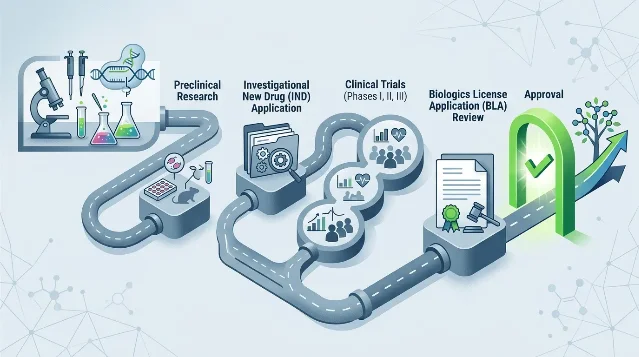
FDA gene therapy regulatory pathway: preclinical research → IND application → Phase I/II/III clinical trials → BLA review → Approval, shown as a winding road with labeled stage nodes
FDA CBER regulatory pathway for biologics license applications — both BEAM-304 (IND cleared June 18) and PM577a (CTA cleared in New Zealand June 18) are now authorized to enter the clinical trials stage. AI-generated illustration.
On June 18, Beam Therapeutics (Nasdaq: BEAM) announced FDA clearance of its investigational new drug application for BEAM-304, an in vivo LNP-formulated base editing therapy for phenylketonuria (PKU). 11 BEAM-304 targets the PAH gene (encoding phenylalanine hydroxylase), converting the R408W mutation — the most common PKU-causing allele — back to wild-type via a single A-to-G base change. A second mutation-specific editor is in development within the same platform program. PKU affects approximately 20,000 people in the U.S.; the only existing curative option is a hematopoietic stem cell transplant, rarely pursued given the availability of dietary management and pegvaliase enzyme therapy. 11
Beam's Chief Scientific Officer Gopi Shanker said the program exemplifies a "scalable development pathway" — a shared LNP delivery backbone and manufacturing approach across mutation-specific editors that "may serve as a model for other genetically diverse liver diseases." 11 BEAM-304 is Beam's second active in vivo IND, after BEAM-302 (alpha-1 antitrypsin deficiency, currently in pivotal enrollment). Preclinical data for BEAM-304 will be presented at the FASEB Genome Engineering Conference (July 6–9, 2026, Porto, Portugal). 11 Beam explicitly cited FDA's June 2 draft guidance on leveraging prior platform knowledge as enabling this multi-mutation strategy.

PM577a: the first in vivo prime editing clinical authorization

Also on June 18, Prime Medicine (Nasdaq: PRME) announced that New Zealand's Medsafe cleared the Clinical Trial Application (CTA) for PM577a, an investigational prime editor targeting Wilson disease. 12 This is the first clinical authorization worldwide for an in vivo prime editing therapy — from any regulator.
PM577a targets the H1069Q mutation in ATP7B (encoding a copper-transporting ATPase), the most prevalent Wilson disease-causing allele in North America and Europe, accounting for 30–50% of disease-associated variants. 12 Wilson disease affects approximately 1 in 30,000 people globally; current treatments — chelating agents (penicillamine, trientine) and zinc supplementation — require lifelong dosing and do not address the underlying ATP7B dysfunction. PM577a delivers its prime editing cargo via a single IV LNP infusion. The Phase 1/2 global trial is expected to initiate in the second half of 2026, with initial clinical data expected in 2027. 12
Chief Medical Officer Mohammed Asmal noted a distinctive readout strategy: "The incorporation of 64Cu PET as a non-invasive functional readout of ATP7B activity is a particular strength of the program." 12 Using radiocopper PET to directly image copper transporter function — rather than relying on indirect serum copper or ceruloplasmin markers — provides a mechanism-linked pharmacodynamic endpoint that regulators can tie directly to the gene edit.
A follow-on candidate targeting the R778L mutation, which predominates in East Asian populations, is in preclinical development. 12

SCD: two NEJM publications on the same day

On June 18, University Hospitals Rainbow Babies & Children's Hospital announced co-authorship on two separate NEJM papers, both covering ex vivo gene-edited cell therapies for sickle cell disease (SCD), both published the same day. 13
Beam risto-cel (ristoglogene autogetemcel) — BEACON Phase 1/2, n=31 SCD patients, NEJM DOI: 10.1056/NEJMoa2504835. Risto-cel uses Beam's base editor to make precise A-to-G changes in the HBG1/HBG2 promoters, mimicking the naturally occurring -175 T>C variant that dysregulates BCL11A binding and reactivates fetal hemoglobin (HbF). All 31 patients received busulfan myeloablative conditioning. Results: rapid engraftment, durable HbF elevation, and no researcher-reported severe vaso-occlusive crises (VOC) from 60 days after the last red blood cell transfusion through data cutoff. 13 14
Editas reni-cel (renizgamglogene autogedtemcel) — RUBY trial, n=28 SCD patients, NEJM DOI: 10.1056/NEJMoa2415550. Reni-cel uses CRISPR-Cas12a rather than Cas9 to disrupt a 13-bp regulatory region in the HBG1/HBG2 promoters, again via HbF reactivation. Results: 27 of 28 patients (96%) had no VOC events after infusion; total hemoglobin and HbF levels were elevated in all evaluable patients. 13 15
These two publications and lonvo-z's NEJM paper mark three separate in-NEJM gene editing publications within six days. Jignesh Dalal (UH Rainbow, pediatric cellular therapy and bone marrow transplantation) co-authored both SCD papers and noted: "These studies reflect the promise of gene editing and may meaningfully change the course of treatment and quality of life for patients and their families." 13
From a competitive standpoint, neither risto-cel nor reni-cel presents data sufficient to distinguish between them and Vertex/CRISPR Therapeutics' CASGEVY — the only SCD gene therapy currently approved. Both are still in Phase 1/2, and the all-important comparative question — outcomes versus CASGEVY in head-to-head-equivalent populations — will not be answerable until BLA packages arrive. Beam's BLA filing target for risto-cel remains year-end 2026.

Research: two delivery breakthroughs and a new insertion method

PE-LNP: 63× efficiency improvement, curative-level PKU correction in mice
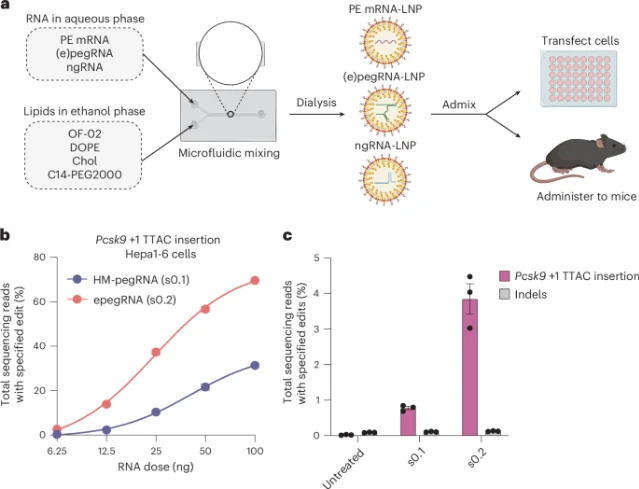
A Nature Nanotechnology paper published June 15 by AY Jiang, Jennifer Doudna (Innovative Genomics Institute / UC Berkeley), and colleagues describes a systematic optimization of prime editing lipid nanoparticles (PE-LNPs) for in vivo liver delivery. 16 The system packages three RNA components — the prime editor mRNA, an engineered pegRNA (epegRNA), and a nicking guide RNA — into two separately formulated LNP populations (PE mRNA-LNP and ngRNA-LNP) using the OF-02 lipid formulation, then admixes them before administration.
PE-LNP workflow: microfluidic encapsulation of PE mRNA and ngRNA into separate LNP populations, admixed before administration; dose-response curves at the Pcsk9 locus in Hepa1-6 cells; in vivo editing bar chart in bulk mouse liver
PE-LNP system overview: three-component RNA assembly (prime editor mRNA + epegRNA + ngRNA) encapsulated via microfluidic mixing, achieving 49% average in vivo prime editing at the Pcsk9 locus in mouse liver with a single 2 mg/kg dose. 16
The headline number is 49% average in vivo prime editing efficiency in bulk mouse liver — a 63-fold improvement over the team's initial approach — achieved with a single 2 mg/kg dose. 16 In a humanized PKU mouse model carrying the PAH R408W mutation (the same mutation Beam's BEAM-304 targets), the system achieved editing levels that returned serum phenylalanine to what the authors anticipate would be curative levels. Off-target editing was lower than with DNA delivery approaches, liver enzyme elevation was transient, and repeat dosing was feasible — three parameters that regulators will scrutinize in first-in-human packages. 16
The timing is notable: BEAM-304's IND cleared the same week a top-tier paper demonstrated curative-level in vivo prime editing of the same disease mutation in the same target organ. The two programs use different editing chemistries — BEAM-304 uses base editing, the Doudna lab used prime editing — but both approach PAH R408W as a single-base-change correction problem accessible to RNA-based, LNP-delivered tools.

LEAPER 2.0: RNA editing in NHPs and first-in-human

A Cell paper by Wei Wensheng (Peking University) and colleagues reports LEAPER 2.0, an evolved version of the LEAPER (Leveraging Endogenous ADAR for Programmable Editing of RNA) platform. 17 LEAPER 2.0 uses circular ADAR-recruiting RNAs (circ-arRNAs), which recruit endogenous adenosine deaminase acting on RNA (ADAR) to perform A-to-I RNA editing without DNA modification or protein cargo.
In Duchenne muscular dystrophy (DMD) nonhuman primates, a single administration of AAV delivering circ-arRNA targeting exon 51 (which benefits approximately 13% of DMD patients) restored dystrophin protein and motor function for at least 1.5 years without triggering anti-dystrophin immunity — a complication that has affected some protein-replacement and gene therapy approaches. 17 In three first-in-human patients, LEAPER 2.0 showed safe, dose-dependent exon skipping alongside measurable gains in motor and cardiopulmonary function. 17
LEAPER 2.0 is mechanistically distinct from DNA-level editors: it produces transient RNA-level corrections that do not propagate to daughter cells, and it works through both ADAR-dependent and a newly identified ADAR-independent pathway. That non-permanence limits applicability in tissues where durable editing is required, but in post-mitotic muscle tissue — and particularly in pediatric patients where growth-related cell division would dilute permanent edits — a repeat-dosable RNA approach is a legitimate alternative to DNA editors.

Prime assembly: large DNA insertions at therapeutic efficiency

Nature Biotechnology's June 16 Research Highlight covers the "prime assembly" (PA) system by Liu et al., published in Nature. 18 Prime assembly builds on twin prime editing: instead of using the two single-stranded DNA flaps as a template for small point corrections, it uses them as landing pads for annealing a PCR-synthesized double-stranded DNA donor carrying a 5′ end resection. The result is seamless insertion of a 0.8 kb donor at up to 40% efficiency in human cells, without the junction scars that HDR (homology-directed repair) typically leaves and without requiring plasmid templates that carry immunogenic bacterial DNA. For gene editing programs that need to insert full-length coding sequences rather than fix single bases — gene addition therapies, CAR-T construct integration, or large deletion repair — prime assembly addresses the efficiency and safety bottleneck that has limited large-insert prime editing applications.

Ethics and policy: institutional silence meets legislative action

Embryo editing: six weeks of governance vacuum
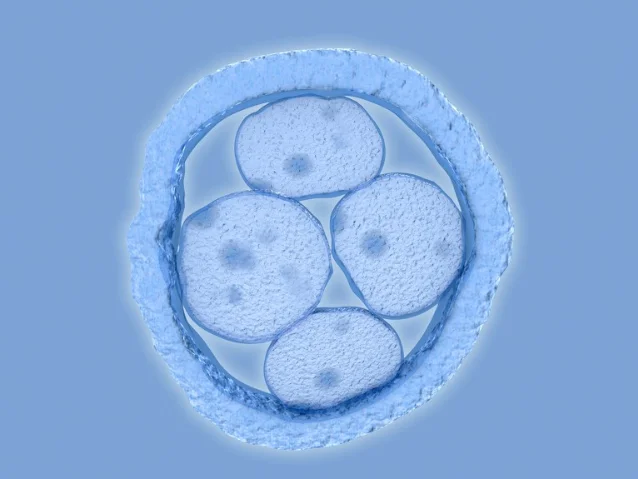
The Jerabek/Egli base-editing embryo preprint (bioRxiv, DOI: 10.64898/2026.05.30.728989) was posted June 1, covered by Nature News on June 5 and updated June 8. 19 WHO, the Nuffield Council on Bioethics, the Hastings Center, and the National Academies have now gone six consecutive weeks without publishing a direct institutional response.
Four-cell human embryo within the zona pellucida, light blue tones, four blastomeres visible
Four-cell human embryo — the cleavage stage targeted in the Jerabek/Egli experiment. Mosaicism (inconsistent editing across blastomeres) remains a technical barrier to clinical translation. 19
The silence itself carries information. The Hastings Center did update a related Bioethics Forum essay on June 8 — the same week — but on genome modification of species, not heritable human editing. 20 The three societies that issued the 2025 moratorium call (ASGCT, ISCT, and ARM) responded immediately when the preprint appeared; the four bodies with the formal governance mandates have not. Whatever the internal reasons for that silence — review processes, jurisdictional caution, resource constraints — it means the only currently active institutional position on heritable human genome editing remains the ASGCT/ISCT/ARM call for a ten-year moratorium extending to at least 2035. 21
For the science, Dieter Egli, the Columbia researcher who led the preprint work, has been unambiguous: "These base editors — they can have damaging effects on the embryo. So why would you use it if you don't fully understand that? In its current form, you can't use it. It's as clear as day and night." 19 Fyodor Urnov (UC Berkeley) has characterized embryo editing for disease prevention as "a solution in search of a problem," given that IVF combined with preimplantation genetic testing already prevents heritable disease transmission without touching the germline. 19 Hank Greely (Stanford) identified a more specific downstream concern: that the technical roadmap in the preprint could enable commercial IVF operators to attempt embryo editing before governance structures are in place — "one result might be really sick kids." 19

EU Parliament passes gene-edited crops fast-track law

On June 18, the European Parliament passed legislation establishing an expedited approval pathway for gene-edited crops that produce changes achievable by conventional breeding — primarily simple base changes or small insertions/deletions with no exogenous DNA introduced. 22 Crops involving transgenic engineering retain the existing stringent GMO-level review. A 2-year implementation period begins before the European Commission can receive the first applications. The law reverses the practical effect of the European Court of Justice's 2018 ruling, which had required EU member states to regulate CRISPR-edited plants as GMOs regardless of whether they contained foreign DNA.
Parliament rejected a proposed amendment that would have banned patents on gene-edited crops; a compromise provision requires public disclosure of existing patents covering approved crops. 22 The European Sustainable Agriculture through Genome Editing network (EU-SAGE) called the vote "a landmark decision for science, innovation, and sustainable agriculture in Europe." 22 For the gene editing field broadly, the EU law establishes a second major regulatory jurisdiction — alongside the U.S. and Japan — where gene editing is formally treated as a distinct category from transgenics, with implications for the IP and market access strategies of agricultural biotech companies working in European markets.

FDA prior knowledge guidance: comment window open

FDA's June 2 draft guidance "Leveraging Prior Knowledge in the Development of Human Gene Therapy Products Incorporating Genome Editing" (Docket FDA-2026-D-1257) entered the Federal Register on June 3 with a comment deadline of September 1, 2026. 23 As of June 19, no public comments have been filed. 23 Sponsors working on multi-mutation base editing or prime editing platform programs — Beam (PKU, AATD), Prime Medicine (Wilson, AATD) — have three months to submit formal comments shaping how FDA implements the guidance in practice. The FDA Law Blog analysis published June 12 noted that the guidance's practical value will depend heavily on whether FDA reviewers interpret "leveraging" as partial reduction in testing requirements or as potential full waivers; initial implementation will likely favor partial reduction. 24

Scribe Therapeutics: >$25M CIRM grant for cardiovascular CasX programs

Scribe Therapeutics (co-founded by Jennifer Doudna, private) received more than $25 million from the California Institute for Regenerative Medicine (CIRM) across two preclinical programs: STX-1200, targeting LPA to reduce lipoprotein(a) for atherosclerotic cardiovascular disease prevention, and STX-1400, targeting APOC3 to lower triglycerides for severe hypertriglyceridemia and familial chylomicronemia syndrome. 25 Both programs use Scribe's X-Editor (XE) technology — an engineered CasX variant with greater than 100-fold improved editing efficiency over natural CasX, a non-Cas9 CRISPR enzyme with a distinct protein fold and smaller size that may enable delivery configurations that Cas9 cannot access. 25 Scribe has existing research collaborations with Sanofi and Eli Lilly.

Pending items

ItemLast confirmed eventCurrent status
Intellia lonvo-z BLARolling BLA initiated April 2026FDA review ongoing; U.S. approval and launch targeted H1 2027
REGENXBIO RGX-121 CRL appeal (clemidsogene lanparvovec, MPS II / Hunter syndrome)CRL issued; appeal filed6 consecutive weeks without FDA response as of June 19; no new SEC filings; RGNX small uptick on UniQure reversal sentiment 10
uniQure AMT-130 BLAFDA Type B meeting June 17; BLA target Q3 2026BLA submission expected July–September 2026; confirmatory study design under discussion
Beam risto-cel BLAYear-end 2026 target confirmed at ASGCTBEACON Phase 1/2 NEJM published June 18; BLA submission on track
Prime Medicine PM577a Phase 1/2New Zealand CTA cleared June 18First-in-human dosing expected H2 2026; initial data 2027
Beam BEAM-304 Phase 1/2IND cleared June 18Preclinical data at FASEB Genome Engineering Conference, July 6–9, 2026, Porto
FDA prior knowledge guidance commentsPublished June 3; docket FDA-2026-D-1257Comment period closes September 1, 2026; no public comments filed as of June 19
Cover image: AI-generated editorial illustration

相似内容

围绕这条内容继续补充观点或上下文。

  • 登录后可发表评论。