Five papers: June 17, 2026
2026/6/17 · 9:19

Five papers: June 17, 2026

Five papers from the June 16–17 window (23.6-hour daily cycle), ranked by journal IF tier and clinical signal. Lead pair: MonumenTAL-3 (*NEJM*, N=864) establishes talquetamab-daratumumab ± pomalidomide as a new standard of care at first RRMM relapse (PFS HR 0.28/0.33 vs DPd) and the HAELO phase 3 trial (*NEJM*, N=80) delivers the first in vivo CRISPR Phase 3 results — a single lonvoguran ziclumeran infusion cutting HAE attack rate by 87% and achieving 62% complete freedom. Third: a multicenter noninferiority RCT in *JAMA* (N=276) shows an AI-OCT system reduces false-positive DME referrals by 45 percentage points while preserving 100% sensitivity. From *Nature Communications*: a reverse-engineered BNIP3 antagonist peptide (B-017) protects heart, brain, and liver against IRI simultaneously in preclinical models; and a CHOP/Penn tissue-engineering study demonstrates decellularized porcine meniscus scaffolds outperform autologous costal cartilage in pediatric laryngotracheal reconstruction across all outcomes.

研究速览

At a glance — June 16–17, 2026

#PaperJournal (IF tier)DesignPrimary result
1MonumenTAL-3: talquetamab + daratumumab ± pomalidomide in RRMMNEJM (IF ~96, T1)Phase 3 RCT, N=864, 3-armPFS HR 0.28 (Tal-DP) / 0.33 (Tal-D) vs DPd; both P<0.001
2HAELO: lonvoguran ziclumeran (in vivo CRISPR) in hereditary angioedemaNEJM (IF ~96, T1)Phase 3 RCT, N=80 (2:1)Attack rate −87% vs placebo; 62% attack-free
3AI-OCT for diabetic macular edema: multicenter noninferiority RCTJAMA (IF ~63, T1)Noninferiority RCT, N=276False-positive referrals −45 pp (24.1% vs 69.1%); 100% sensitivity
4BNIP3 reverse engineering: B-017 peptide protects against multi-organ IRINat Commun (IF ~14.7, T2)Preclinical (structural + 3 in vivo models)3-organ IRI protection (cardiac, cerebral, hepatic); KD=303 nM
5MEND graft vs autologous costal cartilage in pediatric airway reconstructionNat Commun (IF ~14.7, T2)Preclinical RCT equivalent, N=38 rabbitsMEND outperforms gold standard in all outcomes; zero adverse events
正在加载统计卡片…

1. MonumenTAL-3: talquetamab-daratumumab cuts progression risk by 72% at first relapse in RRMM (NEJM, IF ~96)

Journal: New England Journal of Medicine · IF ~96, Tier 1 · Published June 13, 2026 (EHA 2026 plenary) · PMID: 42294841 · NCT05455320 · Funded by Johnson & Johnson
Design: Three-arm phase 3 RCT across 182 sites in 18 countries. 864 patients with relapsed or refractory multiple myeloma (RRMM) randomized 1:1:1 to Tal-DP (talquetamab 0.4 mg/kg weekly + daratumumab + pomalidomide, n=287), Tal-D (talquetamab + daratumumab, n=287), or DPd (daratumumab + pomalidomide + dexamethasone, n=290). Median prior lines: 2–3 in 52.2% of patients; 40% treated at first relapse. Median follow-up 24.6 months. Presenting author: Peter M. Voorhees, MD (Atrium Health/Wake Forest University). 1
Primary endpoint — PFS: 24-month PFS 81.3% (Tal-DP) vs 51.2% (DPd); HR 0.28 (95% CI 0.20–0.40, P<0.001). Tal-D: 77.6% vs 51.2%; HR 0.33 (95% CI 0.24–0.46, P<0.001). At first relapse, the PFS benefit sharpened further: HR 0.19 (Tal-DP) and 0.23 (Tal-D) vs DPd. 1
Depth of response: ORR 88.2% (Tal-DP) vs 77.6% (DPd). Complete response or better: 71.1% vs 34.5%. MRD-negative CR (10⁻⁵ threshold): 52.3% (Tal-DP) and 46.3% (Tal-D) vs 15.9% (DPd), all P<0.001. 1 2
OS: 24-month OS 89.2% (Tal-DP) vs 79.1% (DPd); HR 0.47. Pre-specified superiority boundary not crossed at this analysis — longer follow-up required. 1
Safety tradeoffs: Grade ≥3 neutropenia was lower in Tal-D (29.2%) than in DPd (86.2%), but rose to 76.4% with pomalidomide added (Tal-DP). Grade 3/4 infections: 37.7% (Tal-DP), 29.2% (Tal-D), 42.4% (DPd). Fatal AEs: 1.8%, 4.0%, 4.6% respectively. CRS occurred in 67.8% (Tal-DP) and 58.4% (Tal-D), predominantly grade 1; ICANS in 2.9% and 1.8%, all resolved. GPRC5D-targeting side effects — taste changes (~73–75%), weight loss (38–46%), ataxia/balance disorders (12–15%) — were common to both talquetamab arms. 2
Voorhees stated: "In total, our data support talquetamab with daratumumab, with or without pomalidomide, as a new standard of care for patients with relapsed/refractory multiple myeloma as early as first relapse." 3
Clinical implication: The HR 0.19 in the first-relapse subgroup is the clinically actionable number here. Myeloma specialists face a concrete regimen choice between Tal-D (lower hematologic toxicity, less infection, simpler administration) and Tal-DP (potentially deeper responses, higher neutropenia). The authors note the trial was not powered to formally compare the two talquetamab arms — the arms cannot be ranked statistically. The 11.5% prior daratumumab exposure rate and predominance of CD38-naive patients limit direct applicability to daratumumab-refractory disease; GPRC5D bispecifics retain activity regardless of prior CD38 exposure, but this cohort doesn't fully test that scenario. For programs with access to both BCMA and GPRC5D bispecifics, these data now sharpen sequencing decisions at first relapse.
Funding: Johnson & Johnson (Janssen). Prior daratumumab exposure: 11.5%.

2. HAELO: single IV dose of lonvoguran ziclumeran cuts hereditary angioedema attacks by 87% — first phase 3 in vivo CRISPR result (NEJM, IF ~96)

Journal: New England Journal of Medicine · IF ~96, Tier 1 · Published June 13, 2026 (EAACI 2026) · PMID: 42294842 · NCT06634420 · Funded by Intellia Therapeutics
Design: Phase 3 double-blind RCT. 80 adults with hereditary angioedema (HAE) type I or II randomized 2:1 to a single IV infusion of lonvoguran ziclumeran (lonvo-z, formerly NTLA-2002) at 50 mg (n=52) or placebo (n=28). Lonvo-z delivers CRISPR/Cas9 via lipid nanoparticle to permanently edit the KLKB1 gene (encoding plasma prekallikrein) in hepatocytes, blocking bradykinin overproduction upstream of all HAE triggers. Principal investigator: Danny Cohn, MD, PhD (Amsterdam UMC). Efficacy evaluation window: weeks 5–28 post-dose. Median follow-up 7.5 months (range 4.9–12.8). 4
Primary endpoint: LS mean monthly attack rate 0.26 (lonvo-z) vs 2.10 (placebo); relative reduction −87% (95% CI −93 to −78, P<0.001). 4
Key secondaries: 62% of lonvo-z patients were completely attack-free and off long-term prophylaxis (LTP) for the full 6-month efficacy period vs 11% placebo (P<0.0001). Additional: 89% reduction in attacks requiring on-demand treatment; 91% reduction in moderate/severe attacks; −17.04-point improvement in AE-QoL score (minimally clinically important difference: 6 points). Kallikrein suppression was detected by day 15, reached steady state by week 5, and remained stable through data cutoff. All patients in the lonvo-z arm showed attack rate reductions from baseline. 5
Safety: 92% of lonvo-z patients had any adverse event (86% placebo). No serious AEs and no grade ≥3 AEs in the lonvo-z arm. No deaths. Most common: infusion-related reaction, headache, fatigue, back pain, upper respiratory tract infection — all mild or moderate. No hepatotoxicity signals reported. 4
Cohn commented: "As a clinician who has witnessed patients struggle with the unpredictability and emotional toll of HAE, the prospect of offering lasting freedom from attacks and chronic medication with a one-time treatment is incredibly exciting." 5
Context: 20% of enrolled patients had achieved complete disease control on existing long-term prophylaxis — yet elected to enroll, reflecting residual unmet need despite current options (Takeda's Takhzyro/lanadelumab, BioCryst's Orladeyo/berotralstat, Ionis's Dawnzera/donidalorsen). A rolling BLA submission to FDA was initiated in April 2026; lonvo-z carries Orphan Drug, RMAT, PRIME, and Innovation Passport designations. US commercial launch is anticipated H1 2027. 6
Clinical implication: For allergists and immunologists managing HAE, the functional question is whether a one-time edit offering 87% attack reduction and 62% complete freedom — with a favorable safety profile at 7.5 months — displaces chronic subcutaneous or oral prophylaxis for motivated, eligible patients. The permanence of CRISPR editing means long-term off-target safety data are still accumulating; the current follow-up window of 4.9–12.8 months cannot capture late effects. The 38% of patients who were not attack-free despite treatment, and the durability beyond 12 months, will be the key questions for the BLA review and post-approval surveillance. HAE centers with high-volume type I/II patient panels should prepare counseling frameworks around the irreversible mechanism before first commercial doses arrive.
Funding: Intellia Therapeutics (NCT06634420).

3. AI-OCT system eliminates false-positive diabetic macular edema referrals while preserving 100% sensitivity — multicenter noninferiority RCT (JAMA, IF ~63)

Journal: JAMA · IF ~63, Tier 1 · Published June 15, 2026 · PMID: 42295755 · ChiCTR2300075087 · Hong Kong SAR
Design: Two-phase study. Phase 1: prospective silent-mode validation (N=603, February 2020 – July 2023) at a diabetic retinopathy (DR) screening program in Hong Kong SAR. Phase 2: multicenter noninferiority RCT (N=276, September 2023 – April 2025). Participants with diabetes attending DR screening were randomized to AI-OCT + fundus photography (intervention) vs fundus photography alone (control). The AI system integrated image-quality assessment, diabetic macular edema (DME) detection, and uncertainty flagging before generating a referral recommendation. Authors: Zhang S, Ran A, Zhou J et al. Conflict of interest disclosures: T. Wong (inventor, cofounder of EyRiS and Visre); C. Cheung (US patent 12,361,697 B2). 7
Silent-mode validation (N=603): 7.2% of scans ungradable; of gradable scans, 4.4% flagged as uncertain. Sensitivity 98.8% (95% CI 94.5–100.0%); specificity 90.7% (95% CI 88.7–92.4%). 7
RCT primary outcome: False-positive DME referral rate 24.1% (AI-OCT) vs 69.1% (fundus only); absolute difference −45 percentage points (95% CI −58.2 to −31.9, P<0.001). Upper CI bound well below the prespecified 20-percentage-point noninferiority margin, confirming formal noninferiority. DME sensitivity: 100% in both groups. Specificity: 86.5% (intervention) vs 0.0% (control). Zero DME cases among patients not referred in the intervention arm. DME prevalence was similar between groups: 30.9% vs 29.9%. 7
Clinical implication: The 0% specificity in the fundus-only control arm documents the core problem: conventional fundus-based DR screening programs refer almost all gradable cases regardless of true DME status, generating a >69% false-positive rate that overloads retinal specialists. The AI-OCT system's 86.5% specificity — while preserving 100% sensitivity — represents a potentially deployable triage gate for high-volume community screening. The 4.4% "uncertain" flagging rate is the operationally important number: those cases still need human review, so the system reduces but does not eliminate specialist workload. Ophthalmologists and health systems designing DR tele-screening pipelines should weigh COI disclosures carefully (two inventors are co-founders of commercial entities building on this IP) when evaluating independent replication.

4. Reverse-engineered BNIP3 peptide protects heart, brain, and liver from ischemia-reperfusion injury in preclinical models (Nature Communications, IF ~14.7)
Journal: Nature Communications · IF ~14.7, Open Access CC-BY · Published June 17, 2026 · DOI: 10.1038/s41467-026-73993-2 · University of Duisburg-Essen (Germany)
Design: Multistage preclinical study: structural modeling (homology + AlphaFold2), protein-peptide microarrays, in vitro BAX activation assays in human cell lines (MCF-7, HepG2, HEK293, HL-1 cardiomyocytes), and in vivo mouse ischemia-reperfusion injury (IRI) models across three organ systems. Investigators: Hendgen-Cotta and Rassaf et al., Department of Cardiology and Vascular Medicine, University of Duisburg-Essen. 8
Mechanistic findings: BNIP3 (BCL2/adenovirus E1B 19-kDa-interacting protein 3), a BH3-only protein that is upregulated under hypoxia and triggers mitochondrial cell death, was found to engage executioner proteins BAX/BAK1 through a specific N-terminal activation domain (residues 13–20: sequence WVELHFSN). The team synthesized B-017 — a TAT-fused antagonist octapeptide (TAT-WVELHFFN) — that disrupts the BNIP3–BAX interaction with KD = 303 nM for BAX binding. B-017 preserved mitochondrial membrane integrity in all tested human cell lines and suppressed both apoptotic and necrotic cell death simultaneously — addressing the co-activation of both pathways that characterizes IRI. 8
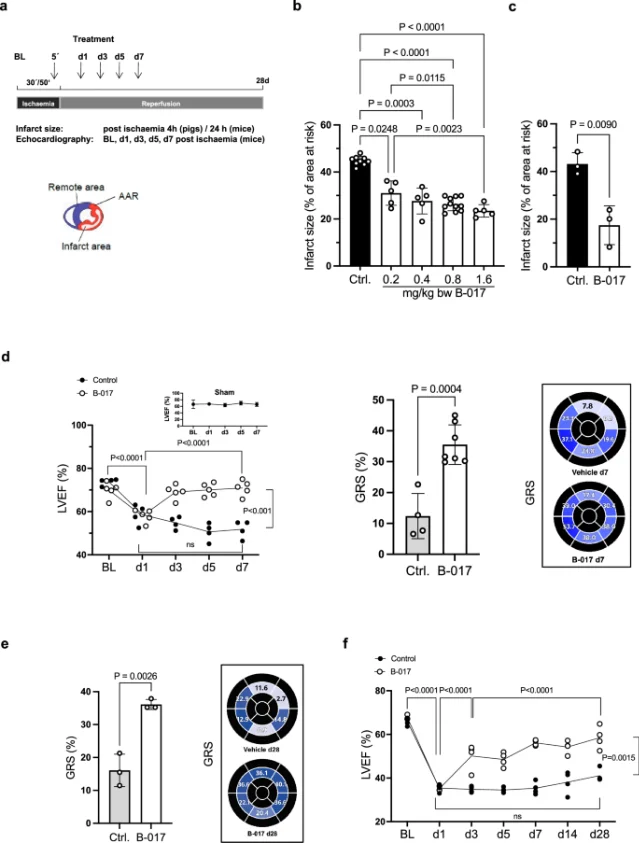
In vivo efficacy: B-017 significantly reduced tissue damage in clinically relevant mouse IRI models across three organ systems: cardiac IRI, cerebral IRI, and hepatic IRI. No off-target toxicity was detected in any model. 8
In vivo B-017 protective effects in cardiac, cerebral, and hepatic ischemia-reperfusion injury models (Hendgen-Cotta, Rassaf et al., Fig. 5)
B-017 reduces IRI-induced tissue damage across three organ systems in mice. 8
Why this matters beyond prior apoptosis-targeting attempts: Multiple clinical trials of late-stage apoptosis inhibitors — including caspase inhibitors and mitochondrial permeability transition pore (mPTP) blockers — failed in cardiac IRI, likely because IRI simultaneously activates both apoptosis and necrosis and because downstream effector targeting leaves the upstream signal intact. B-017 intervenes at the BNIP3–BAX interaction upstream of both pathways and in a hypoxia-specific context, which is mechanistically distinct from the earlier failed approaches. The simultaneous multi-organ protection suggests BNIP3 is a convergent mediator rather than an organ-specific one.
Clinical implication: B-017 is currently a preclinical candidate — no human data yet. The translational signal is: multi-organ IRI is the core complication of cardiac surgery with cardiopulmonary bypass, liver transplantation, and stroke reperfusion therapy (thrombectomy or tPA). A peptide that demonstrates protection across all three in a single compound — if the signal holds in larger animal models and pharmacokinetic development — would address a persistent unmet need that has resisted prior drug programs. The next milestones are large-animal IRI models and formal IND-enabling toxicology. Cardiac surgeons, transplant hepatologists, and stroke neurologists should track this as an early-stage program with an unusually broad target profile.
Funding: Disclosed as University of Duisburg-Essen institutional funding (article is open access CC-BY; specific grant numbers not listed in abstract). No competing interests declared.

5. Decellularized meniscus scaffold (MEND) outperforms autologous costal cartilage in pediatric laryngotracheal reconstruction — zero adverse events in 38-rabbit study (Nature Communications, IF ~14.7)
Journal: Nature Communications · IF ~14.7, Open Access CC-BY · Published June 17, 2026 · DOI: 10.1038/s41467-026-73680-2 · Children's Hospital of Philadelphia / University of Pennsylvania
Design: Preclinical translational study. Materials development phase: porcine menisci underwent selective elastase-based decellularization creating aligned microchannels (average diameter 6 ± 3 μm, 16% porosity) — the MEND scaffold (MENiscal Decellularized scaffold). Seeding phase: ear-derived cartilage progenitor cells (eCPCs, obtained by minimally invasive ear biopsy) fully recellularized MEND in 3 days and reached implant-ready maturation in 3 weeks. Animal validation: N=38 New Zealand white rabbits in a laryngotracheal reconstruction (LTR) model, comparing MEND/eCPC grafts vs autologous costal cartilage (the current surgical gold standard). Follow-up: 3 months post-implantation. Investigators: Gehret, Gottardi et al., Children's Hospital of Philadelphia (CHOP) and University of Pennsylvania. 9
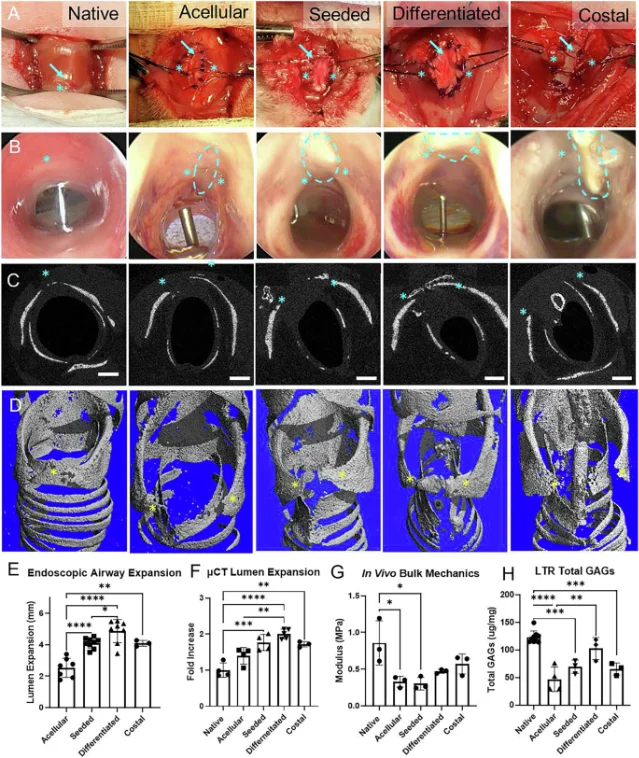
Outcomes: MEND grafts outperformed autologous costal cartilage in all measured outcomes at 3 months: airway lumen expansion, graft re-epithelialization, neocartilage formation, and histological integration with adjacent native laryngotracheal cartilage. Zero adverse events — no extrusion, granulation tissue, infection, or calcification — across all 38 rabbits. 9
Rabbit laryngotracheal reconstruction outcomes at 3 months: MEND grafts vs autologous costal cartilage comparisons including airway expansion, re-epithelialization, and histology (Gehret, Gottardi et al., Fig. 6)
In vivo laryngotracheal reconstruction outcomes at 3 months: MEND vs autologous costal cartilage. 9
Why meniscus?: Porcine menisci are a byproduct of the food industry (abundant, reproducible, low-cost source). The selective elastase digestion preserves the collagen ECM and its aligned fiber architecture, which physically guides recellularization — a key advance over simpler decellularization protocols that collapse the scaffold structure. The eCPC cell source requires only an ear punch biopsy, avoiding the rib harvest that generates the perioperative morbidity and thoracic scar of autologous costal cartilage. The 3-week manufacturing window is compatible with elective surgical scheduling.
Clinical context: Over 20,000 US infants per year develop severe subglottic stenosis requiring LTR. The current gold standard — autologous rib cartilage — carries a >24% pediatric revision rate attributed to insufficient graft volume, especially in neonates and infants, and requires a separate thoracic incision. MEND addresses both limitations simultaneously (no rib harvest, off-the-shelf scaffold with patient-specific cells). 9
Clinical implication: This remains preclinical — the rabbit LTR model is a validated but small-animal system; primate or large-animal bridge studies and IND-enabling manufacturing scale-up are the expected next steps before first-in-human trials. The zero adverse event profile at 3 months is a meaningful safety signal for the regulatory package. Pediatric otolaryngologists and cardiothoracic surgeons managing LTR patients — particularly neonates with high rib-harvest risk — should track CHOP's IND timeline and the manufacturing scale-up pathway, where porcine meniscus supply chain and GMP cell expansion are the limiting variables.
Funding: Not specified in abstract; institutional affiliation CHOP/Penn. Porcine meniscus sourcing from commercial food processing streams (no material supply constraint anticipated).

Cover image: photo by Edward Jenner via Pexels (royalty-free).

相似内容

围绕这条内容继续补充观点或上下文。

  • 登录后可发表评论。