
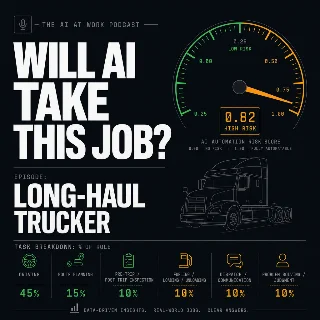
Will AI Take the Long-Haul Trucker's Job?

Aurora's trucks are running driverless hauls right now — but 2.2 million trucking jobs aren't vanishing overnight. A task-by-task breakdown of what autonomous systems can do today, where the exposure actually lands, and why wage compression may be the bigger threat.

Will AI Take the Long-Haul Trucker's Job?
0:0021:52
On April 27, 2025, a Class 8 semi-truck pulled out of a Dallas terminal with nobody in the cab. No safety driver. No one to take the wheel. It ran 240 miles down I-45 to Houston, dropped its load, and came back — alone. Aurora Innovation called it a commercial haul. It was. And yet the Bureau of Labor Statistics still projects this occupation to grow 4% through 2034. Both things are true. That tension is what this episode is about.
Key findings
  • The "3.5 million jobs at risk" headline conflates distinct job types. The directly at-risk segment — non-specialized long-haul highway freight — is closer to 294,000 jobs, per the UC Berkeley Labor Center analysis.
  • Aurora launched commercial driverless operations in May 2025 (Dallas–Houston), surpassed 250,000 driverless miles by June 2025, and expanded to 10 routes across the U.S. Sun Belt by February 2026. Kodiak launched driverless commercial operations in December 2024 and has delivered over 12,600 commercial loads.
  • All current systems are SAE Level 4: they operate within defined domains — hub-to-hub on specific highway corridors. First-and-last-mile urban delivery, complex docking, hazmat, oversized, and livestock hauling remain outside those domains.
  • BLS's February 2025 analysis explicitly reviewed autonomous truck technology and kept the growth projection unchanged — calling the technology "commercially constrained" at current scale.
  • The more consequential risk may not be headcount loss but wage compression: if high-wage, unionized long-haul miles shift to AV fleets, what remains for human drivers is predominantly gig-economy last-mile work — lower pay, fewer benefits, no collective bargaining.
  • Verdict: medium-high displacement risk for repetitive long-haul highway freight over a 10-year horizon; low near-term risk for local, specialized, and first-and-last-mile roles.
Chapter timestamps
  • 0:08 — Cold open: the April 2025 driverless haul
  • 2:13 — Task breakdown: six categories, one automatable
  • 4:41 — Deployment reality check: Aurora and Kodiak in actual numbers
  • 6:51 — Where the exposure actually lives: 294K, not 3.5M
  • 9:36 — The driver shortage counterforce
  • 12:29 — Augmentation: AI tools already in the cab
  • 14:55 — Regulatory and physical constraints
  • 17:28 — Verdict
Sources

围绕这条内容继续补充观点或上下文。

  • 登录后可发表评论。