July 23 in business history: The first signal is not the business
Four July 23 breakthroughs show why a launch, acquisition, or demonstration only becomes durable when its channel, funding model, reliability, and access rules can repeat.

A demonstration can be a business event, not a business
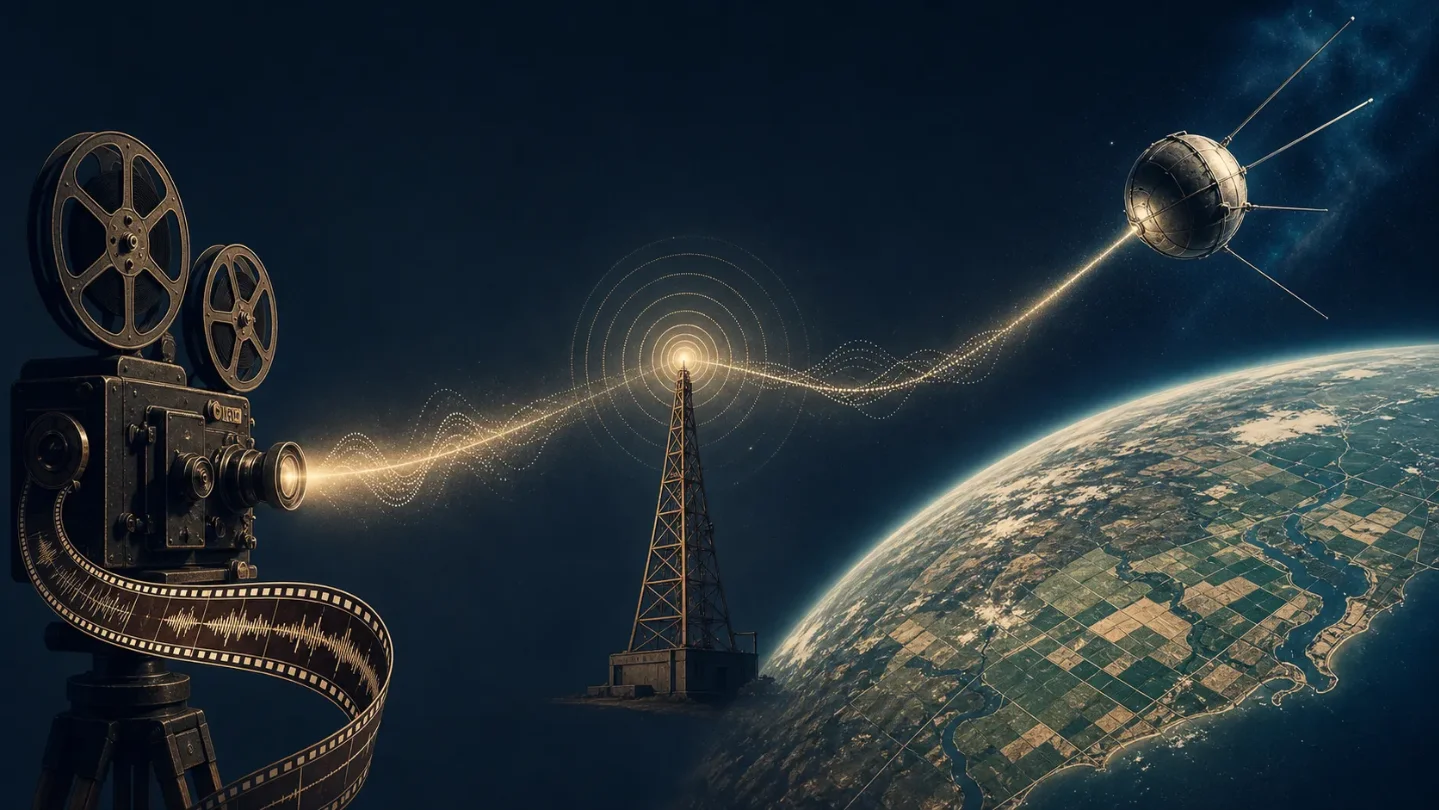
On July 23 across 46 years, four decisions moved new signals into public view. Fox Film acquired the patent rights behind Movietone sound-on-film recording. A private company put India's first organized radio network on air. AT&T's Telstar carried live television across the Atlantic. NASA launched the satellite that became Landsat 1, a public Earth-observation platform.
Each event proved that something could happen once. None, by itself, proved that the system could repeat the result at an acceptable cost. That is the useful mirror for today's product launch, infrastructure investment, or strategic partnership: the first signal earns attention, but the channel, operating model, and access rules determine whether attention becomes a business.
1926: Fox bought the sound, then had to find its audience
On July 23, 1926, Fox Film bought the patents of the Movietone sound system, a method for recording sound onto film. 1 The underlying work came from Theodore Case and Earl I. Sponable at the Case Research Laboratory. William Fox and Case then created Fox-Case Corporation to commercialize the technology inside the film business. 2
The acquisition gave Fox a technical position in the race to make filmed images audible. It did not yet give the studio a product customers would pay to see. The decisive work came after the transaction: Fox-Case put the system into a mobile recording truck, ran its first field trial at West Point in March 1927, and showed the resulting synchronized-sound footage publicly at New York's Roxy Theatre on April 29. The company then used Movietone for talking newsreels, where the sound of an event could be part of the news rather than a separate narration added later. 2
The business moved because the technology found a distribution job. A sound film of a public figure or a dramatic event could travel through the existing theater network and make the new capability legible to an audience. By late 1927, Encyclopedia.com records 150 Movietone installations. The same account places Fox's first full Movietone feature, Sunrise: A Song of Two Humans, in September 1927, while the Cayuga Museum notes that the optical system ultimately proved more commercially durable than Warner Bros.' sound-on-disc Vitaphone. 3 4
The decision mirror is narrow but demanding. An acquisition is not a capability until the buyer can move it through a repeatable route to customers. For a technology deal on today's agenda, ask what has to happen after the patents, code, or laboratory team change hands. Which sales channel, installation base, workflow, or partner network turns the acquired asset into a habit? Fox did not win by owning a sound system in isolation. It won by putting sound where audiences already gathered.
1927: India's first private broadcaster showed the cost of a missing model
On July 23, 1927, the Indian Broadcasting Company came into being, and its Bombay station began broadcasting. A second station followed in Calcutta on August 26. This was an organized private broadcasting venture, not the first radio experiment in India: the Radio Club of Bombay had broadcast as early as June 1923. 5 6
The launch carried a familiar promise. Radio could turn one program into a service that reached many listeners at once, but the network also required transmitters, programming, maintenance, scheduling, and a dependable way to fund all of it. The first broadcast proved that the service could operate. It did not settle how a private broadcaster would sustain audience growth and infrastructure costs.
The outcome was stark. Prasar Bharati's institutional history says the Indian Broadcasting Company faced liquidation in less than three years. In April 1930, the Indian Broadcasting Service began operating under the government on an experimental basis. The service became All India Radio in 1936; the broadcaster now known as AIR eventually grew into a nationwide network. 5
The official history does not, on the page cited here, break the liquidation into a single cause. That is useful discipline: the date supports the launch and the later institutional change, not a confident claim about one failed revenue mechanism. The observable business lesson is still clear. A network product can look viable at the moment of first transmission while its cost base and funding structure remain unresolved.
For a current platform or media decision, separate three proofs that are often bundled together: someone can use the product; an audience will return; and the organization can pay for the infrastructure between uses. If the first proof is the only one on the table, the company has demonstrated a broadcast, not a durable service. The next question belongs in the launch plan, not in a postmortem: what funds the second year?
1962: Telstar separated a spectacular demo from a continuous service
At 3:00 p.m. Eastern time on July 23, 1962, Telstar 1 relayed the first publicly available live transatlantic television signal. The program was carried in Europe by Eurovision and in North America by NBC, CBS, ABC, and CBC. 7 The satellite itself had launched on July 10. Bell Telephone Laboratories developed it for AT&T as an active communications satellite, meaning it received a signal, processed it onboard, and retransmitted it to another location. 8
The demonstration was commercially meaningful because it made a new service visible to millions of viewers. It also exposed the gap between a successful transmission and a reliable network. Telstar facilitated more than 400 telephone, telegraph, facsimile, and television transmissions before its electronics failed in November 1962 after radiation damage from the Van Allen belts. 8
There was a second constraint. Telstar circled the Earth every two and a half hours but was in the right position to beam a signal between the United States and Europe for only about 20 minutes per orbit. Bell Labs' later account explains why subsequent satellites had to work in tandem, passing the broadcast from one satellite to the next if live transmission was to continue. 9
That is a useful test for any infrastructure promise. What service level did the announcement imply, and what physical or organizational constraint makes that service hard to repeat? A one-off demo can tolerate a narrow window, a hand-built process, or a single point of failure. A product customers depend on cannot. The real design work begins when the team maps the handoffs, redundancy, maintenance, and economics required to make the moment ordinary.
Telstar's result was not failure because the first satellite stopped working. The demonstration did its job: it proved the path and revealed the operating requirements for the next generation. The management error would have been treating the proof as the finished network.
1972: Landsat made access part of the product
On July 23, 1972, NASA launched the Earth Resources Technology Satellite, later renamed Landsat 1, on a Delta 900 rocket from Vandenberg Air Force Base. It was the first civilian Earth-observation satellite designed specifically to study the planet, with an objective of continuously acquiring imagery of land for environmental and resource management. 10 11
The launch was a product decision as much as an aerospace achievement. Landsat 1 was designed to operate for one year but collected images for five and a half years. Its value came from repeated observation, not from a single spectacular image. The platform created a consistent way to compare land, resources, and environmental change over time. 11
The larger business consequence arrived through the access model. In 2008, USGS, NASA, and the Department of the Interior approved a data-distribution policy that made Landsat imagery free to the public worldwide. USGS says that policy helped companies including Amazon, Esri, Google, and Microsoft host the archive and build tools for searching, processing, and visualizing it. Cloud computing later reduced some large-scale processing tasks from months to hours. 12
The mirror is not that every company should give away its core asset. It is that the access rule can determine whether a technical asset remains a demonstration or becomes infrastructure. Landsat's public availability let users, researchers, land managers, and software companies add value without first negotiating access to every image. The resulting ecosystem was not an accidental side effect of the satellite; it depended on a decision about who could use the data and on what terms.
When approving a platform, ask what kind of participation the rules invite. Which layer must remain proprietary? Which layer becomes more valuable when others can build on it? What is the cost of restricting access, even if the restriction protects short-term revenue? A product that nobody can easily test, combine, or revisit may be technically impressive and commercially lonely.
The managerial test for July 23
These four July 23 decisions separate four kinds of repeatability:
- Capability transfer: Fox acquired sound-on-film rights, then built a field and theater distribution path. Ask what work turns an acquisition into a usable capability.
- Economic continuity: The Indian Broadcasting Company put a private network on air, then disappeared into liquidation in under three years. Ask how the service is funded after the launch budget is spent.
- Service reliability: Telstar proved transatlantic live television, then exposed its short transmission window and radiation risk. Ask what the customer promise requires between demonstrations.
- Ecosystem access: Landsat became more useful as its imagery became broadly available. Ask which access rules let other participants increase the value of the asset.
Before approving today's product launch, acquisition, or infrastructure bet, name the first result that has to repeat. Then name who operates the channel, who pays for the interval between uses, and who is allowed to build on the asset. The first signal gets the headline. The system behind it decides whether the headline has a second act.
参考来源
- 1July 23
- 2Beaten by their own Scoop: Fox Movietone News and the Orteig Prize
- 3Fox-Case, Movietone, and the Talking Newsreel
- 4Movietone vs. Vitaphone
- 5Growth & Development
- 6National Broadcasting Day: Marking 1st ever radio broadcast from Bombay station in 1927
- 7Telstar
- 8Model, Communications Satellite, Telstar
- 9Telstar 1
- 10Landsat 1
- 11Formerly Earth Resources Technology Satellite (ERTS-1)
- 12Fifty Years of Landsat: Sharing Earth information for the benefit of all
相似内容
- 登录后可发表评论。