"He cannot chuse but hear": Coleridge's grammar of enchantment
In the opening of Coleridge's 1798 Rime, repeated verbs of holding and hearing turn a wedding guest's detour into the poem's first act of enchantment.

The passage
Samuel Taylor Coleridge, "The Rime of the Ancyent Marinere," in Lyrical Ballads, 1798, Part I. Original spelling and punctuation retained. 1
He holds him with his glittering eye— The wedding guest stood still, And listens like a three year’s child: The Mariner hath his will.The wedding guest sate on a stone, He cannot chuse but hear: And thus spake on that ancient man, The bright-eyed Mariner.The Ship was cheer’d, the Harbour clear’d— Merrily did we drop Below the Kirk, below the Hill, Below the Light-house top.The Sun came up upon the left, Out of the Sea came he: And he shone bright, and on the right Went down into the Sea.Higher and higher every day, Till over the mast at noon— The wedding-guest here beat his breast, For he heard the loud bassoon.The Bride hath pac’d into the Hall, Red as a rose is she; Nodding their heads before her goes The merry Minstralsy.The wedding-guest he beat his breast, Yet he cannot chuse but hear: And thus spake on that ancyent Man, The bright-eyed Marinere.Listen, Stranger! Storm and Wind, A Wind and Tempest strong! For days and weeks it play’d us freaks— Like Chaff we drove along.Listen, Stranger! Mist and Snow, And it grew wond’rous cauld: And Ice mast-high came floating by, As green as Emerauld.And thro’ the drifts the snowy clifts Did send a dismal sheen; Ne shapes of men ne beasts we ken— The Ice was all between.The Ice was here, the Ice was there, The Ice was all around: It crack’d and growl’d, and roar’d and howl’d— Like noises of a swound.At length did cross an Albatross, Thorough the Fog it came; And an it were a Christian Soul, We hail’d it in God’s name.The Marineres gave it biscuit-worms, And round and round it flew: The Ice did split with a Thunder-fit; The Helmsman steer’d us thro’.And a good south wind sprung up behind, The Albatross did follow; And every day for food or play Came to the Marinere’s hollo!In mist or cloud on mast or shroud It perch’d for vespers nine, Whiles all the night thro’ fog-smoke white Glimmer’d the white moon-shine.“God save thee, ancyent Marinere! “From the fiends that plague thee thus— “Why look’st thou so?”—with my cross bow I shot the Albatross.
A few words worth pausing over
- "Chuse but hear" means "can do nothing except hear." The phrase matters because it makes listening sound like compulsion rather than a decision.
- "Hollo" is a shout or call used to summon or greet. The Mariner's call gives his relation with the albatross the shape of a social exchange.
- "Swound" means a swoon or fainting fit. The phrase "noises of a swound" makes the cracking ice feel not merely audible but bodily, as if the landscape itself were losing consciousness.
Close read: how the poem captures an ear
The poem's first verb in this passage is not tells but holds. The Mariner's glittering eye performs the same work as a hand: it stops the wedding guest, freezes him in place, and converts the sentence "The Mariner hath his will" into a small statement of possession. The next line makes the mechanism explicit. "He cannot chuse but hear" is not simply a description of interest; its modal construction removes the possibility of an alternative action. The guest may be sitting at the wedding, but grammatically he has already been taken elsewhere.
The wedding does not disappear. The bassoon, the bride, and the "merry Minstralsy" keep supplying a competing world, one with movement, music, and a social future. But the repeated phrase "Yet he cannot chuse but hear" routes attention back to the old sailor. The frame keeps reasserting itself through the repeated names "the wedding-guest" and "the bright-eyed Marinere," as though the poem must say who is listening and who is speaking before the spell can continue. Then the Mariner changes the address: "Listen, Stranger!" The word widens the scene beyond the man on the stone. A stranger is anyone who has not yet heard the tale, which makes the reader's own attention part of the poem's machinery.
The landscape repeats that capture in physical form. "The Ice was here, the Ice was there, / The Ice was all around" moves from point to point and then closes the circle. The repeated noun and the shifting adverbs do not add new scenery so much as remove every direction of escape. Against that enclosure, the albatross arrives as a figure of relation: it is greeted as a "Christian Soul," fed, and welcomed back in response to the Mariner's "hollo." Its movement around the ship briefly turns a hostile world into a shared one. The last four lines break that fellowship with startling compression. After the long, patterned account of fog, ice, moonlight, and companionship, the crossbow arrives almost without explanation: "with my cross bow / I shot the Albatross." The poem makes the act feel as abrupt in syntax as it is consequential in the story.
The first edition of Lyrical Ballads presents the poem as "The Rime of the Ancyent Marinere" and describes it as an experiment in the style and spirit of older poetry while insisting that its language remains intelligible. 1 That combination helps explain the passage's peculiar force: archaic spellings give the voice the distance of a ballad remembered from elsewhere, while plain verbs such as "holds," "hear," "follow," and "shot" keep the enchantment mechanically close to the reader's ear.
A question to carry with you
When have you been drawn into an account, conversation, or screen that first felt like an interruption but gradually claimed your attention? What, in its language or rhythm, made leaving difficult?
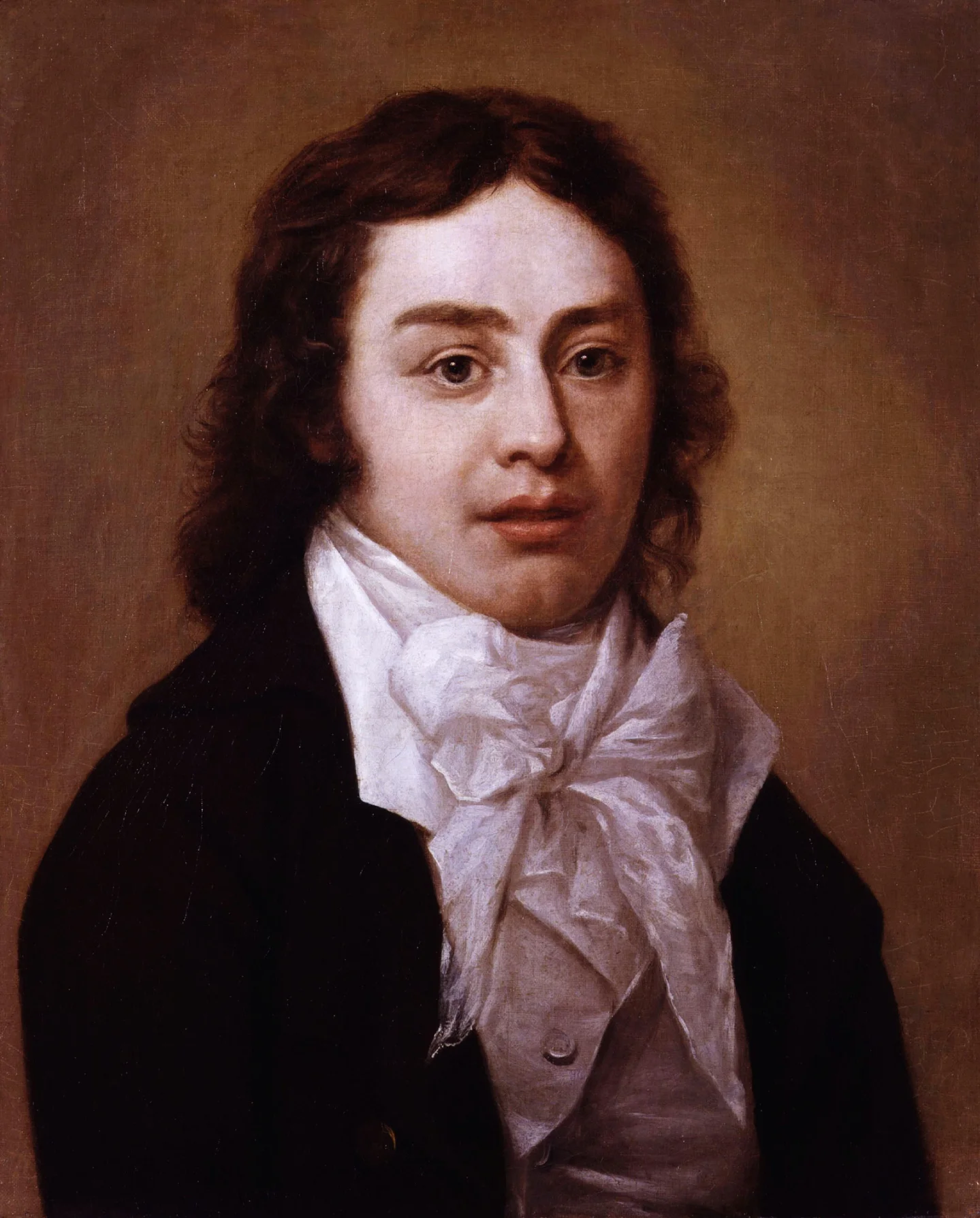
Cover image: Portrait of Samuel Taylor Coleridge (1795), attributed to Peter Vandyke; public-domain file via Wikimedia Commons. 2
相似内容
- 登录后可发表评论。
More from this channel
- "Up we go!": Grahame lets spring interrupt the Mole
- "The full African moon": Schreiner makes a landscape wait for life
- "The studio was filled": Wilde makes beauty a social instrument
- "The Time Traveller": Wells makes a person into a hypothesis
- "The force of truth": Socrates refuses the courtroom's costume
- The Unwritten Epic: George Eliot on Lives Without a Stage
- "A peace-mingling falsehood": Sa'di's moral grammar
- "The shadow swept": Du Bois builds the veil