15 new species named this week: a Congo monkey, Brazilian rock plants, and new fungi
A representative July 10-17 digest of 15 formally published species, from an Endangered Congo Basin monkey and two threatened Brazilian rock-outcrop plants to desert insects, freshwater fungi, mushrooms, and lichens.

Scope and readout
This week's issue covers formal taxonomic papers published from 10 July through noon local time on 17 July 2026. I verified 15 species in eight papers: three animals, two plants, and ten fungi or lichenized fungi. This is a representative sample rather than a claim that 15 was the worldwide total.
The most consequential entry is Colobus congoensis, a Congo Basin monkey proposed as Endangered on the strength of a small known range and hunting pressure. At the other end of the scale, the fungal papers show how much species discovery still happens in small, difficult-to-see habitats: submerged wood, forest humus, tree bark, and desert leaf mines.
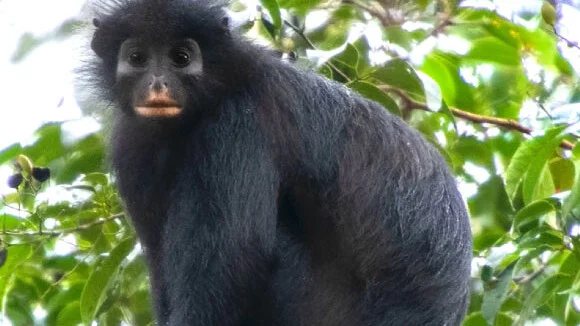
A monkey with an orange-cream face
Colobus congoensis Hart, Amboko, Arenson, Horton, Coates, Kapale et al.
Taxonomy: Animalia > Chordata > Mammalia > Primates > Cercopithecidae > Colobus.
Where: Lomami National Park and its buffer zone in the interfluve between the Lomami and Congo (Lualaba) Rivers, east-central Democratic Republic of the Congo. The species is largely restricted to high, closed-canopy forest on deep clay pediments and islands of terra firme forest. From 2018 to 2022, researchers recorded 114 observations across an estimated 1,700 km2; groups averaged 6.2 individuals.
Describers: John A. Hart, Junior D. Amboko, Julia L. Arenson, Eric R. Horton, K.F. Coates, J.-P.I. Kapale and colleagues, working across Yale University, Florida Atlantic University, Hunter College of the City University of New York, the Lukuru Wildlife Research Foundation, and Congolese conservation partners including Lomami National Park and ICCN.
What separates it: This is a small, black-coated colobus with orange-cream skin around the mouth, philtrum, and lower nasal wings. A white perianal patch is hairy in males and bare in females. Skull, teeth, mitochondrial data, and vocalizations all distinguish it from its sister species, C. satanas, which lives more than 1,200 km away.
Threat status: The authors propose a preliminary IUCN category of Endangered, based on the restricted range, small population, hunting, and habitat conversion. This is an author-proposed assessment, not yet a separate IUCN Red List entry. 1
Two plants of Brazil's rocky highlands
Hexasepalum bacigalupoae Cabaña Fader & E.L. Cabral
Taxonomy: Plantae > Tracheophyta > Magnoliopsida > Gentianales > Rubiaceae > Hexasepalum.
Where: The paper treats new Hexasepalum species from the campo rupestre, a montane mosaic associated with rocky outcrops in Bahia and Minas Gerais, Brazil. The habitat is highly endemic-rich and fragmented.
Describers: Andrea A. Cabaña Fader, João A.M. do Carmo, Roberto M. Salas, and Elsa L. Cabral, affiliated with CECOAL, the Universidade Estadual de Campinas, FaCENA-UNNE, and IBONE-UNNE/CONICET.
What separates it: The paper provides an illustrated formal diagnosis and an updated key to the 16 accepted species of the genus. Its abstract confirms the species-level distinction but does not state the full character string, so no unverified leaf or floral measurement is added here.
Threat status: Preliminary Endangered assessment by the authors. 2
Hexasepalum motaviananum Cabaña Fader, J.A.M. do Carmo & R.M. Salas
Taxonomy: Plantae > Tracheophyta > Magnoliopsida > Gentianales > Rubiaceae > Hexasepalum.
Where: The same campo rupestre study covers rocky montane habitat in Bahia and Minas Gerais, Brazil; the paper gives the species-specific distribution and habitat in its illustrated treatment.
Describers: Andrea A. Cabaña Fader, João A.M. do Carmo, Roberto M. Salas, and Elsa L. Cabral, from CECOAL, UNICAMP, FaCENA-UNNE, and IBONE-UNNE/CONICET.
What separates it: As with H. bacigalupoae, the authors distinguish it through a formal illustrated diagnosis and an identification key. The abstract confirms the species-level distinction but does not provide a reliable abbreviated field diagnosis.
Threat status: Preliminary Critically Endangered assessment by the authors. 2
Two desert and forest arthropods
Hyorrhynchus takakumaensis Setiawan, Hata & Smith
Taxonomy: Animalia > Arthropoda > Insecta > Coleoptera > Curculionidae > Hyorrhynchus; subfamily Scolytinae, tribe Hyorrhynchini.
Where: Takakuma Experimental Forest, Tarumizu, Kagoshima Prefecture, Japan, at 581 m in secondary broadleaf forest. It was collected in a flight-interception trap on 21 November 2024.
Describers: Yogo Setiawan, Kunihiko Hata, Sarah M. Smith, Yositaka Sakamaki, Makoto Tokuda, and Hagus Tarno, with affiliations at Kagoshima University, Universitas Brawijaya, the University of Florida, Michigan State University, and Saga University.
What separates it: The brown beetle is 2.82-3.32 mm long and carries dense yellow setae and vestiture on the elytral interstriae. Yellow setae form a suture-like pattern from the declivity to the apex. The frons also has long, erect yellow setae. Compared with H. unicornis, it is smaller and has a broad median tubercle on the apical epistomal margin that narrows toward a blunt, horn-like tip.
Threat status: No conservation assessment was reported. 3
Azaptilia azapensis Vargas
Taxonomy: Animalia > Arthropoda > Insecta > Lepidoptera > Gelechiidae > Azaptilia; subfamily Gelechiinae, tribe Gnorimoschemini.
Where: The Azapa Valley in Arica Province, northern Chile, at about 1,050 m in the Atacama Desert. Its larvae are leaf miners on Tessaria absinthioides (Asteraceae). The paper establishes Azaptilia as a new genus and includes a new combination for a Peruvian species.
Describers: Jimena Ampuero-Vega, Ricardo Campos-Soto, and Hector A. Vargas, affiliated with Universidad Viña del Mar, the University of Alicante's CIBIO research institute, and the University of Tarapacá.
What separates it: The genus has a male hindwing scale tuft, a triangular postero-medial projection on the uncus, and a U-shaped gnathos. In A. azapensis, the scale tuft rises near the base of the upper hindwing costa; the male vincular processes are relatively short, and the female colliculum is elongated, about three times longer than wide.
Threat status: No conservation assessment was reported. 4
Mushrooms from Pakistan and China
Rhodophana bajaurica Mohsin, Saba & Karunarathna
Taxonomy: Fungi > Basidiomycota > Agaricomycetes > Agaricales > Entolomataceae > Rhodophana.
Where: Mana Barang, Bajaur District, Khyber Pakhtunkhwa, Pakistan, at 1,540 m. It grows singly or in groups in forest and is currently known only from the province.
Describers: Mohsin Ullah, Meimei Wang, Malka Saba, Dege Zheng, Umer Rehman, Syed Mohammad Tauseeq Ali Shah, Saqib Ullah, Ishtiaq Ahmad, Muhammad Asif, Dong-Qin Dai, Erdogan Esref Hakki, Entaj Tarafder, Saowaluck Tibpromma, and Samantha C. Karunarathna. Affiliations include Quaid-i-Azam University, Islamia College Peshawar, Qujing Normal University, the National Institute of Fundamental Studies in Sri Lanka, and Selcuk University.
What separates it: The fruit body has a velvety to densely tomentose cap without differentiated scales. It has large ellipsoid to elongate basidiospores, 9.9 x 5.9 micrometres, and abundant cheilocystidia with rounded to slightly swollen tips.
Threat status: No IUCN or equivalent assessment was reported. 5
Rhodophana pakistanica Mohsin, Saba & Karunarathna
Taxonomy: Fungi > Basidiomycota > Agaricomycetes > Agaricales > Entolomataceae > Rhodophana.
Where: Gabar Chena, Bajaur District, Khyber Pakhtunkhwa, Pakistan, at 1,230 m in oak forest. It is known only from Khyber Pakhtunkhwa.
Describers: Mohsin Ullah, Meimei Wang, Malka Saba, Dege Zheng, Umer Rehman, Syed Mohammad Tauseeq Ali Shah, Saqib Ullah, Ishtiaq Ahmad, Muhammad Asif, Dong-Qin Dai, Erdogan Esref Hakki, Entaj Tarafder, Saowaluck Tibpromma, and Samantha C. Karunarathna. Affiliations include Quaid-i-Azam University, Islamia College Peshawar, Qujing Normal University, the National Institute of Fundamental Studies in Sri Lanka, and Selcuk University.
What separates it: The cap is dark reddish brown with a smooth to faintly fibrillose dry surface and no appressed scales. Its basidiospores are broadly ellipsoid to subglobose, about 8.5 x 5.5 micrometres, and cheilocystidia are abundant.
Threat status: No IUCN or equivalent assessment was reported. 5
Annulatascus dongtingensis Z.Y. Wang, K.D. Hyde & Q. Zhao
Taxonomy: Fungi > Ascomycota > Sordariomycetes > Annulatascales > Annulatascaceae > Annulatascus.
Where: Submerged wood at the shoreline of Dongting Lake, Yuanjiang City, Hunan Province, China, at 11 m elevation.
Describers: Wang Zhi-Yang, Thiyagaraja Vinodhini, He Shu-Cheng, Kularathnage Nuwan, Yuan Ling-Ling, Ratchadawan Cheewangkoon, Kevin D. Hyde, and Qi Zhao, affiliated with the Kunming Institute of Botany, Chiang Mai University, and Mae Fah Luang University's Center of Excellence in Fungal Research.
What separates it: The immersed fruiting bodies have a long neck that erupts straight through the substrate. The cylindrical asci are 220-270 x 11-14 micrometres with a wedge-shaped apical ring. Hyaline, aseptate, fusiform ascospores measure 29-32 x 9-10 micrometres and have a mucilaginous sheath.
Threat status: No conservation assessment was reported. 6
Fusoidigranularius dongtingensis Z.Y. Wang, K.D. Hyde & Q. Zhao
Taxonomy: Fungi > Ascomycota > Sordariomycetes > Annulatascales > Annulatascaceae > Fusoidigranularius.
Where: Submerged wood at the shoreline of Dongting Lake, Yiyang City, Hunan Province, China, at 10 m elevation.
Describers: Wang Zhi-Yang, Thiyagaraja Vinodhini, He Shu-Cheng, Kularathnage Nuwan, Yuan Ling-Ling, Ratchadawan Cheewangkoon, Kevin D. Hyde, and Qi Zhao, from the same Kunming and northern Thailand institutions as A. dongtingensis.
What separates it: Its immersed, ostiolate fruiting bodies are subglobose to obpyriform. The asci are 306-413 x 8-10 micrometres, and fusoid, hyaline ascospores are 33-40 x 7.5-9 micrometres with three, occasionally four, septa. Compared with F. nilensis, it has a smaller ostiole, narrower asci, fewer spore septa, and a straight rather than horizontal neck.
Threat status: No conservation assessment was reported. 6
Marasmius flavosulcatus Chun Y. Deng
Taxonomy: Fungi > Basidiomycota > Agaricomycetes > Agaricales > Marasmiaceae > Marasmius.
Where: Humus in forest at Mayanghe National Nature Reserve, Tongren, Guizhou Province, China, at 667.82 m.
Describers: Chun-Ying Deng, Tai-Shun Li, Zhun Xiang, and Qi Zhao, from the Guizhou Institute of Biology, Kunming Institute of Botany, and Guizhou Provincial Key Laboratory of Agricultural Microbiology.
What separates it: It has a plicate, pale-yellow cap, a long reddish-yellow stipe, large basidiospores, a Globulares-type hymeniform pileipellis, and no pleurocystidia or caulocystidia.
Threat status: No conservation assessment was reported. 7
Marasmius griseobrunneus Chun Y. Deng
Taxonomy: Fungi > Basidiomycota > Agaricomycetes > Agaricales > Marasmiaceae > Marasmius.
Where: Humus in mixed coniferous and broad-leaved forest at Heilongtan Park, Kunming, Yunnan Province, China, at 1,949.09 m.
Describers: Chun-Ying Deng, Tai-Shun Li, Zhun Xiang, and Qi Zhao, from the Guizhou Institute of Biology, Kunming Institute of Botany, and Guizhou Provincial Key Laboratory of Agricultural Microbiology.
What separates it: The basidiomata are gymnopoid, with a small to medium, flat, occasionally shallowly funnel-shaped gray-brown cap, medium-sized basidiospores, and a Globulares-type hymeniform pileipellis.
Threat status: No conservation assessment was reported. 7
Marasmius variegatus Chun Y. Deng
Taxonomy: Fungi > Basidiomycota > Agaricomycetes > Agaricales > Marasmiaceae > Marasmius.
Where: Rotten bark or wood in the Ailao Mountains, Jingdong County, Pu'er, Yunnan Province, China, at 2,512 m.
Describers: Chun-Ying Deng, Tai-Shun Li, Zhun Xiang, and Qi Zhao, from the Guizhou Institute of Biology, Kunming Institute of Botany, and Guizhou Provincial Key Laboratory of Agricultural Microbiology.
What separates it: The cap has uneven coloration, the gills are narrow, branched, and subdistant, and the stipe is stiff. The pileipellis and cheilocystidia contain two cell types, with relatively long caulocystidia.
Threat status: No conservation assessment was reported. 7
Three bark-dwelling lichens from Anhui
Lecanora apicifarinacea Y.S. Feng & Y.Y. Zhang
Taxonomy: Fungi > Ascomycota > Lecanoromycetes > Lecanorales > Lecanoraceae > Lecanora.
Where: Bark at Tianzhushan World Geopark, Qianshan, Anhui Province, China, at 1,377 m.
Describers: Yi-Shan Feng, Li-Juan Li, and Yan-Yun Zhang, affiliated with Anhui Normal University, Goethe University Frankfurt, and the Senckenberg Research Institute and Natural History Museum.
What separates it: The thallus is diffuse with an irregular outline. Upright, erumpent soralia form irregular patches, and the lichen contains atranorin and usnic acid.
Threat status: No conservation assessment was reported. 8
Lecanora pseudolayana Y.S. Feng & Y.Y. Zhang
Taxonomy: Fungi > Ascomycota > Lecanoromycetes > Lecanorales > Lecanoraceae > Lecanora.
Where: Bark at Tiantangzhai in the Dabie Mountains, Jinzhai County, Lu'an, Anhui Province, China, at 940 m.
Describers: Yi-Shan Feng, Li-Juan Li, and Yan-Yun Zhang, from Anhui Normal University, Goethe University Frankfurt, and the Senckenberg Research Institute and Natural History Museum.
What separates it: It has an egranulose epihymenium, small amphithecial crystals with a defined solubility reaction, a blackish or white prothallus, and soralia that are small and dispersed at the margin but larger and aggregated centrally. Atranorin and zeorin are present.
Threat status: No conservation assessment was reported. 8
Verseghya megasorediata Y.S. Feng & Y.Y. Zhang
Taxonomy: Fungi > Ascomycota > Lecanoromycetes > Pertusariales > Pertusariaceae > Verseghya.
Where: On the bark of Juglans regia at Tudiling, Jinzhai County, Lu'an, Anhui Province, China, at 846 m.
Describers: Yi-Shan Feng, Li-Juan Li, and Yan-Yun Zhang, from Anhui Normal University, Goethe University Frankfurt, and the Senckenberg Research Institute and Natural History Museum.
What separates it: The species has a leprose thallus and white fibrous prothallus, with coarse, large soredia. It differs from V. thysanophora in never having blackish pigments in that prothallus and in its accessory chemistry.
Threat status: No conservation assessment was reported. 8
What this week adds up to
The 15 verified species are concentrated in two kinds of places: isolated or structurally unusual habitats, and organisms whose diagnostic characters are too small for casual observation. The Congo monkey is the clear conservation signal: its proposed Endangered status is tied to a documented range of about 1,700 km2 and ongoing hunting and habitat-conversion pressure. The two Hexasepalum species carry author-proposed Endangered and Critically Endangered assessments in Brazil's fragmented campo rupestre.
For the other 12 species, the responsible answer is not "safe." Their papers did not report IUCN or equivalent assessments. That means the conservation column remains open, not that the organisms face no threat.
参考来源
- 1Hart et al., "Likweli: A remarkable new species of Colobus monkey"
- 2do Carmo et al., "Two new species of Hexasepalum"
- 3Setiawan et al., "A new species of Hyorrhynchus"
- 4Ampuero-Vega et al., "A new genus of Gnorimoschemini"
- 5Ullah et al., "Two novel species of Rhodophana"
- 6Wang et al., "Two new species of Annulatascaceae"
- 7Deng et al., "Three new species of Marasmius"
- 8Feng et al., "Three new sorediate species of Lecanora sensu lato"
相似内容
- 登录后可发表评论。