"Mrs. Dalloway said she would buy the flowers herself" — Woolf's opening and the technique that changed fiction
Virginia Woolf opens Mrs. Dalloway (1925) with six words and no quotation marks — and within two sentences the reader is inside a character's mind without knowing how they got there. This issue examines free indirect discourse: the technique Woolf uses to dissolve the boundary between narrator and character, with a gloss on three key phrases and a reflection on inner speech versus outer narration.

Mrs. Dalloway said she would buy the flowers herself. Six words. A third-person narrator, an unnamed character, a simple errand. And yet by the time Woolf is done with the next three paragraphs, that sentence has opened into an entire interior world — one that belongs not quite to the narrator and not quite to Clarissa, but to both at once.
The passage
Mrs. Dalloway said she would buy the flowers herself.For Lucy had her work cut out for her. The doors would be taken off their hinges; Rumpelmayer's men were coming. And then, thought Clarissa Dalloway, what a morning — fresh as if issued to children on a beach.What a lark! What a plunge! For so it had always seemed to her, when, with a little squeak of the hinges, which she could hear now, she had burst open the French windows and plunged at Bourton into the open air. How fresh, how calm, stiller than this of course, the air was in the early morning; like the flap of a wave; the kiss of a wave; chill and sharp and yet (for a girl of eighteen as she then was) solemn, feeling as she did, standing there at the open window, that something awful was about to happen; looking at the flowers, at the trees with the smoke winding off them and the rooks rising, falling; standing and looking until Peter Walsh said, "Musing among the vegetables?" — was that it? — "I prefer men to cauliflowers" — was that it? He must have said it at breakfast one morning when she had gone out on to the terrace — Peter Walsh. He would be back from India one of these days, June or July, she forgot which, for his letters were awfully dull; it was his sayings one remembered; his eyes, his pocket-knife, his smile, his grumpiness and, when millions of things had utterly vanished — how strange it was! — a few sayings like this about cabbages.She stiffened a little on the kerb, waiting for Durtnall's van to pass. A charming woman, Scrope Purvis thought her (knowing her as one does know people who live next door to one in Westminster); a touch of the bird about her, of the jay, blue-green, light, vivacious, though she was over fifty, and grown very white since her illness. There she perched, never seeing him, waiting to cross, very upright.
Virginia Woolf, Mrs. Dalloway (1925), opening pages 2
Gloss
"fresh as if issued to children on a beach" — Issued carries a bureaucratic, institutional weight: children don't receive a beach morning the way they receive rations or uniforms. The word is mildly absurd applied to weather. That slight wrongness is deliberate. Woolf is recording how the mind reaches for analogy and slightly misses, which is truer to thought than a polished simile would be.
"What a lark! What a plunge!" — These are exclamations, but they are Clarissa's vocabulary, not the narrator's. Lark (a spontaneous, lighthearted escapade) is a word from her class and generation, circa 1923 London. The exclamation mark after a single noun — no verb, no subject — is the signature rhythm of interior excitement. Notice the pair: lark is buoyant, plunge is vertiginous. The morning feels both.
"the leaden circles dissolved in the air" — Woolf uses this phrase a few pages later for Big Ben's chime. Leaden circles is synesthesia: we see sound. The adjective leaden carries the weight and dullness of the metal, against the verb dissolved, which implies lightness and dissipation. The phrase will recur across the novel like a tolling. It is the book's own heartbeat.
The device: free indirect discourse
What makes these paragraphs strange is that no quotation marks appear after the opening sentence, yet we are clearly inside Clarissa's mind within two lines. This technique is called free indirect discourse: the narrator's third-person voice absorbs the character's inner speech without announcing the transition with a "she thought" tag.
Watch how it works mechanically. The first sentence is pure narration: "Mrs. Dalloway said she would buy the flowers herself." A narrator reporting speech. Then: "For Lucy had her work cut out for her." Still narration — but for is doing something. It means because, as Clarissa would explain to herself, not as a narrator would explain to us. The grammar of self-justification has leaked into the third person.
By "What a lark! What a plunge!" there is no pretense of narration at all. We are in Clarissa's exclamations — but no speech marks, no "she thought." Woolf never bothers to signal the crossing.
The effect is that reading the passage feels less like being told about Clarissa's morning walk and more like inhabiting it. The reader does not observe the character; the reader is the character, briefly — which is exactly what Woolf wanted to describe. The novel is about what it means to be a self moving through time, and the technique enacts that experience rather than only reporting it.
There is also a small structural trick at the end of the third paragraph. Clarissa, walking in present-day London, slides back to a memory of Bourton — the country house where she grew up, where Peter Walsh made his remark about cauliflowers — and then the paragraph snaps back to "She stiffened a little on the kerb." We have been on a country terrace in memory and returned to a London curb without a chapter break or even a paragraph break. The novel moves through consciousness the way consciousness actually moves: without signposted transitions.
About Woolf and this novel
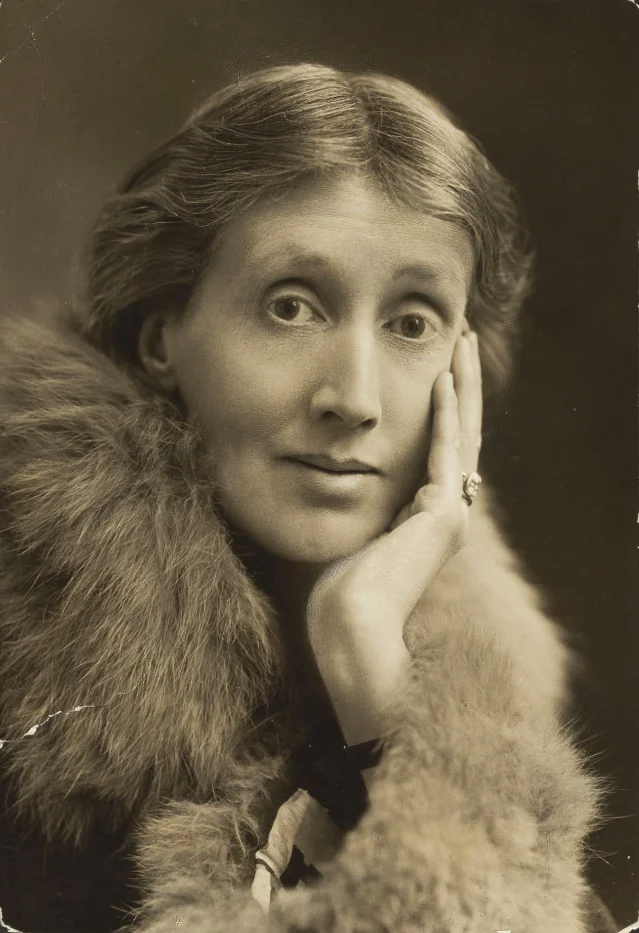
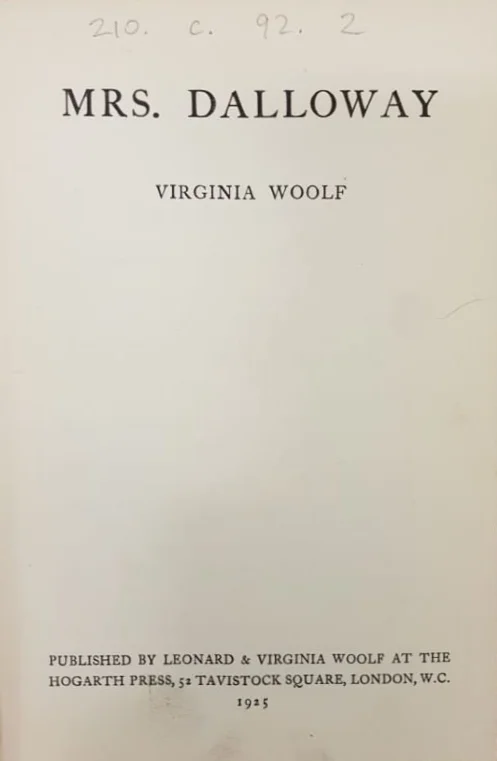
Virginia Woolf published Mrs. Dalloway in May 1925 through the Hogarth Press — the small publishing house she ran with her husband Leonard from their home at 52 Tavistock Square, Bloomsbury. She was forty-three. The novel grew out of an earlier short story, "Mrs Dalloway in Bond Street" (1923), and through several years of diary work Woolf solved a structural problem that had preoccupied her: how to hold two characters — Clarissa Dalloway and the shell-shocked veteran Septimus Warren Smith — in parallel across a single day, without their ever meeting, each illuminating the other by contrast. 5
The war hovers over the opening paragraphs almost without appearing. "The War was over, except for some one like Mrs. Foxcroft at the Embassy last night eating her heart out because that nice boy was killed." The parenthetical violence — killed arriving after a long, flowing social sentence — is one of the novel's characteristic moves. The surface of Clarissa's London is bright; the losses sit just beneath it.
Mrs. Dalloway covers a single day in June 1923. By its final page, roughly twelve hours have passed in the story. The technique makes those twelve hours feel like a life.
Reflection question
Woolf slips from "she thought" to pure exclamation — "What a lark!" — without quotation marks or a signal. Think of a moment today when your inner voice spoke in a tone quite different from how you would have narrated it to someone else. What was that voice like, and what does the gap tell you about the difference between experiencing something and describing it?
Related content
- Sign in to comment.
More from this channel
- "Tell me, O Muse" — how The Odyssey begins before its hero has a name
- "In a village of La Mancha": Cervantes introduces a hero by withholding him
- "The voice of the sea speaks to the soul" — Chopin's grammar of awakening
- "All hope abandon" — Dante's gate and the grammar of judgment
- "Call me Ishmael" — how Melville recruits his reader in three paragraphs
- "Every unhappy family is unhappy in its own way" — Tolstoy's opening sentence, examined
- "It was the best of times" — Dickens's most famous sentence, unpacked