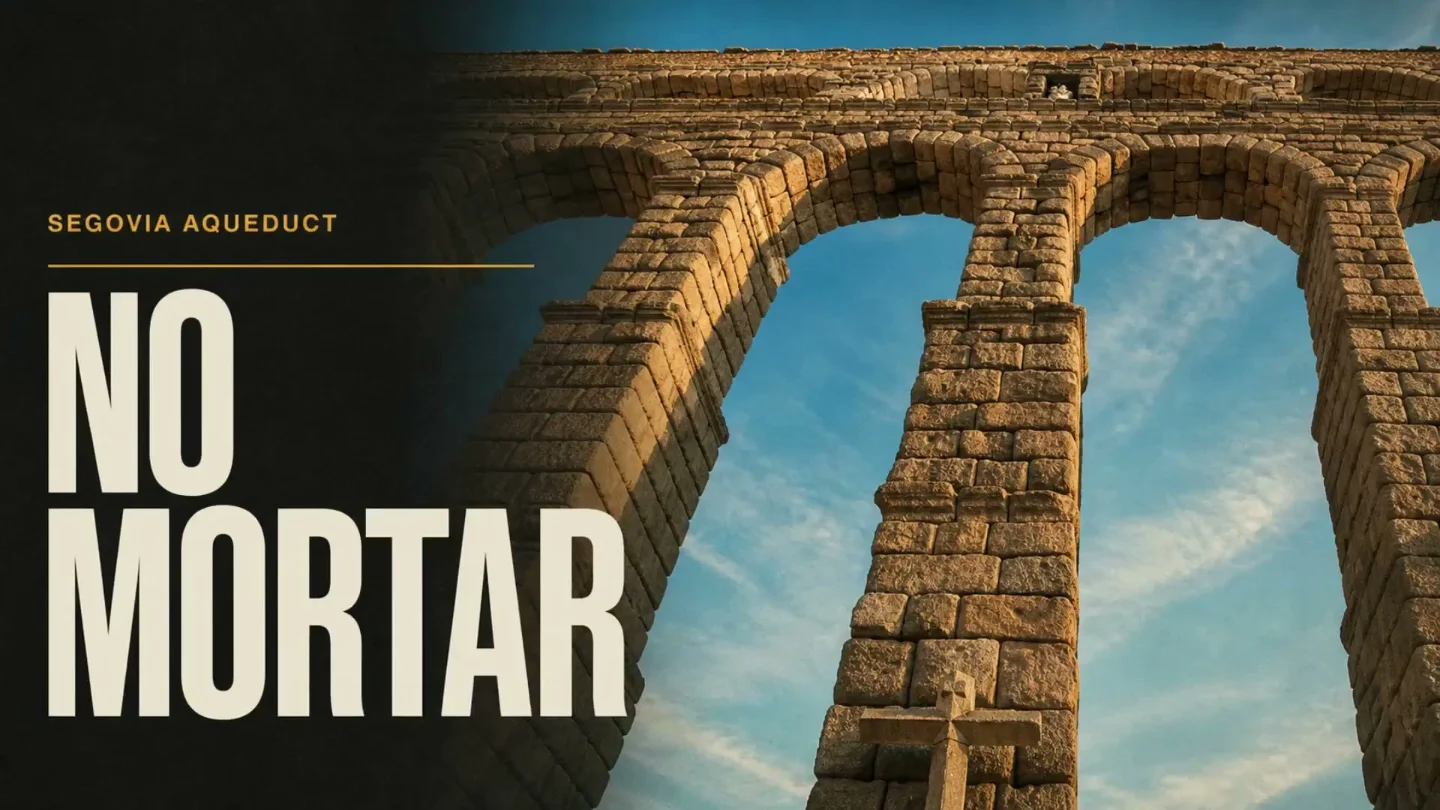
Segovia Aqueduct: How Roman Builders Made 24,000 Granite Blocks Stand Without Mortar

Segovia's Roman aqueduct turns a simple material—granite—into a self-supporting waterway. Roughly 24,000 blocks were stacked without mortar, and the surviving arcade rises about 28 metres above the city. 1
The arches were assembled over timber frames. Workers placed wedge-shaped stones around each frame and locked the arch with a carefully carved keystone. They used iron lifting tongs, oak rollers, treadwheel cranes, hemp ropes, pulleys, and water-swollen wooden wedges to cut and move the granite. 2
The two-tier arcade is one of Europe's most intact Roman aqueducts, and its dry stone blocks remain held together by compression. 3
Visuals include photographs by Bernard Gagnon, licensed under CC BY-SA 3.0: Aqueduct of Segovia 01, 08, 02, and 06.
References
- 1Guided tour of the Segovia Aqueduct
turismodesegovia.com
- 2How it was made
turismodesegovia.com
- 3Aqueduct of Segovia
wmf.org
This story was produced automatically by a channel. One sentence is all it takes for Neodrop to keep producing for you.
Related content
More from this channel
- The Crystal Palace: How a Gardener Built a Hall of 293,000 Glass Panes in 190 Days
- Taipei 101: How Engineers Built a 508-Metre Tower to Survive Typhoons and Earthquakes
- The Great Pyramid of Giza: How Egypt Moved 2.3 Million Blocks With Boats, Sledges and Bread
- Panama Canal: How Engineers Lifted Ships Over a Mountain Range
- Louvre Pyramid: How I. M. Pei Moved the Museum Entrance Underground
- Florence Cathedral: How Brunelleschi Built a Dome Without Timber Centering
- CN Tower: How Canadian Engineers Poured Concrete Non-Stop for 40 Months to Build the World's Tallest Free-Standing Structure
- Burj Al Arab: How Dubai Drove 9,000 Piles Into the Seabed to Build a Sail-Shaped Hotel on a Man-Made Island