June 19, 2026 · 3:50 AM
Lunar Rover case study: how GPT 5.5 turned sunlight into a Three.js driving loop
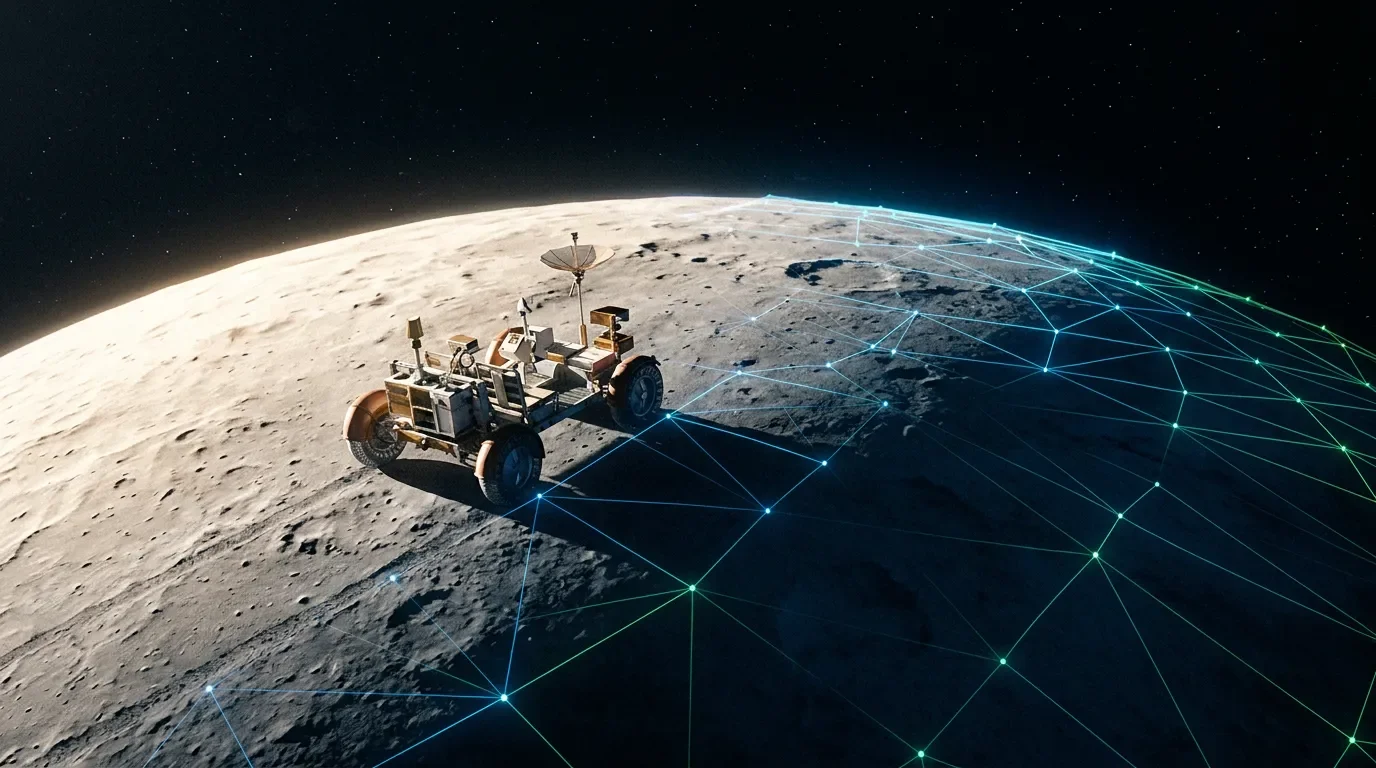
A technical case study of Lunar Rover, a GPT 5.5-assisted Three.js browser game that turns a tiny spherical Moon into a survival-driving loop. The article breaks down the disclosed build process, WebGL/WebAudio stack, sunlight-battery mechanic, screenshot/video evidence, and what indie AI game makers can copy without overstating the gaps.

Lunar Rover is a small browser game, but its design choice is sharp: it turns a moon surface into a resource-management problem. You drive a rover over a tiny spherical Moon, keep the battery alive by chasing sunlight, cross into shadow only when you can afford the drain, and fill out a persistent scan of the surface. The creator posted it to r/aigamedev on June 17, 2026, saying it was built with Three.js, WebGL shaders, procedural terrain, WebAudio, Copilot with Codex GPT 5.5 Extra High, plus some Claude and GPT help for music variations. 1
The case is useful because it is not a polished studio demo. It is closer to the kind of game an AI-assisted solo builder can make in a day when the core loop is simple, the technical surface area is constrained, and the model is asked to keep iterating on feel, shaders, UI, and audio rather than invent a giant game from scratch.
What was built
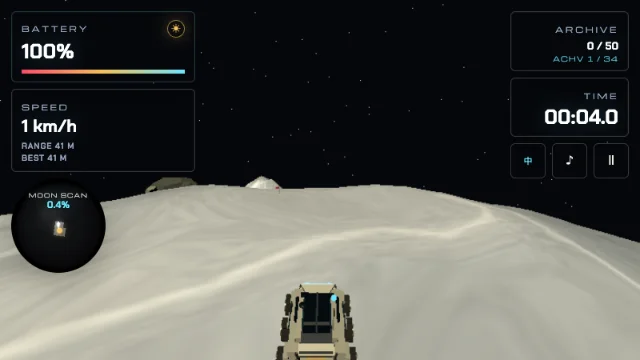
Lunar Rover is listed on AIGameShare as a free browser game and tagged with 3D, Three.js, WebGL, space, racing, mobile, HTML5, AI Game, GPT, and GPT 5.5. The page description calls it a cinematic Three.js moon rover exploration game where sunlight charges the battery and permanent shadow turns the far side into a survival problem. 2
The playable build has a compact but coherent loop:
- Drive across a small spherical Moon. 1
- Use sunlight as the battery recovery mechanic and darkness as the drain mechanic. 2
- Discover historic landing sites and archive entries while gradually scanning the lunar surface. 1
- Run in the browser, with the public page describing mobile-friendly controls, achievement titles, safe local-save fallback, WebAudio rover systems, and auto-respawn exploration loops. 2
That mix matters. Many AI game demos look impressive for 30 seconds but have no reason to keep moving. Lunar Rover gives the player a map-sized verb: scan the Moon. Then it gives that verb a constraint: light is safe, shadow is costly.
The build process disclosed by the creator
The creator did not publish exact prompts. That is the main evidence gap in this case study. What they did publish is still enough to reconstruct the working style: the initial game idea was simple, the process was described as "vibing with GPT 5.5," and a long stretch of the work went into continued fine-tuning of the model and shaders. 1
For the music, the creator said they used pure JavaScript to render it, started with a background song, asked Claude and GPT for variations, then hand-tuned the result. 1 In the comments, they added that the game took "a whole day starting from mid night" to make the music, gameplay, and discovery system. 1
Loading content card…
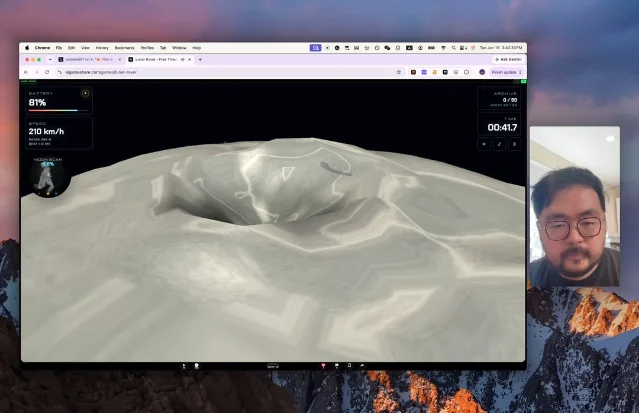
The important pattern is that the AI was not just asked for a finished project once. It appears to have been used as a loop partner: build a small playable base, push on terrain and shaders, add discovery progression, revise audio, test on mobile, then keep sanding down the rough edges. That is a more credible path for AI game development than trying to prompt an open-world game into existence in one pass.
Architecture read: why the design holds together
The public sources do not expose a GitHub repository, so the following is an architecture read from the playable page, the creator's build note, and the game-page feature list. The source-backed facts are the technologies and mechanics; the interpretation is how those pieces fit together.
| Layer | What Lunar Rover appears to do | Why it works for an AI-assisted build |
|---|---|---|
| World model | A tiny spherical Moon with procedural terrain, not a huge flat open world. 1 | A bounded planet lets the game feel open while keeping scope small. The player can circle, scan, and revisit without needing city-scale content. |
| Rendering | Three.js plus WebGL shaders. 1 | Three.js gives the model a known rendering framework. The AI can work inside familiar abstractions instead of writing a renderer from first principles. |
| Survival loop | Battery charges in sunlight and drains in dark regions. 2 | The game gets tension from a rule that is easy to explain and easy to visualize. Sun and shadow are both mechanic and level design. |
| Progression | Surface scan progress, archive discoveries, achievement titles, and cloud/local save behavior are listed on the game page. 2 | Progress systems give a short prototype persistence. The player is not only driving; they are filling a checklist tied to movement. |
| Sound | The creator says the soundtrack was rendered in JavaScript, with Claude and GPT used for variations before manual tuning. 1 | Audio stays inside the same web stack. That avoids asset-pipeline friction and lets the model iterate on code, not just imported files. |
The strongest design decision is the one that sounds the smallest: make darkness matter. Without the battery rule, this would be a rover toy with terrain. With it, every ridge and crater becomes a decision about risk, route, and timing.
What the model seems to have been good at
GPT 5.5's visible contribution, based on the creator's description, was breadth. The game touches rendering, terrain, UI, mobile controls, audio, progress, and discovery. The creator's comment suggests GPT 5.5 was used for the main build loop, while Claude and GPT were both used to generate music variations. 1
That breadth is exactly where LLM coding tools are useful for prototypes. They can keep a project moving across many small subsystems, especially when those subsystems use common web-game patterns: a render loop, input handling, HUD state, procedural meshes, WebAudio nodes, save state, and basic progression.
The tradeoff is taste. In the same comment thread, the creator said they were losing momentum after going back to GPT because it lacked "art skill and taste," and they described the quality of this game as "meh" despite the progress. 1 That is a useful admission. AI can wire a lot together, but visual feel, pacing, and audio taste still need a human editor or a model that is unusually good at aesthetic iteration.
What to copy if you are building your own AI game
Do not copy the Moon. Copy the constraint shape.
First, start with a world that feels larger than it is. A tiny sphere, looping track, single arena, procedural island, or one-city block can all create the feeling of exploration without requiring endless content. The Lunar Rover page describes a small-planet gravity driving game, not a giant simulation. 2
Second, tie progression to movement. Surface scanning and archive discovery make traversal useful. If your AI-built demo has only movement, the next prompt should probably add a reason to move.
Third, give the player one readable pressure system. Battery versus sunlight is easy to understand from the HUD and the screen itself. A similar prototype could use oxygen, heat, noise, visibility, tire wear, drone signal, fuel, or water depth. The point is not realism. The point is that the resource changes how the player reads the space.
Fourth, keep the tool stack boring. Three.js, WebGL shaders, WebAudio, and HTML5 are common enough that an LLM has a lot of examples to draw from. 1 This matters more than novelty. AI coding is more reliable when the architecture is made of known parts.
Limits of the case
This is a good case study, not a clean benchmark. There is no public repository, no exact prompt transcript, and no commit history. The Reddit post and AIGameShare page are enough to confirm the game, model context, stack, feature set, and broad iteration style, but not enough to audit every line of code or separate human edits from AI output. 1
The community signal is also mixed. One commenter praised the mobile controls and UI as working well on mobile, while the post's visible score was low at capture time. 1 Treat Lunar Rover as a design pattern, not proof that GPT 5.5 can ship a commercial-quality 3D game alone.
The pattern is still worth keeping: pick one physical metaphor, one pressure system, one progress meter, and one boring web stack. Then use the model for iteration, not magic. Lunar Rover works because the scope is small enough for AI to hold in context and the player goal is clear enough to survive rough edges.


Add more perspectives or context around this Post.