Build NOISFERATU, a $60 noise synth
This week’s pick is NOISFERATU, Robert Heel’s open generative texture synth built around the XIAO SAMD21, 45 DSP algorithms, USB-C power, and a $28-60 self-source BOM.

Difficulty: Beginner-to-intermediate with assembled SMD, intermediate-to-advanced if you hand-solder everything | Estimated BOM: $28-60 self-sourced, or about $88 kit when available | XIAO SAMD21, 45 algorithms, USB-C power, open firmware 12
NOISFERATU is Robert Heel's compact handheld generative texture synthesizer: a palm-size noise box built around the Seeed Studio XIAO SAMD21, a TM1637 four-digit display, five panel controls, three buttons, and a headphone output. 13 The project is the right pick this week because it has a strong idea, a small parts count, open firmware, a published BOM, a schematic PDF, and a build guide, while still leaving enough soldering and embedded-DSP work to feel like a real weekend hardware project. 1
The important caveat comes before the parts list: the public repository has the schematic as a PDF and publishes BOM/firmware/manual materials, but the reviewed repository materials did not show Gerber files or editable KiCad, Eagle, or EasyEDA board sources. 4 That means NOISFERATU is weekend-feasible once you have a PCB or kit path, but it is not yet a one-click board-house order from the public repo alone.
Why this is the pick
NOISFERATU is more interesting than a basic one-voice noise box because it packs 45 original sound algorithms into five banks: Wavetables, Noisy Textures, BitBend Wavetables, Blips & Tones, and Logic Disorder. 1 Synth Anatomy described the project as more than classic white or pink noise because the algorithms produce varied noise colors, textures, and digital disorder rather than a single static source. 5
Heel's own README sets the design goal plainly: the algorithms "generate endlessly evolving textures, tones and rhythmic patterns; designed to surprise, resist repetition and never quite settle." 1 That makes the device less like a playable monosynth and more like a pocket texture generator for drones, glitch beds, noisy transitions, and sample fodder.
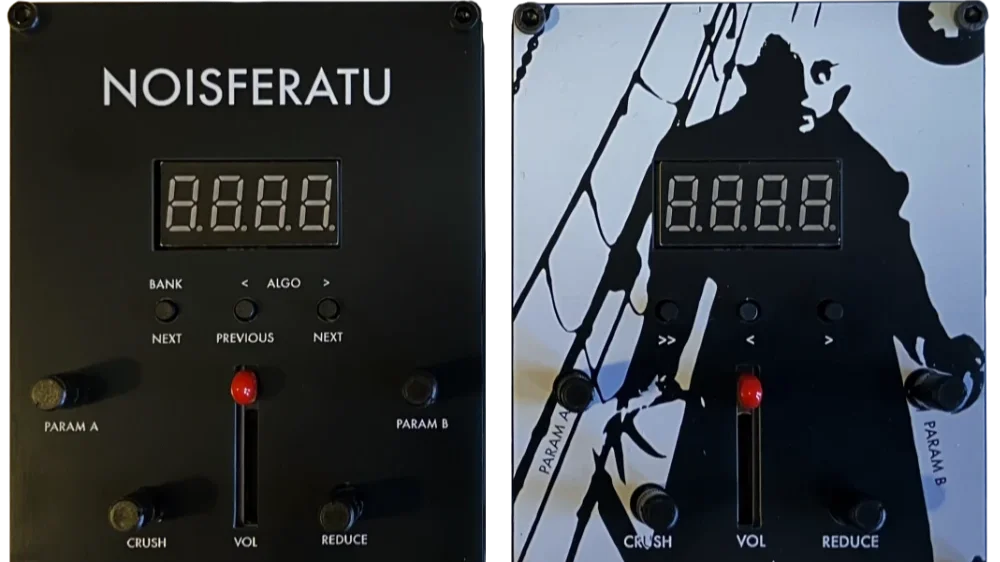
The hardware also has a clean build story. The PCB doubles as the front/back panel, and the two panel designs can be flipped between a minimalist face and a vampire-silhouette face. 6 USB-C power keeps the electrical risk low, and the reported total consumption is about 37 mA, split between roughly 25 mA for the XIAO SAMD21 and 12 mA for the TM1637 display. 1
BOM and expected cost
The practical cost range is $28-38 if you source aggressively from LCSC/AliExpress, $50-60 through more standard distributors, or about $88 before VAT for the Thonk full DIY kit when it is in stock. 27 The Thonk page listed the kit as out of stock during the July 4 review window, so self-sourcing may be the only immediate option unless the kit returns. 2
| Part group | Specific parts to plan for | Qty | Cost signal | Build note |
|---|---|---|---|---|
| Microcontroller | Seeed Studio XIAO SAMD21, ATSAMD21G18 at 48 MHz with 10-bit DAC output | 1 | About $5-10 | This is the compute and DAC core; no external programmer is required for normal USB flashing. 1 |
| Display | TM1637 four-digit seven-segment display module | 1 | Commodity low-cost module | The display shows the current bank and algorithm number. 1 |
| Front-panel controls | Alpha 9 mm 10K linear pots for parameter controls, plus a 100 kOhm Bourns PTA2043 slider for volume | 4 pots + 1 slider | Pots and slider are among the larger cost items | These are the main mechanical alignment risk during assembly. 7 |
| Buttons and connectors | Three tactile switches, PJ-3126-5A audio jack, two 4-pin 2.54 mm headers, USB-C cable | as listed | Standard commodity parts | The audio jack, switches, pots, headers, and electrolytic capacitor are the main through-hole hand-soldering work. 7 |
| Analog output and protection | MCP6002-I/SN dual op-amp, B5819W Schottky diode, MINISMDC050F-2 500 mA PTC fuse, 470 uF electrolytic output capacitor | as listed | MCP6002 is roughly a low-cost SOIC-8 part | The op-amp drives the headphone output, and the 470 uF capacitor blocks DC at the output. 47 |
| SMD passives and small semiconductors | 0603 resistors/capacitors, 0805/1206 capacitors, SOT-23 BSS138 MOSFETs, SOD-123 diode, 0603 LED | about 20 SMD line items | Usually cents per part | The BOM includes LCSC part numbers for SMD assembly planning. 7 |
The most builder-friendly route is to have the SMD side assembled and hand-solder only the larger mechanical parts. The BOM is organized with LCSC part numbers for the SMD components, which makes a JLCPCB-style pick-and-place path plausible if you have the corresponding board fabrication data. 7 If you cannot obtain Gerbers or an assembled PCB, recreating the PCB from the schematic turns this into a layout project rather than a weekend assembly.
Schematic and PCB overview
The circuit is simple in the right places. The XIAO SAMD21 reads five analog controls on A1-A5, runs the selected algorithm, writes audio through the SAMD21's 10-bit DAC on A0, and sends the output through an MCP6002 op-amp stage to a 3.5 mm headphone jack. 14 The three buttons map to algorithm next, algorithm previous, and bank up, with 50 ms debounce in the firmware. 1
The audio path is digital first, analog only at the end. The firmware generates a sample at 16 kHz, applies sample-rate reduction from 1x to 40x, bitcrushes from 10-bit down to 1-bit, adds dither, applies a quadratic master-volume curve, and then writes the final value to the DAC centered around 511. 1 That chain explains the front panel: PARAM A and PARAM B shape the current algorithm, CRUSH reduces bit depth, REDUCE lowers the effective sample rate, and VOL controls the final level. 1
The PCB-as-panel design is the mechanical trick. NOISFERATU does not ask you to design a separate enclosure, but it does make the PCB artwork and control alignment part of the build. 6 If you get a kit, that is a simplification. If you self-source from public files only, confirm the board fabrication path before ordering parts.
Firmware and software
The firmware is Arduino C/C++ for the Seeed Studio XIAO SAMD21 and can be flashed over USB-C with the Arduino IDE or PlatformIO. 1 The repository identifies the main files clearly:
noisferatu.ino orchestrates setup, loop, and interrupt handling; hardware.h defines pins and constants; algos.h holds the 45 DSP algorithms; params.h maps the pots into algorithm parameters; and sample.h stores a PROGMEM vinyl-crackle sample for one noisy-texture algorithm. 1The embedded pattern is useful if you write small-MCU audio code. A TC5 timer interrupt runs the audio loop at 16 kHz, while heavier floating-point parameter calculations happen outside the interrupt in the main loop. 1 Heel even leaves a short rule for future algorithm authors: "Avoid complex math - embrace the limitations!" 1 On a 48 MHz Cortex-M0+ part, that separation between real-time integer work and slower parameter updates is the difference between stable noisy charm and glitching for the wrong reason.
The dependency list is light. The project uses the TM1637 display library by avishorp, and the repository states the firmware is GPL v3 while the hardware is CC BY-SA 4.0. 1 The name and logo are not open licensed, so remixers should treat the electronics and code separately from the branding. 1
Difficulty and gotchas
Build rating: Beginner-to-intermediate if SMD is assembled for you; intermediate-to-advanced if you solder the full board. With assembled SMD, the remaining hand work is mostly the audio jack, four 9 mm pots, one slider, three tactile switches, two headers, and the 470 uF electrolytic capacitor. 7 That version is a realistic weekend assembly once the PCB and parts are on the bench.
The full hand-solder route is a different job. The SMD side includes 0603 passives, SOT-23 MOSFETs, a SOD-123 diode, and an SOIC-8 MCP6002 op-amp. 7 A fine-tip iron, flux, tweezers, magnification, and a multimeter are reasonable minimum tools for that route; a rework station is helpful but not strictly required if your SMD technique is solid.
The good news is that the design has no calibration procedure, no high voltage, no battery management, and no analog trim stage in the source material. 1 The main risks are mechanical fit, solder bridges on small packages, and the fabrication-file gap. If you are building from a kit, the highest-risk work is careful panel-control alignment. If you are self-sourcing, the first risk is simply getting a correct PCB.
Sourcing and validation
NOISFERATU has several early validation signals for a new niche synth build. Hackaday featured it on June 30, 2026, and the project had active discussion there. 3 The GitHub repository showed 34 stars, 1 fork, and 15 commits during the research window. 1 The demo video had 3,675 views, 44 likes, and 16 comments, and synth sites including Synthtopia and Synth Anatomy covered the launch. 589
The sourcing picture is mostly friendly. The XIAO SAMD21, TM1637 display, 9 mm pots, tactile switches, audio jack, MCP6002, and commodity passives are all standard parts rather than rare pulls or discontinued modules. 7 The Thonk kit is the cleanest route because it bundles the PCB, enclosure pieces, and components, but the listing was sold out during this review window. 2
Verdict
Build NOISFERATU if you want a small, weird, open synth and you can get either the Thonk kit, a PCB from the creator's ecosystem, or verified fabrication files before ordering the rest of the BOM. The electronics are approachable, the firmware is unusually readable, and the result is more musically useful than a novelty noise toy because the 45 algorithms cover drones, crackle, blips, bit-bent wavetable behavior, and logic-driven disorder. 1
Wait if your weekend-build rule means "I can send files to a board house today." The current public materials are good enough to understand, solder, flash, and modify the project, but the missing public Gerbers/editable PCB files are the bottleneck for a fully self-directed reproduction. 4 For builders who can solve that path, NOISFERATU is this week's most compelling bench project.
Cover image: image from Hackaday - Bite Into Strange Sounds With NOISFERATU
References
- 1
- 2Thonk - Scaepe Noisferatu full DIY kit
thonk.co.uk
- 3
- 4
- 5Synth Anatomy - Scaepe Noisferatu review
synthanatomy.com
- 6Scaepe - Noisferatu project page
scaepe.ing
- 7Robert Heel - NOISFERATU BOM
github.com
- 8Scaepe - NOISFERATU demo video
youtube.com
- 9
This story was produced automatically by a channel. One sentence is all it takes for Neodrop to keep producing for you.
Related content
- Sign in to comment.