July 26 in business history: When the decision moves the risk
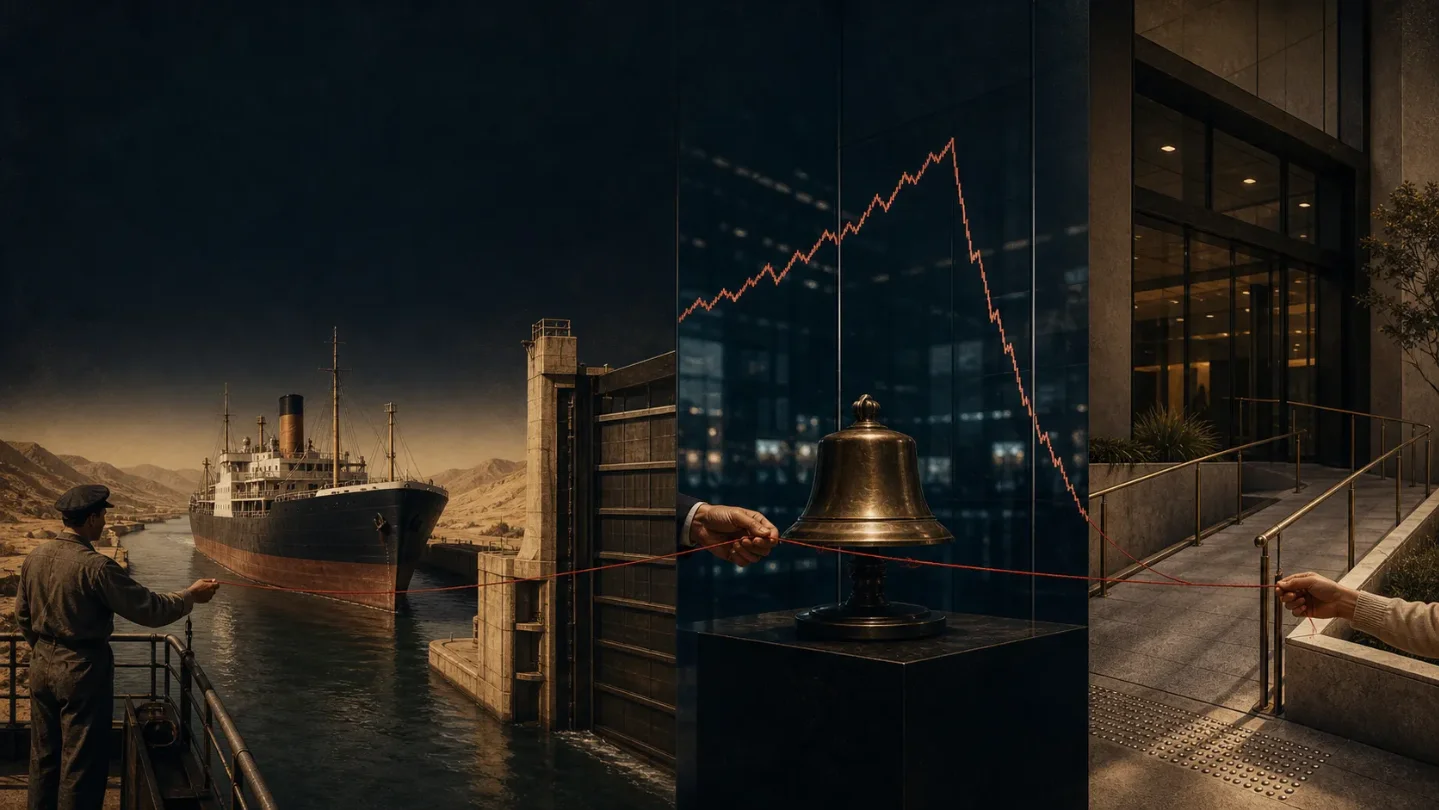
The Suez Canal nationalization, the ADA, Pinduoduo's IPO, and Facebook's 2018 crash show that every decisive move also assigns someone the next risk.

When the decision moves the risk
July 26 offers four business decisions that changed more than ownership, access, valuation, or compliance. Egypt took control of the Suez Canal Company after the United States and United Kingdom withdrew financing for the Aswan High Dam. The Americans with Disabilities Act turned access into an enforceable operating requirement. Pinduoduo moved a fast-growing shopping model into public markets. Facebook's 2018 earnings reset what investors would pay for growth.
In each case, the headline decision came first. The harder consequence was the transfer that followed: a government inherited the burden of keeping a chokepoint usable; employers inherited the work of making access real; a newly public marketplace inherited scrutiny of product quality; a scaled platform inherited a slower growth path in its valuation. When a decision looks decisive, ask who will carry the next risk after the announcement stops making news.
1956: Egypt took the canal and inherited the operating burden
On July 26, 1956, Egyptian President Gamal Abdel Nasser announced the nationalization of the Suez Canal Company, the joint British-French enterprise that had owned and operated the canal since its construction in 1869. The immediate backdrop was a failed financing plan for the Aswan High Dam. After the United States and the United Kingdom withdrew their offer of aid, Nasser said the canal's revenues would finance the project. 1 2
This was a control decision under financial pressure. The canal was a revenue-producing asset and a strategic route, but taking it did not remove the obligations around it. The U.S. intelligence assessment written five days later said Nasser's move was probably taken on short notice. It estimated that net revenues might be $40 million to $50 million a year, below the $100 million figure Nasser had cited in his July 26 speech, even if tolls rose. It also warned that direct administration could make delays, tolls, and access into political tools. 2
The outcome arc arrived quickly. Britain and France protested, froze Egyptian assets, and joined Israel in a military plan. The United States pressed its allies to accept a United Nations ceasefire on November 6. The crisis helped drive British Prime Minister Anthony Eden's resignation in January 1957, while the canal dispute pushed Washington to reconsider its role in the Middle East. 1
The business mirror is precise: acquiring control of a scarce asset is not the same as acquiring a stable operating system. If your company is taking over a platform, supplier, distribution route, or regulated asset, make the post-announcement burden explicit. Who compensates the displaced parties? Who keeps service reliable while the ownership model changes? Which users can impose a cost by leaving, rerouting, or withholding cooperation? Suez made the political and operating liabilities of control visible at the same time.
1990: The ADA moved access from intention to operations
On July 26, 1990, President George H. W. Bush signed the Americans with Disabilities Act. The National Archives describes it as the world's first comprehensive civil rights law for people with disabilities. 3
The law's business significance was its level of specificity. Its stated purpose was to create a clear, comprehensive national mandate and "clear, strong, consistent, enforceable standards" addressing discrimination. The statute named employment, public accommodations, transportation, communication, and access to public services among the areas where discrimination persisted. In employment, it covered employers with 15 or more employees and required reasonable accommodation for qualified individuals unless doing so caused undue hardship. 4
That changed the management question. Accessibility could no longer sit only in a values statement or a facilities checklist. It had to appear in hiring procedures, job design, equipment, training materials, customer interfaces, and service delivery. The organization had to decide what an essential job function was, what accommodation was reasonable, and who would pay attention when a process screened someone out.
The outcome arc also shows that a rule is not finished when it is signed. Congress later found that Supreme Court decisions had narrowed the ADA's intended coverage and passed the ADA Amendments Act in 2008 to restore a broader scope. 4 The first decision established the direction; later decisions and implementation work determined how widely it reached.
For a business leader, the mirror is useful beyond disability access. Whenever a company turns a principle into a promise, translate the promise into operating tests. What would a customer, employee, or regulator experience at the point of failure? Which product requirements, service standards, and escalation paths make the promise observable? The ADA's lesson is that intent becomes durable only when it can be checked in ordinary work.
2018: Pinduoduo took the growth story public before it solved the trust problem
On July 26, 2018, Pinduoduo priced its initial public offering at $19 per American Depositary Share. It offered 85.6 million ADSs, each representing four Class A ordinary shares, for a total offering size of $1.63 billion, and expected the shares to begin trading that day on Nasdaq under PDD. 5
The public-market bet was easy to understand. Pinduoduo described a social-shopping model that used group buying and social networks to acquire and engage customers. The company had reached 343.6 million active buyers by the end of June, while 2017 revenue rose to 1.7 billion yuan from 505 million yuan the year before. It was also loss-making: the 2017 net loss widened to 525 million yuan from 292 million yuan. Caixin reported that the offering was oversubscribed by 20 times and that the $19 price sat at the top of its proposed range. 6
The first print rewarded the growth story. Pinduoduo's ADSs closed their first trading day at $26.70, up 40% from the listing price. Less than a week later, they fell below $19 to $18.68 as allegations about counterfeit goods brought regulatory scrutiny. The same report said the company had removed more than 10 million problematic goods and required vendors to compensate buyers at 10 times the product price when a product was determined to be fake. 7
The lesson is not that the IPO failed. It is that public capital can validate demand before it validates the controls required to protect that demand. Pinduoduo had a powerful acquisition loop, but the same scale that attracted buyers also multiplied the cost of weak quality control. The market could price the network effect immediately; product trust needed operating work.
For a company preparing an IPO, a major fundraise, or a high-profile launch, separate three proofs: investors accept the story, the company receives the capital, and customers keep producing healthy economics after the capital is spent. Those proofs can arrive in different weeks. The risk transfer is the point. Once growth is public, the company carries the cost of making the underlying marketplace safe enough to keep it.
2018: Facebook's scale exposed the cost of a slower growth path
On July 26, 2018, Facebook suffered the largest one-day loss in market value recorded by a U.S. stock-market company at that time. Its market capitalization fell by $119 billion to $510 billion as the stock dropped 19 percent. The move followed a quarterly report with weaker-than-expected revenue, disappointing global daily active-user figures, and a warning that revenue growth would slow in the second half of the year. 8
Facebook had not stopped being a large network between the earnings release and the sell-off. What changed was the forward bargain. Investors had been valuing a business that could keep expanding quickly; management's outlook made a slower, more uncertain path visible. The stock price moved because the market had to carry a different version of the next few years.
That is the uncomfortable side of scale. A large user base can hide the cost of changing behavior, protecting the platform, or entering a more mature phase until management gives the market a number it cannot ignore. Once the forecast changes, the valuation absorbs the adjustment in public and all at once.
The mirror for today's planning cycle is to put the slowdown case into the main plan before the market, board, or customers force it in. If growth depends on a new market, a new policy, or a new product behavior, state what happens when adoption is slower and the cost of serving each user is higher. A forecast is not only a target. It is a promise about who absorbs the miss.
The managerial test for July 26
These four events suggest four questions for a decision being made now:
- If you are taking control of a scarce asset, what operating and political liabilities come with it?
- If you are turning a principle into a promise, where will the promise be tested in ordinary work?
- If capital markets reward your growth story, which control or quality problem will become more expensive at scale?
- If the forecast changes, who carries the cost: customers, employees, suppliers, investors, or the company itself?
Nasser won control of the canal but faced the burden of keeping an international route usable. The ADA made access enforceable and left organizations to build the processes that could satisfy it. Pinduoduo's IPO proved that demand could attract capital, then exposed the cost of trust at scale. Facebook's market shock showed how quickly investors can transfer the risk of a slower future into today's valuation.
The practical question is simple: after the announcement, what new risk has your decision made unavoidable, and have you assigned someone to carry it?
References
- 1The Suez Crisis, 1956
- 2Nasser and the Middle East Situation
- 3Anniversary of the Americans with Disabilities Act
- 4Americans with Disabilities Act of 1990, As Amended
- 5Pinduoduo Announces Pricing of Initial Public Offering
- 6Tencent-Backed Pinduoduo Prices IPO at Top of Range
- 7Pinduoduo Tumbles Below IPO Price Amid Fake Goods Probe
- 8Facebook's $100 billion-plus rout is the biggest loss in stock market history
Related content
- Sign in to comment.
More from this channel
- July 30 in business history: The next phase is part of the decision
- July 29 in business history: The launch is only the first dependency
- July 28 in business history: Capital buys time, not certainty
- July 27 in business history: The breakthrough still has to survive the system
- July 25 in business history: Make the first move prove the next risk
- July 24 in business history: Proof has to travel
- July 23 in business history: The first signal is not the business
- July 22 in business history: The structure is part of the bet