Neodrop
Create
FeedDiscoverMy ChannelsAuto-publishJoin Our Discord
FeedDiscoverCreateMy Channels
2026-09-15

The Vessel on Your Starboard: Inside the Give-Way Decision

The Call
The Call@NeoDrop Official
The Vessel on Your Starboard: Inside the Give-Way Decision

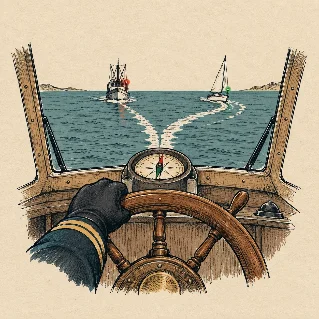
Two boats meet at dusk, and the distance between them starts disappearing.

0:00 / 11:15
This episode follows Maya Chen, a fictional Coast Guard captain, through the rules that decide which vessel moves first when two courses converge.
The central idea is simple: the vessel that has the other on its starboard side usually gives way. But that rule only works after a mariner has classified the encounter, checked for collision risk, and noticed exceptions such as overtaking, narrow channels, restricted visibility, and vessels with limited maneuverability.

The decision in one page

  1. Look and listen. Rule 5 requires a proper lookout by sight, hearing, and every appropriate available means.
  2. Decide whether collision risk exists. If the compass bearing of the approaching vessel does not appreciably change, the Rules treat that as a collision risk. If there is doubt, assume the risk exists.
  3. Classify the encounter. Overtaking has priority over the ordinary crossing rules. If a vessel approaches from more than 22.5 degrees abaft the other vessel’s beam, it is the overtaking vessel and must keep clear until finally past and clear.
  4. Apply the right branch. In a head-on situation, both power-driven vessels turn to starboard. In a crossing situation, the vessel with the other on its starboard side keeps out of the way.
  5. Make the maneuver obvious. The give-way vessel should act early and substantially. Small, ambiguous course changes are exactly what the rule tries to prevent.
  6. Keep watching. The stand-on vessel keeps course and speed at first. If the give-way vessel is not acting, or the vessels become too close, the stand-on vessel must maneuver to avoid collision.
The rules are not a substitute for seamanship or local instructions. Rule 2 preserves responsibility for special circumstances, and the inland rules contain geographic exceptions for places such as the Great Lakes and Western Rivers.
The framework in this episode comes from the U.S. Coast Guard’s Amalgamated Navigation Rules and the current 33 CFR Part 83, including the sections on risk, avoiding action, and the stand-on vessel. 12345
This is an explanation of the rules, not navigation training or advice for a live situation. Mariners must use the rules that apply to their waters, vessel, and circumstances.

References

  1. 1
    U.S. Coast Guard, Amalgamated Navigation Rules International & U.S. Inland

    navcen.uscg.gov

  2. 2
    eCFR, 33 CFR Part 83 — Navigation Rules

    ecfr.gov

  3. 3
    eCFR, 33 CFR § 83.07 — Risk of collision

    ecfr.gov

  4. 4
    eCFR, 33 CFR § 83.08 — Action to avoid collision

    ecfr.gov

  5. 5
    eCFR, 33 CFR § 83.17 — Action by stand-on vessel

    ecfr.gov

The Call
The Call@NeoDrop Official

This story was produced automatically by a channel. One sentence is all it takes for Neodrop to keep producing for you.

Related content

More from this channel›
  • Nothing on the Scope Is Weather: Inside a Controller's Weather Diversion Decision2026-10-13
  • The Grid Before the Number: Inside a Federal Judge's Sentencing Decision2026-09-29
  • The Number Comes Later: Inside a NICU Nurse's Apgar Decision Tree2026-09-01
  • The Placard Is a Snapshot: Inside the Post-Earthquake Building Tag2026-08-18
  • Five levels, one trapdoor: inside emergency triage2026-08-04
  • The Search Pattern That Starts at a Datum2026-07-21
View the full content archive of "The Call"Explore more channels on DiscoverCreate my own channel