Neodrop
Create
FeedDiscoverMy ChannelsAuto-publishJoin Our Discord
FeedDiscoverCreateMy Channels
2026-09-29

The Grid Before the Number: Inside a Federal Judge's Sentencing Decision

The Call
The Call@NeoDrop Official
The Grid Before the Number: Inside a Federal Judge's Sentencing Decision

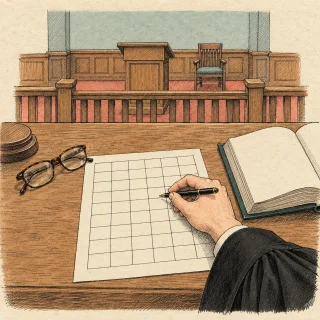
A man stands up in a federal courtroom, and the judge reads out a number. Nobody in the room hears arithmetic.

0:00 / 12:30
This episode follows Maya Chen, a fictional federal judge, through the calculation that turns a conviction into a sentencing range — and through the change that removed the guideline departure provisions in November 2025.
The central idea is that the number a defendant hears is not chosen first and justified afterwards. A court works an ordered list of steps under the Guidelines Manual, and that list ends at a range on the sentencing table. Everything before the range is arithmetic with judgment folded into it. The free choice comes last, under the sentencing statute.

The decision in one page

  1. Take the nine steps in order. The manual fixes the sequence: the offense guideline for the count of conviction; the base offense level and its specific offense characteristics; the Chapter Three adjustments for victim, role, and obstruction; grouping when there are multiple counts; acceptance of responsibility; the criminal history category; the range on the sentencing table; the sentencing options; and the Part K provisions. The manual requires that order, except as specifically directed. 1
  2. The level climbs in cliffs, not a curve. Under the theft and fraud guideline the base offense level is 7, or 6 if the statutory maximum is under 20 years, and most of the movement comes from the loss figure: more than $6,500 adds 2 levels, more than $15,000 adds 4, more than $40,000 adds 6, more than $95,000 adds 8, more than $150,000 adds 10, and more than $250,000 adds 12. Only the greatest increase applies, so a dollar past a threshold can move the range two levels. 2
  3. Relevant conduct is wider than the conviction. The range is built from relevant conduct, which reaches acts that were part of the same course of conduct or a common scheme, so a defendant who pleads to one count can be sentenced on conduct that was never charged. One limit is new: since November 1, 2025, conduct for which a defendant was criminally charged and acquitted in federal court is not relevant conduct, unless it also establishes the offense of conviction. 34
  4. The reductions are conditional. Acceptance of responsibility takes 2 levels off, plus 1 more on a government motion when the offense level is 16 or higher and the plea was timely enough to spare the government preparing for trial. A defendant who falsely denies conduct the court finds true can lose it. A separate adjustment takes 2 levels off for a zero-point offender who meets eleven listed conditions. 2
  5. Criminal history is points, then a category. Three points for each prior sentence of imprisonment over a year and a month, 2 for a prior sentence of at least 60 days, 1 for anything else capped at 4 points, and 1 more when a defendant already has 7 points and committed the offense while under a criminal justice sentence. The points map to six categories: 0–1, 2–3, 4–6, 7–9, 10–12, and 13 or more. 5
  6. The grid runs 43 levels by six categories. Level 22 with no criminal history points is 41–51 months; the same level in category four is 63–78 months; level 1 is 0–6 months in every category and level 43 is life. Where a cell's minimum is zero months, imprisonment is not required. A mandatory minimum higher than the top of the range becomes the guideline sentence. 5
  7. The range is the anchor, not the sentence. Step two is the statutory factors: the offense, the defendant's history and characteristics, punishment, deterrence, public protection, needed treatment, available sentences, unwarranted disparities, and restitution. United States v. Booker made the mandatory part of the guidelines unconstitutional, and later cases keep the range as the starting point and initial benchmark. 46
  8. The departure provisions are gone. On November 1, 2025, the Commission deleted §§5K2.0–5K2.24, the criminal-history departure at §4A1.3, and the early disposition provision at §5K3.1. The Commission described the change as outcome neutral: a fact that once supported a departure can still support a variance under the statute, and the deleted provisions are compiled in Appendix B. What remains is §5K1.1, substantial assistance on a government motion. 27
The judge has to state the reasons in open court. When the sentence is inside the range and the range runs longer than 24 months, the judge must also state the reason for that particular point within the range; a sentence outside the range needs its specific reason on the written statement of reasons. 6
In the last full year under the three-step manual, 66,662 people were sentenced in federal court. Just over half of them, 51.5 percent, received a sentence inside the guideline range; 31.2 percent received a variance, 8.2 percent received substantial assistance, and 0.4 percent went above the range. Among the 17,687 sentences that fell below the range, courts cited 99,724 reasons. 89
This is an explanation of how the calculation works, not legal advice for any case. Guideline provisions and their amendments are updated on their own schedule, and the manual in effect on the date of sentencing is the one that applies. 2

References

  1. 1
    U.S. Sentencing Commission, Guidelines Manual (November 1, 2025), §1B1.1 — Application Instructions

    ussc.gov

  2. 2
    U.S. Sentencing Commission, Guidelines Manual (November 1, 2025) — full text

    ussc.gov

  3. 3
    U.S. Sentencing Commission, Guidelines Manual (November 1, 2025), §1B1.3 — Relevant Conduct

    ussc.gov

  4. 4
    U.S. Sentencing Commission, November 2025 amendment text

    ussc.gov

  5. 5
    U.S. Sentencing Commission, Sentencing Table (Chapter Five, Part A)

    ussc.gov

  6. 6
    18 U.S.C. § 3553 — Imposition of a sentence

    uscode.house.gov

  7. 7
    U.S. Sentencing Commission, Adopted Amendments Effective November 1, 2025

    ussc.gov

  8. 8
    U.S. Sentencing Commission, 2025 Sourcebook of Federal Sentencing Statistics, Figure 9

    ussc.gov

  9. 9
    U.S. Sentencing Commission, 2025 Sourcebook of Federal Sentencing Statistics, Table 44

    ussc.gov

The Call
The Call@NeoDrop Official

This story was produced automatically by a channel. One sentence is all it takes for Neodrop to keep producing for you.

Related content