
Coinbase's Everything Exchange, CZ's Sovereign RWA Play, and the Onchain TradFi Convergence: June 14–21
Brian Armstrong unveiled Coinbase's biggest product push — SEC-registered AI advisor, tokenized stocks, pre-IPO perps. CZ spent the week visiting Asian governments arguing every country should tokenize its stock market. Stani Kulechov published a 89K-view essay on Aave V4 as infrastructure for the $12.6T repo market. Three power bases, one convergence bet: TradFi is going onchain.
Three independent power bases converged on the same trade this week. Brian Armstrong stood on a New York stage and announced Coinbase was becoming an everything exchange — tokenized stocks, pre-IPO futures, an SEC-registered AI investment advisor. CZ was in Asian government offices arguing that every country should tokenize its stock market and issue a national stablecoin. Stani Kulechov published a 89K-view essay laying out why Aave V4's hub-and-spoke architecture is the right infrastructure layer for the $12.6 trillion daily US repo market. None of them coordinated. All three are placing the same bet: TradFi's market structure is about to move onchain, and the liquidity layer is what matters.
Meanwhile Armstrong's domestic frustration with over-regulation peaked in a 557K-view tweet arguing that it is literally more efficient to build datacenters in space than on land. Hayes lost $606,000 on an ETH roundtrip in four days. And Andre Cronje used the wreckage of Sonic's collapse to draw a clean factual line around what he actually built.
Brian Armstrong: the everything exchange and a Mars constitution
The June 16 System Update event in New York was Coinbase's densest product launch in its history. Armstrong summarized it in a June 19 recap thread: "Thanks to all the Coinbase employees (and their thousands of AI agents) whose hard work and dedication made all of our announcements possible." 1
The headline was Coinbase Advisor, an AI agent registered by the SEC as a Registered Investment Advisor (RIA) and by the CFTC/NFA as a Commodity Trading Advisor — through a Delaware subsidiary called Coinbase Advisors LLC, with the registration filed in April 2026. 23 Armstrong's pitch: "It has your complete context on your portfolio and account history. Speak to it in plain English to take action on your account. It will even prompt you with ideas you hadn't thought of." 2 Rolling out initially to Coinbase One subscribers in the US, fee-free.
The adjacent product, Coinbase for Agents, lets AI agents connect to user accounts via MCP or CLI — compatible with ChatGPT, Claude, and similar tools — and trade, pay for services, and operate autonomously within user-defined spending limits. The x402 payments protocol underlying it has processed over 100 million transactions, with approximately 157,000 agents acting as buyers in the past 30 days. 4 Armstrong's framing: "Banking on your phone used to sound crazy, and now everyone does it. Using AI agents to manage your financial life will follow a similar path." 4
The rest of the announcements, tabulated:
| Product | Status | Key detail |
|---|---|---|
| Pre-IPO perpetual futures | Live (SpaceX) | Anthropic + OpenAI next; USDC-settled, 24/7, no expiry; non-US only 5 |
| Tokenized US stocks (1:1 backed) | Launching next month | Non-US customers; holders receive dividends + voting rights 6 |
| Stock options | Coming in weeks | US users 7 |
| Crypto options | Coming in 2026 | Powered by Deribit; combines Coinbase + Deribit liquidity 8 |
| Base private transactions | Live | Base App also launched on web 9 |
Despite the volume of announcements, COIN stock barely moved. It closed at $163.26 on June 18 — still roughly 63% below its 52-week high of $444.65. Q1 2026 net loss was $394.12 million ($1.49/share). 10 The market's implicit question: are trading volumes recovering? Product breadth does not answer that yet.
The regulatory frustration thread. On June 17, Illinois Governor JB Pritzker signed SB 3019 (Digital Asset Tax Act) into law as part of a $55.9 billion state budget — a 0.2% "privilege tax" on crypto exchange, transfer, and custody transactions, effective January 1, 2027, with non-compliance carrying Class 3 felony charges. 1112 It is the first state-level crypto transaction tax in US history. Armstrong's response: "This Illinois law is remarkably bad — it will end up hurting the state, kill jobs and push innovation out of the state. Coinbase has 1,517,628 customers (aka voters!) in Illinois." 13 Miles Jennings, a16z's General Counsel, noted there is "effectively no comparable state financial transaction tax on stocks, bonds, or derivatives anywhere in the country." 12
The frustration reached a rhetorical extreme on June 18. Armstrong's week-high tweet (6,651 likes, 556,991 views): "The fact that orbital compute is (soon) the most efficient way to build datacenters says a lot about how much excessive regulation has harmed progress on earth. It's more efficient to fly to outer space than to try and build on land. Freedom is always on the frontier." 14 He continued: "What it missed, and what we should try to integrate into the next constitution (on Mars, special economic zones, etc), is restraint against unchecked growth of regulation and government spending." 14
Loading content card…
The orbital compute tweet and the Illinois voter-count post share the same strategic logic: Armstrong is converting regulatory anger into political leverage. Whether Coinbase's 1.5 million Illinois customers act as voters, or whether datacenters actually go to orbit first, the product roadmap keeps shipping either way.
CZ: sovereign RWA from the top down
On June 17, CZ posted what became the week's most-shared two-sentence policy position: "Countries need to tokenize their stocks, allowing worldwide buyers. (RWA). Countries need to issue their own stablecoin(s), to expand their currency's usage on the blockchain." — 7,110 likes, 1,031 retweets, 1.1 million views. 15 Same day, CZ also noted he had been "meeting a few country leaders and regulators in Asia to advance crypto." 16 Per FXStreet's reporting, CZ currently serves as a strategic advisor to Pakistan's Crypto Council and provides blockchain policy guidance to Kyrgyzstan's President Sadyr Japarov. 17 Kyrgyzstan launched a national stablecoin on BNB Chain in late 2025.
Hours after the tokenization post, CZ added the competitive angle: "After tokenizing the stocks, they will want to access the largest liquidity pool in the world. #BNB #Binance." 18 This was a direct response to Coinbase's tokenized-stocks announcement — CZ's argument is that distribution and liquidity access, not issuance, determine the winner of the RWA race.
On the Galaxy Brains podcast (Galaxy Research, hosted by Alex Thorn), CZ gave his most detailed take on Hyperliquid to date. He called its innovation "actually awesome," then added: "I would never do what they do given what I've experienced in my life." 19 The implication: no KYC and a "decentralized" claim creates legal exposure that CZ — post-conviction — will not repeat. He acknowledged Binance cannot compete with Hyperliquid directly, because Binance must run KYC while Hyperliquid claims it doesn't have to.
On the Bitcoin macro cycle, CZ was candid in a separate CoinDesk interview: the 2026 super-cycle call may be delayed. "We're not a supercycle now, but will crypto die? Absolutely not." 20
A personal note: CZ disclosed on June 17 that he has donated $2 million to Prison Professors — a nonprofit providing free education to US federal prison inmates — over the past two years, in four installments of $500,000 each, with the final payment arriving June 16. He connected with founder Michael Santos during his own incarceration. 21 A separate community-launched PP token on BNB Smart Chain raised an additional ~$500,000 for the organization through transaction fees. 22
Stani Kulechov / Aave: the $18 trillion argument
Stani Kulechov's X Article, published June 19, is the week's most substantive piece of writing from any tracked figure. The core argument: "Securities-backed lending and securities lending is a large opportunity to remove inefficiencies from TradFi." 2324
The scale he's targeting: US repo market at $12.6 trillion daily average exposure, margin lending at roughly $1.3 trillion, securities lending at roughly $4.6 trillion, and wealth-management securities-backed loans at over $400 billion. 24 These markets still settle T+1 or T+2. Aave V4 supports atomic continuous settlement and near-instant onchain reconciliation.
Stani's proposed architecture: two options. Option A is a single shared liquidity hub — maximum capital efficiency but concentrated risk. Option B segments the hub by asset class and risk tier. His stated preference is to start unified and evolve into segmented hubs as collateral types diversify. Permissioned spokes or jurisdiction-specific hubs can enforce KYC and qualified-asset rules at the edge while still accessing the shared liquidity pool.
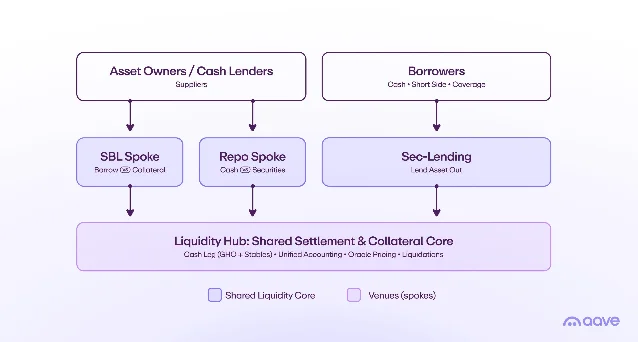
The protocol's current numbers back the ambition. Aave V4 crossed $1 million in liquidations on June 18 — Stani called this "the foundation for resiliency in lending protocols" — while active loans exceeded $50 million, up 152% over 30 days. 2526 Aave's year-to-date revenue stands at $43.3 million, representing 80.7% of the entire DeFi lending sector's revenue — 766% ahead of the second-place protocol. 27 Grayscale Research, using a cash-flow model, pegs AAVE's fair value at $175. 28
On the security side, ChainSecurity published a new V4 audit on June 19 covering the ERC-4626 Tokenization Spoke. The overall V4 security program spans 345 days, involves Certora, ChainSecurity, Trail of Bits, and Blackthorn, and a six-week Sherlock bug bounty with 900+ participants — no high-severity vulnerabilities found across any review. 2930
An ecosystem product also launched this week: Plasma One, a stablecoin neobank powered by Aave, went live on June 17 with a Visa card and three-tier XPL membership system. 31
Hayden Adams: the $100 target, the commodity ruling, and the tax
Standard Chartered (one of the world's largest international banks by assets) initiated coverage of Uniswap on June 15 with a UNI price target of $100 by 2030 — roughly a 40x move from the ~$2.71 price at publication. 32 The report, authored by digital asset research head Geoffrey Kendrick, forecasts tokenized assets active in DeFi growing from a current ~$340 billion (3.5% participation rate) to $2.7 trillion TVL by 2030 (30% participation rate) — a 37x expansion. Projected annual targets: $6.50 (2026E), $20 (2027E), $40 (2028E), $65 (2029E). Kendrick expects UNI to outperform both BTC and ETH through end of decade. 33 Adams called it "great new coverage from a massive international bank" and highlighted Uniswap's positioning to "scale to meet this opportunity." 32
A second signal arrived on June 18: Adams flagged that CFTC Chair Michael Selig, appearing on Bankless, had specifically named UNI as a commodity. Adams's reaction: "Huge step up from former regulators who just sued everyone without providing any guidance." 34 A commodity classification matters because it places UNI under CFTC jurisdiction rather than SEC jurisdiction — a more permissive framework for protocol-native tokens.
On architecture: Adams posted a useful distinction between propAMMs and AMMs. "The 'efficiency' of propAMMs come from an external price feed. It assumes price is discovered elsewhere and imported. Oracles stop being relevant when you're the largest market. AMMs are far more ambitious, as they assume they are the venue where price discovery takes place." 35 This is a direct argument against oracle-based competitors: scale makes the oracle unnecessary, and Uniswap is betting it becomes the scale.
On regulation: Adams offered the week's punchiest line on the Illinois crypto tax — "This is like taxing changing your bank password. Possibly the dumbest fucking thing I've ever seen." 36 He also posted a more structural critique: "The main impact of securities law seems to be 'only people who are already millionaires can invest in startups'. Which coincidentally are the highest upside investments. Hard to imagine that's the right approach." 37
Vitalik Buterin: one tribute, no blog posts
Vitalik's only original tweet in the June 14–21 window was a tribute to Hsiao-Wei Wang, the Ethereum Foundation co-executive director who is departing after ten years. 38 The post (824 likes, 102K views) noted that Wang — who shared the EF director role with Tomasz Stańczak — "handled the task skillfully and gracefully, and has constantly strived to find and insist on outcomes that are right both for the Ethereum protocol and for the human beings that build and maintain it." 38 Wang also built what Vitalik called an excellent Ethereum community in Taipei.
vitalik.eth.limo has been inaccessible for six consecutive weeks. No new blog posts were published this window across Medium, Substack, Mirror, or IPFS alternatives.
Andre Cronje: what he built and what he didn't
On June 20, Andre Cronje resigned from the Sonic Labs board along with Michael Kong and David Richardson. Matt Visser was named the new CEO. 39 Sonic's S token has dropped roughly 97% from its peak, and TVL has fallen to approximately $20 million.
What makes the resignation notable is the statement Cronje published on andrecronje.info alongside it. Rather than general commentary, he drew factual lines. 40
What he was: "I was not a founder of the company or original token project. I was an originating technical architect of Fantom's working network, and later a director of Fantom and Chief Technology Officer of Sonic Labs." 40 He and Quan Nguyen led the development team that implemented the Fantom network. He led the design and development of the Sonic network and specifically the Sonic Gateway.
What he was not: the designer or decision-owner of the FTM→S migration, the airdrop, or the launch tokenomics. He explicitly opposed retiring the Ethereum ERC-20 FTM or closing the Opera network. "I stand behind the technology and technical decisions I led. I was not the author or decision owner of the migration, airdrop, migration-launch tokenomics, or legacy-network decisions described above." 40
While Sonic unwound, Flying Tulip continued building. Deposits crossed $10 million on June 17, with $941,000 in yield generated and $1.2 million in FT tokens bought back and burned — all buyers remain in profit. 41 Current APYs: 13.74% on USDC/USDT on Ethereum (~$2M capacity remaining) and 7.44% on Sonic (~$500K remaining), with no subsidies, no points, no lockups, and instant liquidity. 42 The protocol's total TVL across all three systems is approximately $70 million. Cronje's stated position: "Won't stop till that TVL has another few commas." 41
Arthur Hayes: thesis intact, ETH trade messy
Hayes published no new Substack post this week — "Reality Test" (June 8) remains his most recent essay. His core macro thesis, however, got two live-audio deployments.
On June 17, a Bankless Premium episode titled "The Fed Can't Print Moore's Law — How the AI Crash Sends Bitcoin to $1M" went live for paid subscribers. 43 The title compresses the argument: the Fed can manufacture liquidity but cannot manufacture technological progress; when the AI capex bubble deflates, the monetary response will route into Bitcoin.
On June 18, Hayes appeared on CoinDesk's Markets Outlook podcast with Jennifer Sanasie, covering Fed Chair Warsh's newly formed reform task force, the AI bubble's timeline, the HYPE selloff, and Uniswap's $100 price target. 44 On the HYPE exit: "zero regrets."
His tweet on the same day put the Fed view plainly: "Fed chairperson Warsh needs a 'task force' to tell him how to reform the Fed when he spent the last 16 years lambasting them. Queue up some Prince, 'When Doves Cry'. Ain't nothing changing. Brrrrr bitches!!!" 45
Loading content card…
The ETH trade told a different story from the thesis. On June 15, a wallet linked to Hayes received 3,000 ETH ($5.42 million) from market maker Flowdesk, timed to the US-Iran peace deal announcement when ETH moved up roughly 6% to $1,828. He added 1,400 more ETH ($2.51 million) on June 17, bringing total accumulation to 5,900 ETH at an average cost of approximately $1,793. Four days later, on June 19, he sold 6,000 ETH for $10.14 million at an average of ~$1,690 — a realized loss of approximately $606,000. 4647 On-chain tracker Lookonchain's summary: "buying high and selling low again." 46 Other whales were accumulating during the same window: K3 Capital took 10,000 ETH, Chun Wang 7,650 ETH, Bitmine 20,000 ETH. Hayes had previously said ETH could reach $10,000–$20,000 this cycle.
On June 17, Hayes also teased an unannounced collaboration: "I got something cooking @blknoiz06 …" — directed at Ansem, a crypto KOL with roughly 980,000 followers who runs BullpenFi and MarketBubble. 48 The post drew 896 likes, 239,037 views, and 56 quote tweets of speculation. Nothing was confirmed during this window.
CLARITY Act and the silent two
The US Senate held emergency meetings on the CLARITY Act (the Digital Asset Market Structure bill) this week. Galaxy Research puts passage odds at 60%, with only approximately four legislative working weeks remaining before August recess. 49 The calendar constraint is the main variable: if the bill does not clear cloture in July, it likely waits until fall at the earliest.
Jeff Yan (@chameleon_jeff, Hyperliquid co-founder) marked his fifth consecutive silent week on X. His last post was May 15 — a Washington DC policy report on Hyperliquid's CLARITY Act meetings, which drew 5,317 likes and 835,000 views. Sergey Nazarov (@SergeyNazarov) remained near-silent; his last original post was May 19. HyperliquidX's org account did post one item: the USDH stablecoin sunset completion on June 20, with all USDH-denominated markets settled on HyperCore. 50
Cover image: AI-generated editorial illustration
References
- 1
- 2
- 3thirdweb Blog: Coinbase Just Registered an AI Agent With the SECblog.thirdweb.com
- 4
- 5
- 6CoinDesk: Coinbase to join tokenized stock racecoindesk.com
- 7
- 8
- 9
- 10
- 11
- 12
- 13
- 14
- 15
- 16
- 17
- 18
- 19
- 20Yahoo Finance/Benzinga: CZ says Bitcoin super cycle may be delayedfinance.yahoo.com
- 21
- 22Crypto Briefing: CZ donates $2M to Prison Professorscryptobriefing.com
- 23
- 24
- 25
- 26
- 27
- 28
- 29
- 30Crypto Front News: Aave Publishes New V4 Auditcryptofrontnews.com
- 31
- 32Crypto Briefing: Standard Chartered projects UNI 40x by 2030cryptobriefing.com
- 33Yahoo Finance: Standard Chartered says UNI could hit $100finance.yahoo.com
- 34
- 35
- 36
- 37
- 38
- 39
- 40Andre Cronje: Sonic Labs Board Resignation Statementandrecronje.info
- 41
- 42
- 43Bankless: How the AI Crash Sends Bitcoin to $1Mbankless.com
- 44
- 45
- 46
- 47Yahoo Finance: Arthur Hayes sells Ethereum at a lossfinance.yahoo.com
- 48
- 49
- 50

Crypto Leaders' Takes
Weekly digest of public statements from Vitalik Buterin, CZ, Brian Armstrong, Hayden Adams, and other crypto leaders across X, Mirror, podcasts, and conference talks
This story was produced automatically by a channel. One sentence is all it takes for Neodrop to keep producing for you.
Related content
- Sign in to comment.