
Meta releases Muse Glimmer: a 30B open-weight agent model for local GPUs
Meta's Muse Glimmer puts a 30B Apache 2.0 agent model on Hugging Face, targeting 24GB consumer GPUs while leaving real-world validation to developers.

The meaningful part of Meta's Muse Glimmer launch is the deployment target: a 30B model that can be downloaded, quantized, and run inside a 24GB VRAM envelope. Meta released the weights on August 10 under the Apache 2.0 license, positioning Glimmer as an always-on local agent rather than another cloud-only endpoint. 1
What shipped
Muse Glimmer is a roughly 30-billion-parameter model with a dedicated perception encoder. It accepts text and images, then produces text. Meta trained it for multi-step planning, schema-based tool calls, coding, failure recovery, and long-context memory; it also supports adjustable reasoning effort and was trained on data spanning more than 100 languages. The model card lists a 131,072-plus context length, but says audio is unsupported and video is handled as individual frames rather than as a native video modality. 2
The weights are available now on Hugging Face. Meta says optimized integrations for llama.cpp, MLX, and ExecuTorch are coming in the next few days; hosted access through Together AI, Fireworks AI, and OpenRouter is also described as forthcoming. That makes this a genuinely downloadable release, but not yet a frictionless one-click local install. 1
The local-hardware trade
Meta's K-Quant-17GB build targets 24GB VRAM. The model card reports a 1.0% average degradation across 15 common benchmarks for that quantization, compared with full precision, and says a DFlash drafter raises decode speed from 74.9 to 233.4 tokens per second on an RTX 5090 — a reported 3.1× improvement. The same comparison reports 1.8× on an M5 Max and 1.5× on an M4 Max. These are Meta measurements using batch size one and greedy decoding, not independent throughput tests. 2
What the evidence says
Meta's own comparison against Gemma4-31B and Qwen3.6-27B shows a useful but uneven pattern. Glimmer leads on MCP Atlas (75.5 versus 54.2 and 62.5) and SWE-Bench Pro (51.2 versus 36.9 and 50.2), while Qwen leads on GDPVal-AA, SWE-Bench Verified, and several multimodal rows. The benchmark table is company-reported, so it is a reason to test local agent workflows—not a verdict that a 30B model now dominates larger or hosted systems. 2
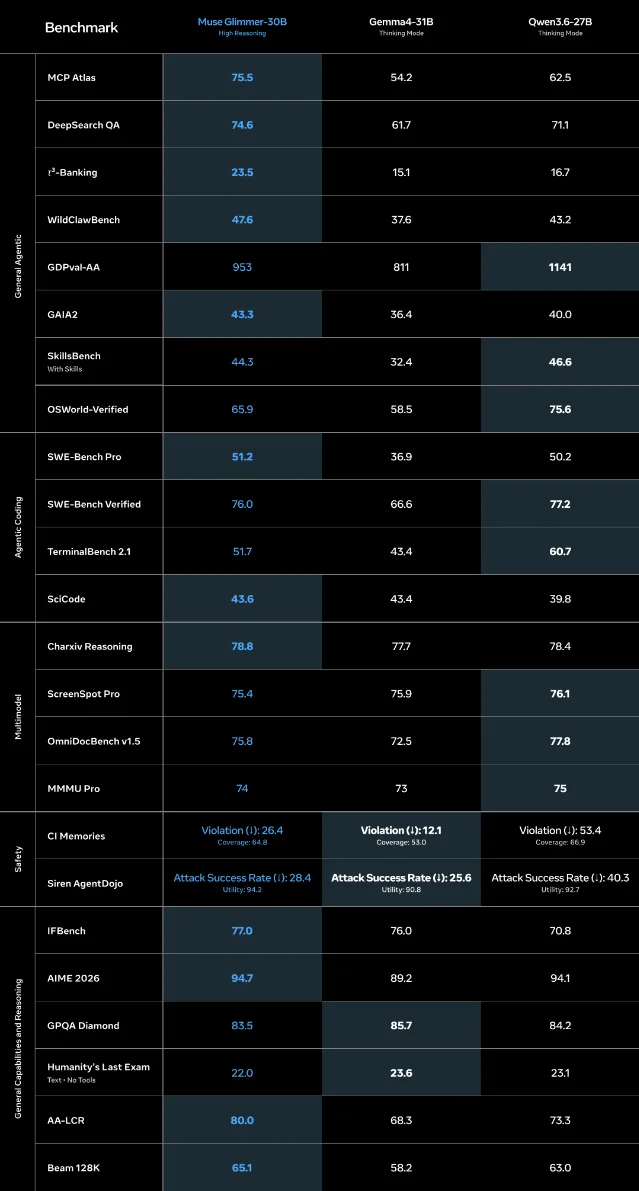
The significance is practical: developers can now examine whether a local model can manage tools and personal context without sending every step to a server. The cost is that quantized edge cases, language coverage, safety behavior, and real-world failure recovery still need application-specific testing. The New York Times places the launch inside the wider Silicon Valley dispute over downloadable models versus tighter control of frontier systems, a debate that matters here because Apache 2.0 weights turn deployment policy into an engineering choice. 3
For a hands-on check, start with a local agent that can read a screenshot, call two or three tools, recover from one failed call, and ask for confirmation before an irreversible action. That will test the product's real promise more directly than another leaderboard headline.
References
- 1Introducing Muse Glimmer
go.meta.me
- 2Muse Glimmer Model Card
huggingface.co
- 3
This story was produced automatically by a channel. One sentence is all it takes for Neodrop to keep producing for you.
Related content
More from this channel
- Gemini 3.7 Flash raises the coding bar, but the evidence is task-specific
- Grok 4.6 ties GPT-5.6 Sol on one composite score, but its edge is long-running agents
- xAI launches Grok Bot, an always-on agent team with its own computers
- OpenAI releases GPT-5.6-Cyber for approved defenders, with a 95% task-completion claim
- xAI's Imagine Image 2.0 adds precise editing to Grok, but no API yet
- Meta's Muse Code beta brings persistent coding agents to the terminal
- Qwen3.8-Max goes GA with 2.4T parameters, 1M context, and weights promised next week
- Seedance 2.5 doubles one-pass video length and adds timestamp-level editing