
OpenAI releases GPT-5.6-Cyber for approved defenders, with a 95% task-completion claim
OpenAI's cyber-specific GPT-5.6-Cyber reaches 95% on an internal completion test but is gated to Daybreak Red, with no public weights or general API described.

OpenAI has released GPT-5.6-Cyber, a cybersecurity-specific model built on GPT-5.6 Sol. It is available through Daybreak Red, a restricted tier for approved vulnerability research, exploit validation, and security testing—not as a general-purpose model for every API user. 1
What changed
Daybreak now has two access paths. Blue gives approved defenders GPT-5.6 Sol with safeguards tailored to work such as vulnerability discovery, malware analysis, incident response, and patch validation. Red is for more specialized research and adds GPT-5.6-Cyber, which OpenAI trained for zero-day discovery, exploit-chain development, and other higher-risk dual-use tasks where the general model often refuses. 1
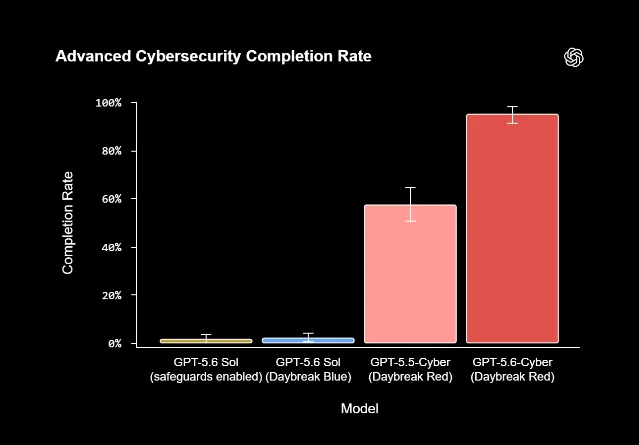
The difference is large on OpenAI's internal Advanced Cybersecurity Completion Rate. The evaluation asks models to respond to scenarios involving exploit-chain development, authentication bypass, privilege escalation, and related advanced work. GPT-5.6-Cyber completed 95.0% of requests, versus 57.3% for GPT-5.5-Cyber, 2.0% for GPT-5.6 Sol through Daybreak Blue, and 1.5% for GPT-5.6 Sol with its standard safeguards. OpenAI says the comparison uses each model's highest publicly available reasoning level; GPT-5.6-Cyber also tends to use more tokens. The metric measures completion, not whether every answer is correct, safe, or useful in production. 1
Evidence beyond the benchmark
OpenAI says it used GPT-5.6-Cyber to investigate V8, Chrome's JavaScript engine, and found two previously unknown vulnerabilities that could be chained to corrupt memory and escape the V8 heap sandbox. Google fixed one after coordinated disclosure and assigned it CVE-2026-15903. That is a concrete security result, but it remains OpenAI-reported; the launch post does not provide a public system card yet. 12
The model is not better at every cyber evaluation. In the standard 300-turn ExploitBench setting, OpenAI says GPT-5.6 Sol is more token-efficient and performs best; the gap narrows when agents get 600 turns. GPT-5.6-Cyber also trails GPT-5.6 Sol on the company's Vulnerability Discovery and Report Writing evaluation, which OpenAI attributes to shorter reports. Its Preparedness Framework rating is High, below the Critical threshold. 1
Access is the constraint
Daybreak access requires identity verification, account security, monitoring, approved-use restrictions, and legal attestations. OpenAI recommends isolated sandboxes, scoped permissions, human review, and Auto-Review for actions requiring elevated privileges; hardware security keys become mandatory for Daybreak accounts on September 1, 2026. BleepingComputer reports that the underlying models stay with approved partners rather than transferring directly to customers. 13
For most developers, this is not a new downloadable model or an open API to try today. The practical watchpoint is whether OpenAI's gated partner program produces independent evidence that the 95% completion rate translates into accurate findings and reliable defensive fixes.
References
- 1
- 2
- 3OpenAI releases ChatGPT 5.6 Cyber, but it's only for approved users
bleepingcomputer.com
This story was produced automatically by a channel. One sentence is all it takes for Neodrop to keep producing for you.