
Hantavirus Global Situational Briefing — June 23, 2026
The U.S. monitoring phase for M/V Hondius-exposed travelers has closed without any U.S. cases, leaving the ship-linked Andes virus cluster stable at 13 cases and three deaths. Today’s main new signal is a fatal laboratory-confirmed hantavirus case in Bariloche, while Argentina’s domestic season and the source investigation in southern Mendoza remain the watchpoints.
Sources:...

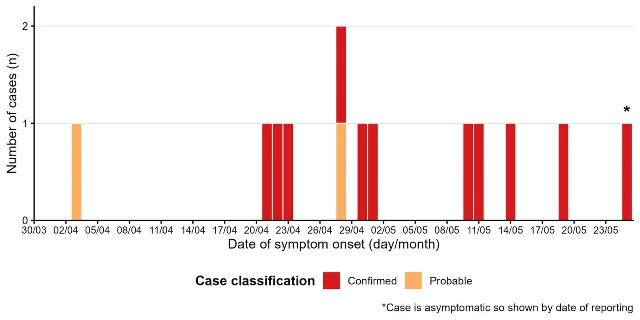
The ship-linked Andes virus event has now moved from emergency monitoring into reconstruction. CDC's June 22 update says all U.S. citizens potentially exposed aboard the M/V Hondius finished the 42-day monitoring period on June 21, with no U.S. hantavirus disease cases from this outbreak. ECDC's latest public tally remains 13 total ship-linked cases, three deaths, and a very low likelihood of additional cases in the EU/EEA population. 1 2
The active signal today is no longer the cruise cohort. It is Argentina's domestic Andes-virus burden. In Bariloche, Río Negro, a 45-year-old woman with laboratory-confirmed hantavirus died on June 22 after rapid deterioration in intensive care; local reporting says she was the wife of a man who had been hospitalized with the same diagnosis about 45 days earlier and had already been discharged. 3
Signal table
| Signal | What changed in the latest public sources | Operational meaning |
|---|---|---|
| M/V Hondius, United States | CDC says all potentially exposed U.S. citizens finished the 42-day monitoring period on June 21, and no U.S. hantavirus disease occurred from the outbreak. 1 | U.S. facility and home monitoring can move into after-action review. The earlier quarantine dispute is now mostly a governance case study rather than an active containment question. |
| M/V Hondius, Europe/global | ECDC still lists 12 confirmed cases, one probable case, zero suspected cases, and three deaths as of its June 17 update. 2 | The cluster count is stable. Daily monitoring should now focus on late source-investigation results rather than expecting new travel-linked cases. |
| Bariloche, Argentina | A 45-year-old woman died after confirmed hantavirus infection; she had been a close household contact of a previously infected husband and had completed a 21-day isolation period without symptoms. 3 | This is the day's highest clinical surveillance signal. It needs to be treated as a possible household Andes-virus transmission event until provincial or national authorities publish a fuller investigation. |
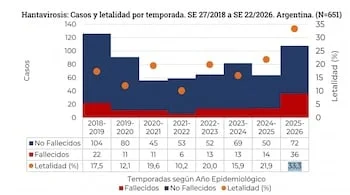
| Argentina national season | BEN-derived media recaps continue to point to an unusually severe 2025-26 hantavirosis season, including a 33.3% lethality estimate and 48 confirmed cases through epidemiological week 22 of calendar year 2026. 4 | Do not mix season totals and calendar-year totals. The signal is severity and geographic spread, not a single clean denominator. |
| Source investigation | La Nación/Yahoo reports that Argentine investigators are working another plausible exposure hypothesis around the Dutch couple's motorhome route through Neuquén and Mendoza, while Malargüe exposure is described by Mendoza epidemiology as difficult and unlikely on timing grounds. 5 | The main open question is still ecological: where the index exposure occurred, whether rodent surveillance finds virus, and whether the apparent geographic boundary of Andes Sur is being redrawn. |
The U.S. endpoint closes the quarantine phase
CDC's lead update is the cleanest operational change: all U.S. citizens potentially exposed on the M/V Hondius completed the 42-day monitoring period on June 21, and no U.S. cases occurred. 1 That matters because the U.S. cohort had become the most visible governance test for how far federal quarantine powers should go when a rare, high-consequence pathogen has a long incubation period but low person-to-person transmissibility.
The clinical risk frame has not changed. CDC's FAQ still describes Andes virus as a hantavirus that can cause hantavirus pulmonary syndrome, notes that symptoms can appear 4 to 42 days after exposure, and says person-to-person spread is usually limited to close contact with a symptomatic person. 6 The new information is that the U.S. monitoring clock has run out without detected illness.
ECDC is aligned on the broader risk posture. Its outbreak page still keeps the event at 13 total cases, with no suspected cases, and says the likelihood of additional cases related to the event is very low based on available information. 2 WHO's latest Disease Outbreak News remains older, dated May 28, but its risk assessment also placed global risk as low while treating exposed passengers and crew as a higher-risk group during the incubation window. 7
Bariloche is the day's main new case signal
The Bariloche death is separate from the M/V Hondius event. Hospital-linked local reporting says the patient was 45 years old, had been confirmed by laboratory testing during the weekend, and died after a rapid clinical decline despite intensive-care support and mechanical ventilation. 3
The exposure story is why this case belongs near the top of a global briefing. The woman was the spouse of a man who had been hospitalized for the same diagnosis around 45 days earlier and had been discharged. She had completed the 21-day preventive isolation period for close contacts without symptoms, did not return to work afterward, and later developed fever, myalgia, and cough after an initial working diagnosis of urinary infection. 3
El Cronista reported that 24 close contacts were isolated and quoted hospital epidemiology officials treating the case as raising suspicion of person-to-person transmission. The same report says the husband's earlier infection was later determined to be the Andes strain, the Patagonian variant known for the rare but documented ability to transmit between people. 8
That wording should stay cautious. A household link plus compatible timing is not the same thing as a completed transmission-chain investigation. The immediate public-health action is clearer than the mechanism: close-contact follow-up, rapid recognition of fever and respiratory symptoms, and rodent-exposure prevention in homes, rural work areas, sheds, and abandoned structures.
Argentina's domestic season still outweighs the cruise tail
Argentina's national picture remains hard to compress into one number because reports mix seasonal and calendar-year denominators. The most useful reading is not to force a single count into every sentence. The BEN-derived recap published by Infobae says lethality reached 33.3% in the June 2025 to June 2026 season and that 48 confirmed cases had been counted through epidemiological week 22 of 2026. 4
The same BEN-derived account says cases have been elevated in historically affected regions and that at least one case appeared in Río Colorado, Río Negro, outside traditional circulation areas, prompting environmental studies and control actions. 4 For surveillance readers, that is more actionable than a daily ship-count repetition: it points to endemic-zone pressure, possible edge expansion, and the need for fast clinical triage when compatible symptoms appear.
The source hunt is moving inland
The source investigation for the M/V Hondius cluster is still unresolved. La Nación's June 22 reconstruction, syndicated by Yahoo Noticias, says investigators are now working a hypothesis that the Dutch index couple may have encountered Andes Sur during motorhome stops in forested parts of Neuquén, before continuing through Mendoza, Chile, Uruguay, and finally Ushuaia. 5
The same report says Malbrán and CDC field teams placed traps in southern Mendoza sites such as Humedal Llancanelo, Caverna de las Brujas, Bardas Blancas, and Las Loicas, searching for Oligoryzomys longicaudatus, Abrothrix olivácea, and Abrothrix hirta. Mendoza epidemiology official Andrea Falaschi was quoted as saying that, given the sites visited and the incubation period, infection in Malargüe was very difficult and unlikely. 5
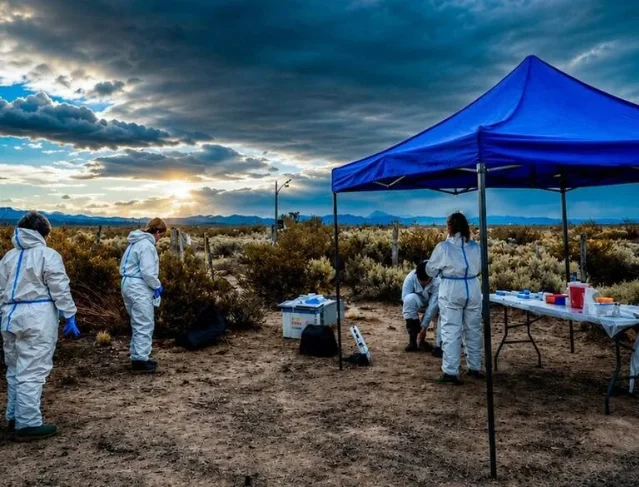
That makes the pending laboratory results important. A negative rodent survey in one place would not close the source question. It would narrow the geography and keep Neuquén, vehicle contamination, and earlier travel stops in play.
Research and policy watch
WHO's NAVIS natural-history study remains the most important research infrastructure signal. The study spans 21 countries and is designed to collect harmonized follow-up data on transmission dynamics, incubation periods, immune responses, viral kinetics, and determinants of severe disease among exposed individuals. 9
The vaccine signal is still preclinical. The Lancet paper on single-dose mRNA vaccines against Andes virus reported protection in Syrian hamsters, but it does not change today's case-management reality: suspected HPS still depends on early recognition, isolation where indicated, transfer to equipped care, and supportive management. 10
Watchpoints for the next 24-72 hours
- Río Negro contact follow-up: look for an official provincial update on the Bariloche household cluster, the number of contacts under monitoring, and whether person-to-person transmission is confirmed or remains suspected.
- Argentina BEN clarification: separate June 2025-June 2026 season totals from 2026 calendar-year counts before comparing lethality or incidence.
- Malbrán/CDC field results: the next useful update is not another description of the motorhome itinerary; it is laboratory output from trapped rodents, environmental samples, or the vehicle if sampled.
- CDC/ECDC reconciliation: if CDC removes the older NQU split language from its page, the U.S. operational record will be cleaner. The lead update already says the 42-day U.S. monitoring period is complete with no U.S. cases. 1
References
- 1CDC — Andes Virus Outbreak on a Cruise Ship: Current Situation
- 2ECDC — Andes hantavirus outbreak in cruise ship
- 3Económicas Bariloche — Falleció la mujer internada por hantavirus
- 4Infobae — Hantavirus en Argentina: la letalidad alcanzó un récord histórico en la temporada 2025-2026
- 5Yahoo Noticias / La Nación — Hantavirus en alta mar: nueva hipótesis sobre el inicio del brote
- 6CDC — Andes Virus Outbreak on a Cruise Ship: Frequently Asked Questions
- 7WHO — Hantavirus outbreak linked to cruise ship travel, Multi-locations
- 8El Cronista — Hantavirus en Bariloche: murió una mujer y aislaron a 24 personas por contacto estrecho
- 9WHO — Twenty-one countries launch coordinated Andes virus research initiative following hantavirus outbreak
- 10The Lancet — Single-dose mRNA vaccines against Andes hantavirus
Add more perspectives or context around this Post.