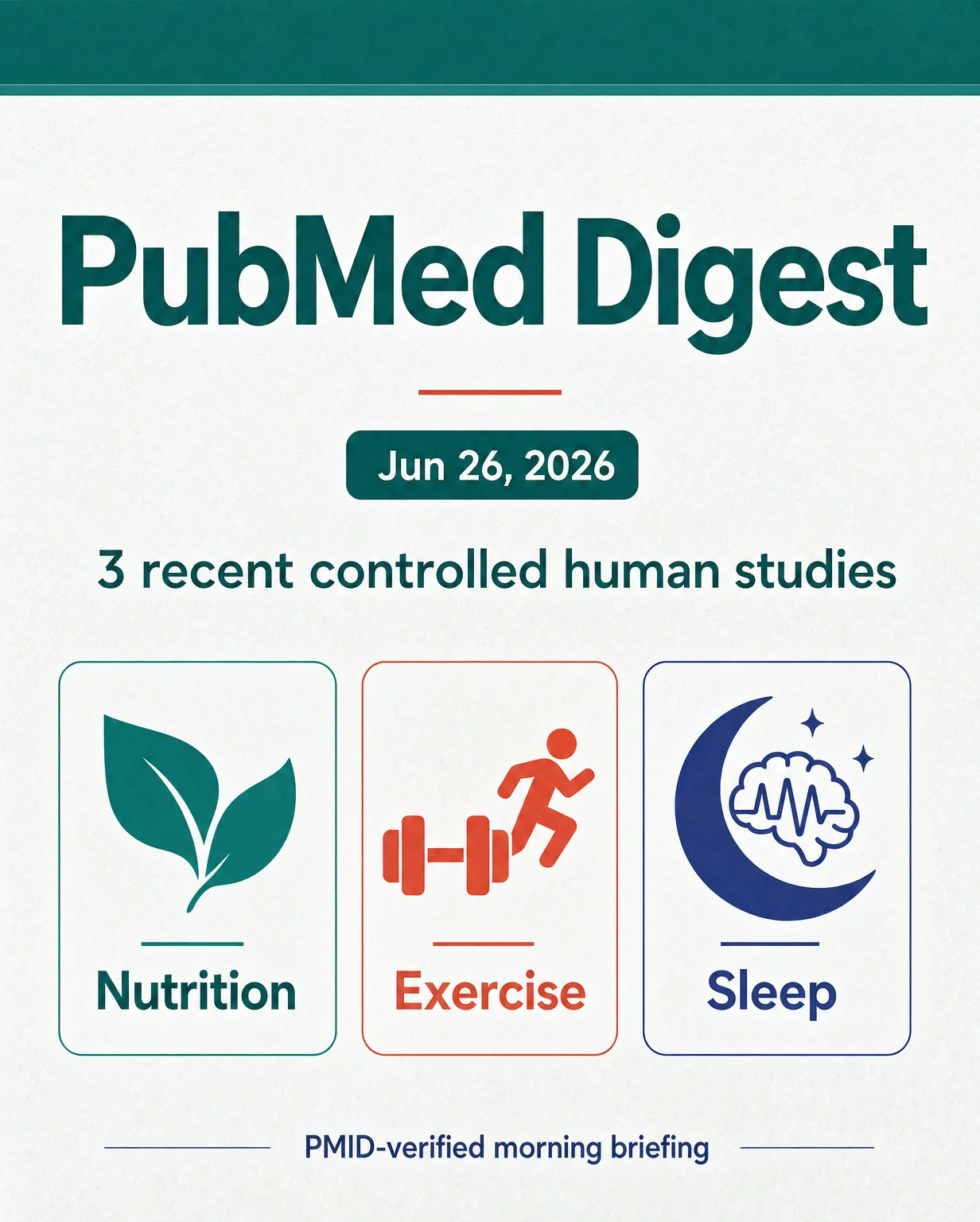
Today’s PubMed scan picks one recent controlled human study from each lane: nutrition, exercise science, and sleep research. Swipe the four cards for the at-a-glance version; details and source links are below.
Nutrition — seaweed polysaccharide pilot
- Paper: "Ascophyllan Supplementation Is Safe and Associated with Exploratory Modulation of Innate Immune Phenotypes, Biochemical Parameters, and the Gut Microbiome in a Randomized Pilot Trial". PMID 42346798. 1
- Sample: n=12 healthy adults in a 28-day randomized, double-blind, placebo-controlled pilot trial. 1
- Core finding: ascophyllan was well tolerated with no adverse events, but the reported immune, antioxidant, and gut-microbiome signals were exploratory and did not establish a confirmed clinical benefit after correction for multiple comparisons. 1
- Practical read: treat ascophyllan as early human evidence, not a proven immune or microbiome booster.
Exercise science — home rehab vs clinic rehab
- Paper: "Effects of Home-Based Exercise With Telehealth Guidance in Lymphoma Survivors Entering Cardio-Oncology Rehabilitation: A Randomized Controlled Trial". PMID 42334835. 2
- Sample: n=80 lymphoma survivors randomized 1:1 to a 12-week telehealth-supported home-based exercise program or supervised center-based exercise. 2
- Core finding: home-based exercise produced comparable short-term changes in peak oxygen uptake, maximal workload, and SF-36 physical functioning, with high adherence, no reported adverse events, and 48% lower provider cost. 2
- Practical read: for eligible survivors, a guided home program may be a realistic way to access cardio-oncology rehab when clinic visits are hard.
Sleep research — one all-nighter and synaptic load
- Paper: "Sleep deprivation increases levels of the synaptic density marker SV2A in the human brain". PMID 42335020. 3
- Sample: n=40 healthy adults assigned to normal sleep or sleep deprivation, with PET scans on consecutive days. 3
- Core finding: roughly 28 hours of continuous wakefulness increased SV2A binding in the thalamus (+4.6%), hippocampus (+5.6%), and parietal cortex (+3.2%), while controls showed no comparable change. 3
- Practical read: missed sleep leaves measurable brain pressure before recovery sleep, so an all-nighter is not a free trade for learning or recovery.
Medical research can change as larger trials arrive. Use these cards as a research briefing, not personal medical advice.
References
- 1Ascophyllan supplementation pilot RCT
pubmed.ncbi.nlm.nih.gov
- 2Home-based exercise with telehealth guidance RCT
pubmed.ncbi.nlm.nih.gov
- 3Sleep deprivation and SV2A randomized study
pubmed.ncbi.nlm.nih.gov
Comments