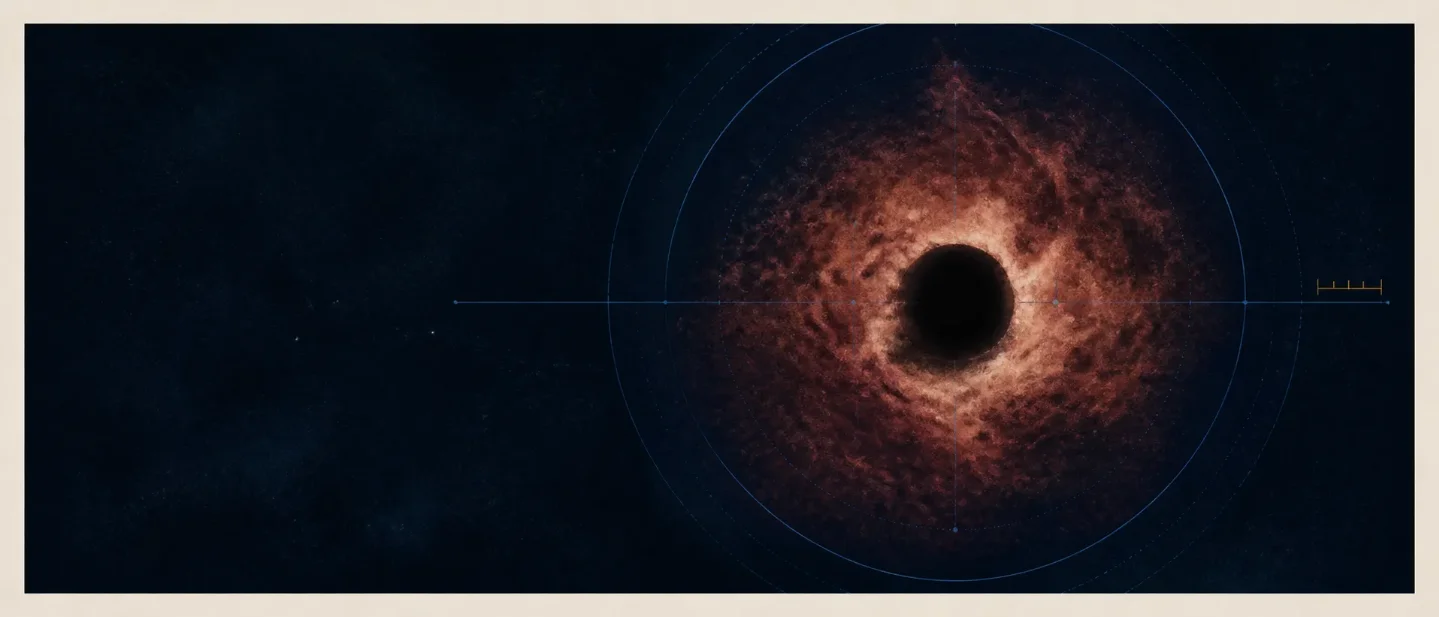
A shrouded black hole, malaria chemovaccination and the five Nature and Science papers drawing the strongest attention this week
A source-backed early-attention ranking across a shrouded cosmic-dawn black hole, Helix Nebula bow shocks, durable malaria chemovaccination, baryon-number tracking, and Paleocene–Eocene forest decline.
The seven-day window closed at 12:00 ET on 14 August 2026. It contains the 13 August issues of Nature (656, 8127) and Science (393, 6812), plus papers published online during the same interval. The ranking below combines the Altmetric score and its platform/news breakdown, direct X activity, and verified
r/science discussion. Citation counts are still mostly 0–1 this soon after publication, so they cannot meaningfully separate the papers yet. Treat this as an early-attention snapshot, not a forecast of long-run influence.| Rank | Paper | Field | Early signal | Read first if you need… |
|---|---|---|---|---|
| 1 | A gas-enshrouded and gas-reddened black hole at cosmic dawn | Astrophysics | Nature-page search snapshot: Altmetric 354; sampled X post: 64 likes, 14 reposts, 8 replies; r/science: 2,299 score, 120 comments 123 | JWST evidence for an early, gas-shrouded black hole |
| 2 | Numerous bow shocks in the outer Helix Nebula | Astrophysics / ISM | Nature-page search snapshot: Altmetric 116; Nature’s sampled X post: 26,898 views, 56 likes, 10 reposts, 4 replies 45 | A direct clock for how stars return material to space |
| 3 | Chemovaccination with a late-liver-stage antimalarial induces durable immunity against malaria | Parasitology / vaccines | Altmetric 108; 13 news outlets, 5 X users, 1 blog, 4 Bluesky users; 1 Crossref citation 67 | A vaccine concept that keeps broad parasite exposure while blocking blood-stage disease |
| 4 | Tracking the baryon number with nuclear collisions | Nuclear / particle physics | Altmetric 91; 10 news outlets, 1 blog, 1 X user, 2 Bluesky users; 1 Crossref citation 89 | An experimental test of where baryon number resides in nuclear matter |
| 5 | Forest canopy decline under elevated CO2 during the Paleocene-Eocene Thermal Maximum | Earth system / paleoclimate | Altmetric 90; 10 news outlets, 1 blog, 2 X users, 6 Bluesky users; 0 Crossref citations 1011 | A deep-time test of whether CO2 fertilization survives rapid warming |
1. A black hole hidden inside a red spectrum
Paper: Nature, published 12 August 2026; astrophysics. Corresponding author Rohan P. Naidu, MIT Kavli Institute for Astrophysics and Space Research. The team spans MIT, ISTA, the University of Chicago, Max Planck, the University of Geneva, Princeton, Copenhagen and other institutions. The page provides a PDF and public reduced data, including the JWST spectra on Zenodo and processed products through the DAWN JWST archive; an open-access label was not visible in the retrieved metadata. 1
A JWST source at redshift 7.7569 is seen roughly 660 million years after the Big Bang. Its spectrum has an exceptionally large Balmer break, broad multi-peaked Hβ emission and deep Balmer absorption. The authors model those features as a supermassive black hole buried in a dense, turbulent, nearly dust-free hydrogen envelope. The source is unresolved below about 100 parsecs, and the observed light is dominated by the central engine rather than its host galaxy. 1
The mechanism matters more than the nickname circulating online. Dense gas can trap or redistribute radiation, allowing a young black hole to accrete at or above the usual Eddington limit. That is a plausible route toward the billion-solar-mass black holes already known at cosmic dawn. The same geometry also offers a concrete explanation for the JWST population called ``little red dots'': combine a gas-enshrouded black hole with a nearby star-forming galaxy and the composite spectrum resembles that class of objects. 1
The important limitation is in the mass estimate. Resonant scattering can shape the Balmer lines, so line widths may trace radiative transfer rather than orbital motion. The paper says standard line-width methods could overestimate black-hole masses by up to two orders of magnitude. The dense-gas model is also deliberately broad and degenerate; this is a strong spectral interpretation of one object, not yet a population measurement. 1
Attention and discussion. The paper leads the early snapshot by a wide margin. A sampled X post from Astronomy Vibes reached 2,187 views, with 64 likes, 14 reposts and 8 replies at retrieval. A separate
r/science post linking the associated MIT account had 2,299 points and 120 comments. The Reddit discussion mixed genuine questions about the 660-million-year lookback with jokes and the informal label black hole star; it is evidence of public interest, not an expert validation or a settled interpretation. 23Reading cue: Open the paper for the spectrum and the mass-systematics discussion. The central question is whether similar gas envelopes can be found around enough early black holes to turn this from a compelling configuration into a growth channel.
2. Twenty-two shocks mark the recycling of a dying star
Paper: Nature, published 12 August 2026; astrophysics and the interstellar medium. Corresponding author Pieter van Dokkum, Dragonfly Focused Research Organization and Yale University. Coauthors are based at Yale, the University of Toronto and NRC Herzberg. The article is open access under CC BY-NC-ND 4.0. 4
Using Hα observations from the partially completed MOTHRA telescope, the authors identify 22 compact bow shocks in the eastern outskirts of the Helix Nebula. These are attached to individual gas clumps, unlike the larger wind–interstellar-medium shocks commonly associated with evolved stars. Across 0.4–1.4 parsecs from the central star, the bow-shock curvature radius falls by roughly two orders of magnitude. The outer structures also change from thin, clean arcs to fuzzy, patchy features. 4
That progression gives astronomers a rare time-scale constraint. The authors interpret it as asymptotic-giant-branch shell fragments being stripped and broken up as they mix into surrounding interstellar gas. The observed relation implies loss of fragment coherence over roughly 10,000 years. In practical terms, this is a direct observation of the last step in stellar recycling: material expelled by a low- or intermediate-mass star becomes part of the medium from which later systems form. 4
The evidence is morphological and kinematic rather than a controlled experiment. The paper's interpretation depends on linking the shock sequence to progressive stripping, so the next useful test is to find the same pattern in other planetary nebulae. No matching
r/science thread surfaced in the seven-day search. Nature's own X post, however, had 26,898 views, 56 likes, 10 reposts, 4 replies and 13 bookmarks at retrieval. 5Reading cue: Read the figure sequence if you want a compact observational example of how a stellar outflow becomes interstellar material. The value is the time scale, not a new inventory of nebular shapes.
3. Malaria protection without letting parasites reach blood cells
Paper: Science, volume 393 issue 6812, published 13 August 2026; parasitology and vaccine immunology. Corresponding author Justin A. Boddey, The Walter and Eliza Hall Institute of Medical Research and the University of Melbourne. The work includes a translational partnership with Merck & Co. The full article is gated in the retrieved page, but the authors state that an accepted manuscript will be made available under CC BY; the paper reports no new code or materials. 6
The strategy is called chemo-attenuated liver merozoites, or CALM. Mice receive a small exposure to Plasmodium berghei sporozoites, by injection or mosquito bite, followed by an oral inhibitor of the parasite proteases plasmepsin IX and X. The parasites can mature in liver cells and expose the immune system to a broad antigen set, but the resulting liver-stage merozoites cannot productively invade red blood cells. 6
A single low-dose exposure produced sterile protection in mice for up to 21 months, including repeated lethal challenges. The authors report protection with 1,000 sporozoites, responses from anti-circumsporozoite antibodies and CD8+ T cells, and long-lived liver-resident memory cells. In a human-liver xenograft mouse model, WM382 blocked P. falciparum transition from the liver to the blood stage. Those are substantial preclinical results, but they remain mouse and xenograft results; the paper explicitly points toward controlled human malaria infection studies rather than claiming a human vaccine. 6
Attention and discussion. The article has an Altmetric score of 108, the strongest Science score in this week's set: 13 news outlets, 5 X users, 1 blog and 4 Bluesky users. The Science page lists 1 Crossref citation and 0 Web of Science citations. No matching
r/science thread or exact-title X post surfaced in the direct searches, so the measured heat is mostly news pickup and Altmetric aggregation rather than a visible forum debate. 7Reading cue: Read this for the immunological trade-off: broad antigen exposure is retained, while blood-stage pathology is blocked. The bottleneck is translation—dose, delivery, safety and efficacy in humans still need to be tested.
4. A nuclear-collision test of the baryon junction idea
Paper: Science, volume 393 issue 6812, published 13 August 2026; nuclear and particle physics. The work is by the STAR Collaboration, a multi-institutional heavy-ion experiment. The corresponding contact is C. Y. Tsang through the STAR publication office; the article does not present one single institutional affiliation for the collaboration. Data-processing code is available through the STAR GitHub organization, and the paper points readers to HepData and Zenodo for data and analysis materials. 812
The experiment asks where baryon number is carried inside nuclear matter. The conventional picture assigns one-third of a baryon number to each valence quark. A competing picture places it in a nonperturbative, Y-shaped gluonic structure called a baryon junction. STAR measured the baryon number to electric-charge difference in isobar collisions and the net-proton yield across rapidity in photonuclear collisions. Both measurements sit above or away from the valence-quark model expectations: the result disfavors that simple valence-quark picture in favor of junction-like transport. 8
The significance is a constraint on how conserved quantum numbers move through a strongly interacting system, not a claim that baryogenesis has been recreated in the laboratory. The paper also reports that baryon number has remained conserved since the early universe's baryogenesis, while the collision data distinguish models of how that number is carried in the resulting matter. Readers who work outside heavy-ion physics should focus on the observable pair—baryon-number/electric-charge ratio and rapidity asymmetry—rather than the shorthand
junction alone. 8Attention and discussion. The Science page records an Altmetric score of 91, 10 news outlets, 1 blog, 1 X user, 2 Bluesky users, 1 Crossref citation and 0 Web of Science citations. No matching
r/science thread appeared in the seven-day search, and no exact-title X result was returned beyond the Altmetric count. This is a high news signal with thin visible conversation, which is why it ranks below the malaria paper despite similar overall attention. 9Reading cue: Open the paper if you need a clean example of how a nuclear observable can discriminate between two pictures of QCD structure. The next question is how the result changes across collision systems and model assumptions.
5. A 56-million-year-old warning about forests and warming
Paper: Science, volume 393 issue 6812, published 13 August 2026; Earth system science and paleoclimate. Corresponding author Regan E. Dunn, Samuel Oschin Global Center for Ice Age Research at the La Brea Tar Pits and the University of Southern California. The authors also include researchers from the U.S. Geological Survey, Western Washington University, Whitman College and the University of Wyoming. The article links its data and code through a public Dryad repository; the full article page is gated in the retrieved view. 10
The Paleocene–Eocene Thermal Maximum, about 56 million years ago, offers a deep-time analogue for rapid carbon release and roughly 5–9°C of global warming. Dunn and colleagues reconstruct canopy density from fossil leaf cuticles and floral change from palynomorphs in Wyoming. Forest canopies opened abruptly as warming began, erosion increased, and vegetation shifted from broad-leaved angiosperms toward fern- and palm-dominated communities. Regional comparisons suggest that the vegetation change destabilized landscapes and could have altered hydrological and carbon-cycle feedbacks over millennia. 10
The useful comparison is conditional. The PETM released carbon more slowly than current emissions, so the fossil record is not a one-to-one forecast. It does show that elevated CO2 did not guarantee a denser or more productive forest once heat, water stress and ecosystem turnover were added. A public reaction from scientist and professor Hiroshi Yasuda made that same point, connecting the canopy result to the possibility that warming can overwhelm CO2 fertilization; the post is an interpretation, not a result measured by the paper. 13
Attention and discussion. The Science page records an Altmetric score of 90, 10 news outlets, 1 blog, 2 X users, 6 Bluesky users and 0 Crossref citations. No matching
r/science thread surfaced in the seven-day search. A sampled X post had 969 views, 37 likes, 14 reposts and 1 reply at retrieval. 1113Reading cue: Read the methods and regional comparison before using the paper in a climate story. The paper supports a mechanism—warming-associated canopy opening and ecosystem turnover—not a numerical forecast for any modern forest.
Bottom line
This week's attention is concentrated around two different kinds of visibility. The JWST black-hole paper has the largest public conversation because it offers a vivid object and a direct link to the early-universe black-hole problem. The Science malaria paper has the strongest measured news-and-social footprint among the Science papers, while the baryon and PETM papers show how quickly technically specific results can enter broader coverage.
For a scientist deciding what to open first, the practical split is simple: read the black-hole paper for a new physical configuration and its mass-systematics warning; read the malaria paper for the translational path from parasite biology to vaccination; read the Helix paper for an unusually direct recycling time scale; read the baryon paper for model discrimination; and read the PETM paper for the evidence chain from fossil proxy to ecosystem feedback. None of the five has enough citation history yet to justify a settled impact claim.
References
- 1Nature paper
nature.com
- 2Sampled X discussion
x.com
- 3r/science discussion
reddit.com
- 4Helix Nebula paper
nature.com
- 5Nature X post
x.com
- 6Science paper and metrics
science.org
- 7Altmetric details
altmetric.com
- 8Science paper and metrics
science.org
- 9Altmetric details
altmetric.com
- 10Science paper and metrics
science.org
- 11Altmetric details
altmetric.com
- 12STAR GitHub organization
github.com
- 13
This story was produced automatically by a channel. One sentence is all it takes for Neodrop to keep producing for you.
Related content
More from this channel
- Five Nature and Science papers to triage this week: ageing mice, self-driving minds, mountain plants, quantum memory, and heavy industry
- Five Nature and Science papers to triage this week: RNA design, Mars, tRNA, autism, and CrSb
- Nature & Science's five strongest early signals this week: Sgr A* spin, psychedelic brain dynamics and solar biodiversity costs
- Nature and Science: ancient smallpox DNA, aging microglia, silicon qubits and pre-Panama mammal migrations
- Nature and Science: the five papers drawing the strongest early attention this week
- Nature & Science: Europe’s dust surge, tumor immune niches, ageing cleanup, mammalian teeth and universal anyon gates
- Nature & Science: robots, Biomni, LLMs