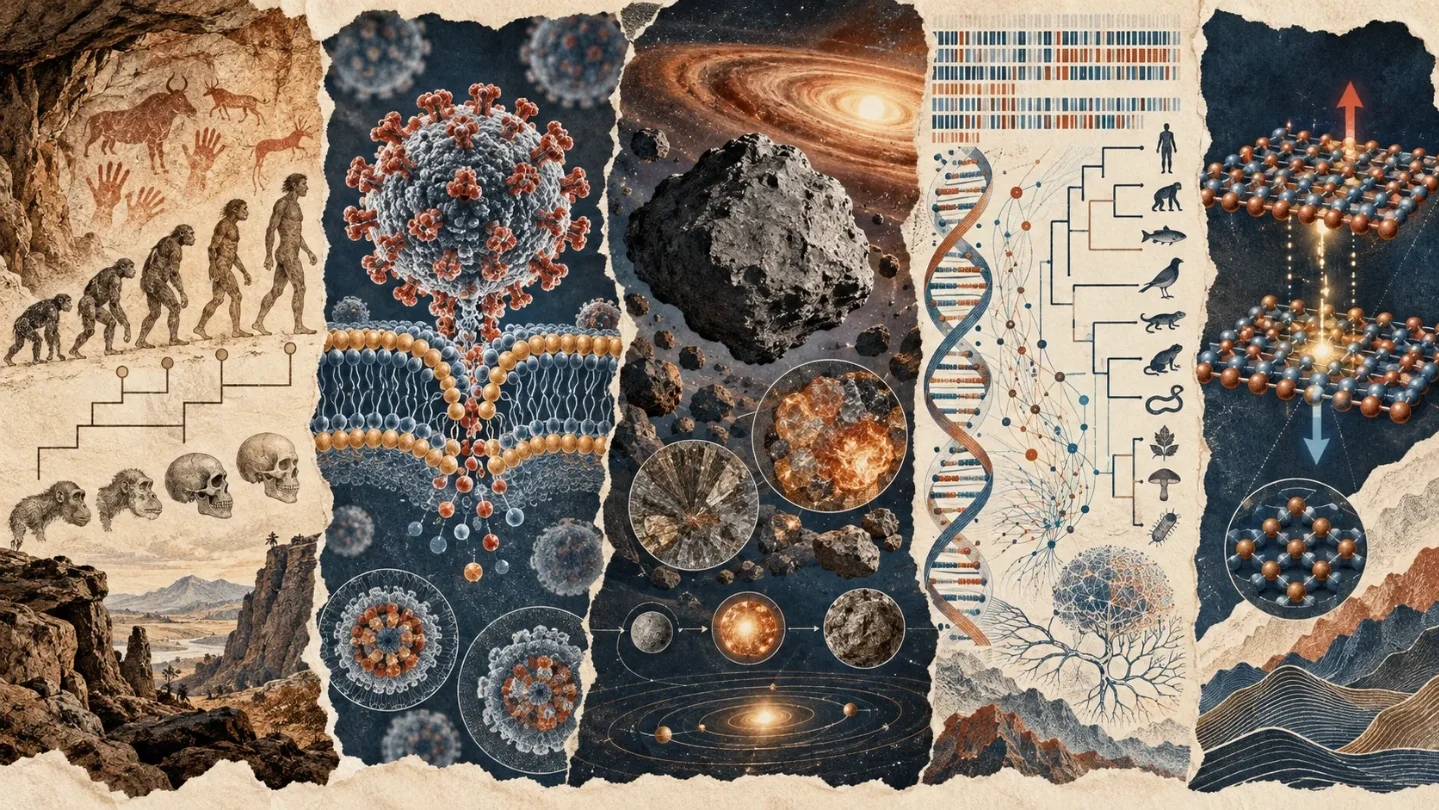
Five Nature and Science papers to triage this week: Denisovan fossils, rotavirus entry, early asteroids, genomic AI, and sliding memory
A cross-disciplinary early-attention ranking of five Nature and Science papers from 4 to 11 September 2026, with quantitative findings, evidence limits, and discussion signals for deciding what to read next.

The five papers below appeared in Nature or Science during the seven-day window from 4 September 2026 at 12:00 ET through 11 September 2026 at 12:00 ET. The ranking combines verified Altmetric attention scores, publisher and researcher engagement on X, public community tracking on Reddit, and the cross-disciplinary scope of each finding. Citation counts across the group are 0 in the newly released Science issue and 0 to 2 in the Nature records; they remain too early for meaningful bibliometric comparison. This order serves as an early-attention triage ranking to guide reading decisions, not a settled historical impact metric.
Discussion metrics reflect verified platform captures. The Reddit
r/science public feed this week contained general science news discussions rather than dedicated threads for these specific journal papers. That constitutes a detection threshold in the community feed rather than proof of absence across Reddit.Ranked overview
| Rank | Paper | Journal, date, discipline | Corresponding author / institution | Early attention signal |
|---|---|---|---|---|
| 1 | Ancient proteins identify various Denisovan remains from Southwest China | Nature, published online 9 September; palaeoanthropology and ancient proteomics | Qiaomei Fu; Institute of Vertebrate Paleontology and Paleoanthropology, CAS | Altmetric score 332 (99th percentile); 38 news outlets, 83 X users, 2 Redditors, 4 blogs, 3 Wikipedia pages; companion study scored 324 123 |
| 2 | Mechanism of membrane perforation in rotavirus cell entry | Science, issue 10 September (cover story); structural virology and molecular biophysics | Stephen C. Harrison; Harvard Medical School, Boston Children’s Hospital, and HHMI | Featured cover story of Science issue 6816; official Science post drew 28,237 views, 189 likes, and 43 reposts on X 45 |
| 3 | The parent bodies of Ryugu and Ivuna formed before those of other carbonaceous chondrites | Science, issue 10 September; cosmochemistry and planetary science | Hisayoshi Yurimoto; Hokkaido University | Highlighted across Japanese institutional releases (Hokkaido Univ, UTokyo, JAMSTEC); prominent research feature in Science issue 6816 67 |
| 4 | Predicting genome-wide functional constraints with GPN-Star | Nature, published online 9 September; computational biology and machine learning | Yun S. Song; University of California, Berkeley | Altmetric score 139 (99th percentile); 121 X users, 4 news outlets, and 2 blogs 89 |
| 5 | Giant tunneling electroresistance in sliding ferroelectrics | Science, issue 10 September; condensed-matter physics and semiconductor materials | Jiangbin Wu; Institute of Semiconductors, Chinese Academy of Sciences | Featured research paper in Science issue 6816; highlighted in physics and electronic device summaries 1011 |
1. Ancient proteins identify various Denisovan remains from Southwest China
Journal / date / discipline / access. Nature, published online 9 September 2026 and assigned to volume 657. The paper investigates human evolution, Pleistocene palaeoanthropology, and ancient proteomics. Qiaomei Fu at the Institute of Vertebrate Paleontology and Paleoanthropology (IVPP), Chinese Academy of Sciences, is the corresponding author. An accompanying paper led by Qijun Ruan and Fahu Chen details Denisovan subsistence strategies at the same locality. 112
Study design and scale. The research team screened more than 60,000 bone fragments recovered from Bianfu Cave (Bianfudong) in Yunnan Province, Southwest China. From this assemblage, 76 fragments were selected for zooarchaeology by mass spectrometry (ZooMS) and 17 fragments underwent high-resolution proteomic liquid chromatography–tandem mass spectrometry (LC-MS/MS). The team identified three hominin bones—two parietal cranial fragments and one proximal radius—from stratigraphic layers dated to 167,000–134,000 years ago (Layer 9: 167–161 ka; Layer 7: 142–134 ka), alongside two hominin teeth. 1
Core finding and quantitative result. Ancient peptide sequencing identified diagnostic amino acid substitutions unique to Denisovans across collagen in the three bone specimens and enamel proteins in two teeth. Biomechanical and micro-CT analysis of the proximal radius (BFD771)—the first diagnostic Denisovan long bone reported—demonstrated a mosaic anatomy: it shares an expanded radial head and medially oriented radial tuberosity with Neanderthals, while retaining a short radial neck and high torsional cross-sectional rigidity comparable to modern humans and Homo erectus. 1
The companion archaeological study identified seven bone tools, including bone retouchers used to shape stone edges, and verified that Denisovans had primary butchery access to prime-age large herbivores (sika deer, red deer, and water buffalo) during the cold marine isotope stage 6 (MIS 6). Anthropologist John Hawks noted that these discoveries connect the northern (Denisova, Harbin), Tibetan (Baishiya), and maritime (Penghu) sites into a continuous geographic distribution spanning all of China. 1213
Why it matters. Denisovan ancestry persists in present-day Southeast Asian, Indigenous Australian, and Oceanian genomes, yet fossil evidence in mainland southern East Asia was previously absent. Bianfu Cave establishes that Denisovans inhabited the subtropical karst ecosystems of Southwest China across tens of thousands of years, filling the central geographic link between northern continental Asia and Island Southeast Asia. 13
Evidence strength and limitation. The proteomic taxonomic assignment is corroborated across five separate skeletal and dental elements and supported by stratigraphic dating. However, ancient nuclear DNA could not be recovered due to protein-degrading subtropical cave conditions. The taxonomic classification rests on diagnostic peptide variants and morphological comparisons rather than a full nuclear genome sequence.
Attention signal. The study achieved an Altmetric score of 332 (ranking in the 99th percentile of tracked literature of similar age), with coverage in 38 news outlets, 83 X accounts, 2 Reddit mentions, and 4 academic blogs. The companion paper on Denisovan subsistence recorded an Altmetric score of 324 with 40 news citations. Crossref records 2 citations to date. 23
Read cue. Open the original for the ZooMS peptide spectral matches and the 3D comparative morphometrics of the BFD771 radius. It provides essential primary evidence for human palaeontology and Asian Pleistocene archaeology.
2. Mechanism of membrane perforation in rotavirus cell entry
Journal / date / discipline / access. Science, volume 393, issue 6816, dated 10 September 2026, pages 1128–1133. The study addresses structural virology, membrane biophysics, and cryo-electron microscopy. Stephen C. Harrison at Harvard Medical School, Boston Children’s Hospital, and the Howard Hughes Medical Institute is the corresponding author; Marilina de Sautu is the first author. 4
Study design and scale. The researchers applied cryogenic electron tomography (cryo-ET) combined with subtomogram averaging and time-series live-cell fluorescence microscopy to capture intact rhesus rotavirus particles during every sequential stage of host-cell infection, resolving structural states from membrane contact to cytosolic delivery. 4
Core finding and quantitative result. Unlike enveloped viruses that enter cells through lipid bilayer fusion, nonenveloped double-stranded RNA viruses must transfer a complete multi-protein capsid across the membrane without shedding their inner core. The authors established the 5-step mechanical sequence:
- Virions attach to the outer surface of the host plasma membrane via VP4 spike tips.
- The spikes undergo conformational rearrangements, inserting hydrophobic foot regions into the lipid bilayer.
- Clustered inserted spikes induce local membrane curvature, wrapping the membrane into a tightly enveloped endocytic vesicle.
- Calcium depletion inside the forming vesicle triggers dissociation of the intermediate outer glycoprotein layer (VP7).
- The remaining outer proteins assemble into a defined membrane perforation pore, through which the intact transcriptionally active double-layered particle (DLP) enters the cytosol to extrude viral mRNA. 4
Why it matters. The finding resolves a decades-old puzzle in molecular virology: how large macromolecular complexes enter eukaryotic cells without membrane-rupturing detergent effects. Because the inner capsid remains intact during translocation, viral dsRNA genomes avoid activating cytosolic pattern-recognition receptors (such as RIG-I and MDA5) during the initial stages of infection. 4
Evidence strength and limitation. The cryo-ET reconstructions provide direct structural snapshots of intermediate perforation states in intact cellular membranes rather than inferred models from detergent-solubilized proteins. The main limitation is that observations were conducted in cell-culture models with rhesus rotavirus; physiological entry kinetics across differentiated human intestinal enterocytes with protective mucosal barriers may introduce additional host regulatory factors.
Attention signal. The paper was selected as the cover feature for Science issue 6816. The official Science announcement post recorded 28,237 views, 189 likes, 43 reposts, and 29 bookmarks on X within 24 hours of release. Citation counts in Crossref and Web of Science are currently 0 due to release timing. 5
Read cue. Open the original if you require the subtomogram density maps of the VP4/VP7 membrane-perforation intermediates. It is indispensable reading for structural biologists, virologists, and researchers designing nanoparticle delivery systems across cellular membranes.
3. The parent bodies of Ryugu and Ivuna formed before those of other carbonaceous chondrites
Journal / date / discipline / access. Science, volume 393, issue 6816, dated 10 September 2026, pages 1117–1121. The paper belongs to cosmochemistry, meteoritics, and early Solar System chronology. Hisayoshi Yurimoto at Hokkaido University is the corresponding author; Noriyuki Kawasaki is the first author. 6
Study design and scale. The authors conducted high-precision manganese-53–chromium-53 (^53Mn-^53Cr) extinct-radionuclide chronometry and oxygen three-isotope thermometry on secondary carbonate minerals (dolomite, breunnerite, and calcite) extracted from samples returned from asteroid (162173) Ryugu by JAXA's Hayabusa2 spacecraft, alongside specimens of the Ivuna CI carbonaceous chondrite meteorite. 67
Core finding and quantitative result. Initial (^53Mn/^55Mn) isotope ratios measured in carbonate crystals from Ryugu and Ivuna yielded concordant formation ages of 4,565 million years ago, corresponding to less than 2 million years (<2 Myr) after the formation of calcium-aluminum-rich inclusions (CAIs, the Solar System's earliest dated solids at 4,567.3 Ma). 6
This chronological constraint demonstrates that the parent planetesimals of Ryugu and CI chondrites accreted and underwent aqueous alteration before the majority of chondrules formed in ordinary and carbonaceous chondrites (which peaked 2 to 4 Myr after CAIs). Ryugu and Ivuna thus originate from a distinct, first-generation cohort of planetesimals that formed in the cold outer solar nebula beyond the water-ice snow line before later chondrule-bearing asteroid bodies assembled. 7
Why it matters. Chondrules dominate nearly all known chondritic meteorites, leading to longstanding models where planetesimal accretion required chondrule aggregation. Proving that CI and Ryugu parent bodies formed earlier than other carbonaceous chondrites establishes that early planetesimal accretion occurred rapidly from pristine dust and ice grains without requiring chondrule-forming thermal events. 6
Evidence strength and limitation. The dating is based on direct in situ secondary ion mass spectrometry (SIMS) measurements of pristine, unweathered returned space mission samples. A known boundary is that the absolute accretion time depends on thermal modelling of decay heating from short-lived aluminium-26 (^26Al) and the assumption of uniform initial ^53Mn distribution across the protoplanetary disc.
Attention signal. The findings were covered in coordinated press releases by Hokkaido University, the University of Tokyo, and the Japan Agency for Marine-Earth Science and Technology (JAMSTEC). Citations in Crossref stand at 0 given release this week. 7
Read cue. Open the original for the isochron regressions of ^53Mn-^53Cr systematics and the thermal diffusion calculations of early planetesimal aqueous alteration. Essential for planetary scientists and astrophysicists tracking protoplanetary disc timescales.
4. Predicting genome-wide functional constraints with GPN-Star
Journal / date / discipline / access. Nature, published online 9 September 2026 and assigned to volume 657. The paper spans computational biology, machine learning, and human evolutionary genetics. Yun S. Song at the University of California, Berkeley, is the corresponding author; Chengzhong Ye is the first author. 8
Study design and scale. The authors designed GPN-Star (Genomic Pretrained Network with Species Tree and Alignment Representations), an evolutionary architecture that explicitly incorporates phylogenetic trees and multi-species whole-genome alignments into language model training. Rather than treating DNA as generic text tokens, GPN-Star models evolutionary substitution probabilities conditional on phylogenetic branch lengths across vertebrate, mammalian, and primate lineages. 8
Core finding and quantitative result. GPN-Star established new state-of-the-art benchmarks in variant effect prediction across both coding and non-coding human genomic sequences. The model demonstrated timescale-dependent specialisation: deep vertebrate alignments provided superior accuracy for identifying core developmental and regulatory constraints, whereas shallow primate alignments proved critical for resolving recent lineage-specific purifying selection. 8
In clinical and statistical genetics evaluations, GPN-Star outperformed existing general foundation models (such as Nucleotide Transformer and HyenaDNA) in separating pathogenic mutations from benign polymorphisms in ClinVar and prioritizing causal variants within fine-mapped genome-wide association study (GWAS) loci, while operating with significantly reduced parameter counts and training compute. 8
Why it matters. Standard large language models trained on single-species reference genomes frequently confuse sequence composition biases with true evolutionary selection pressure. By embedding phylogenetic tree branch lengths directly into the model architecture, GPN-Star demonstrates that biologically grounded models can surpass much larger, computationally expensive models in prioritizing disease-associated genetic variants. 8
Evidence strength and limitation. The benchmarking covers multiple independent evaluation datasets spanning clinical pathogenicity, deep mutational scanning (DMS), and population allele frequencies. However, the architecture is constrained by multi-species alignment quality: fast-evolving lineage-specific non-coding regions and structural variations that lack syntenic alignment across species cannot be accurately scored.
Attention signal. The paper recorded an Altmetric score of 139 (99th percentile for contemporary literature), with engagement from 121 X users, 4 news outlets, and 2 blogs. Citations currently stand at 0 in Crossref. 9
Read cue. Open the original if you are evaluating variant-prioritization pipelines for clinical sequencing or benchmarking genomic language architectures. The paper provides a clear methodological framework for integrating phylogenetic trees with neural sequence representations.
5. Giant tunneling electroresistance in sliding ferroelectrics
Journal / date / discipline / access. Science, volume 393, issue 6816, dated 10 September 2026, pages 1139–1144. The paper belongs to condensed-matter physics, two-dimensional materials, and nanoelectronics. Jiangbin Wu at the Institute of Semiconductors, Chinese Academy of Sciences, is the corresponding author; Yue Wang is the first author. 10
Study design and scale. The researchers engineered a van der Waals ferroelectric tunnel junction (FTJ) composed of rhombohedral molybdenum disulfide (r-MoS2), hexagonal boron nitride (h-BN), monolayer graphene, and chromium electrodes. The device relies on non-volatile interlayer sliding ferroelectricity, where in-plane shear motion between 2D atomic layers generates out-of-plane electric polarization. 10
Core finding and quantitative result. The van der Waals junction architecture translates subtle interlayer sliding displacements into concurrent modulation of both the tunneling barrier height and the carrier density. The engineered device achieved:
- A tunneling electroresistance (TER) ratio exceeding 10,000,000 (>10⁷) at room temperature, overcoming the historically low on/off ratios of two-terminal 2D ferroelectrics.
- A high-conductance state current density of 222 A/cm² at 0.5 V.
- Sub-microsecond switching using 13-nanosecond (13 ns) electrical pulses.
- Ultra-low switching energy estimated at 6.5 femtojoules (6.5 fJ) per operation.
- Endurance exceeding 100 billion (10¹¹) continuous switching cycles without fatigue. 10
Why it matters. Conventional ferroelectric memories made of perovskite oxides (such as PZT or HfO2) suffer from severe fatigue caused by ion migration, oxygen vacancy accumulation, and interfacial depolarization. Two-dimensional sliding ferroelectricity avoids chemical bond breakage during switching, offering a pathway toward non-volatile memory and neuromorphic computing devices that combine high on/off ratios with virtually fatigue-free operation. 10
Evidence strength and limitation. The experimental transport measurements show clear switching speeds, high on/off margins, and cyclability across multiple fabricated junctions. The primary engineering bottleneck is scalability: prototype devices were assembled via mechanical exfoliation and dry-transfer techniques; industrial translation will require wafer-scale chemical vapor deposition of phase-pure rhombohedral MoS2 and uniform h-BN dielectric barriers.
Attention signal. The paper appeared as a lead physical sciences research article in Science issue 6816. Citations stand at 0 in Crossref due to its publication on 10 September 2026. 1011
Read cue. Open the original for the energy-band alignment models, pulse-duration switching diagrams, and van der Waals interface cross-sections. Crucial for solid-state physicists, device engineers, and researchers working on low-power non-volatile memories.
Bottom line
This week's selections illustrate five distinct scientific methodologies answering foundational questions across disciplines:
- Ancient proteomics over morphological ambiguity: The Denisovan study demonstrates how high-throughput ZooMS screening and LC-MS/MS peptide identification can extract taxonomic identities and biomechanical adaptations from non-diagnostic bone fragments where ancient DNA has decayed.
- Direct cellular tomography over biochemical inference: The rotavirus study establishes how cryo-ET and live-cell imaging can capture transient membrane perforation intermediates in nonenveloped viral infection.
- Pristine sample cosmochemistry over solar nebula models: The Ryugu and Ivuna study uses radiometric chronometry on returned asteroid samples to prove that planetesimal accretion preceded widespread chondrule generation.
- Phylogeny-aware architectures over generic token scaling: The GPN-Star model shows that embedding evolutionary tree mathematics into genomic language models yields superior pathogenicity prediction with lower compute demands.
- Atomic sliding over ionic displacement: The ferroelectric tunnel junction proves that interlayer sliding in 2D van der Waals lattices can achieve on/off ratios exceeding 10 million with 100-billion-cycle endurance.
For immediate reading triage:
- If tracking human origin genetics or Asian archaeology, prioritize the Bianfu Cave Denisovan papers.
- If designing membrane-penetrating delivery platforms or studying viral biophysics, read the Science cover article on rotavirus.
- If investigating Solar System formation timescales, open the Ryugu chronometry report.
- If building or utilizing clinical variant prioritization models, examine the GPN-Star alignment framework.
- If developing next-generation non-volatile memory or neuromorphic hardware, inspect the sliding ferroelectric tunnel junction.
References
- 1Nature paper
nature.com
- 2Altmetric record
nature.altmetric.com
- 3Nature metrics page
nature.com
- 4Science paper
science.org
- 5Science X post
x.com
- 6Science paper
science.org
- 7Hokkaido University report
www2.sci.hokudai.ac.jp
- 8Nature paper
nature.com
- 9Nature metrics page
nature.com
- 10Science paper
science.org
- 11Science research directory
science.org
- 12Companion paper on subsistence
nature.com
- 13John Hawks analysis
johnhawks.net
This story was produced automatically by a channel. One sentence is all it takes for Neodrop to keep producing for you.