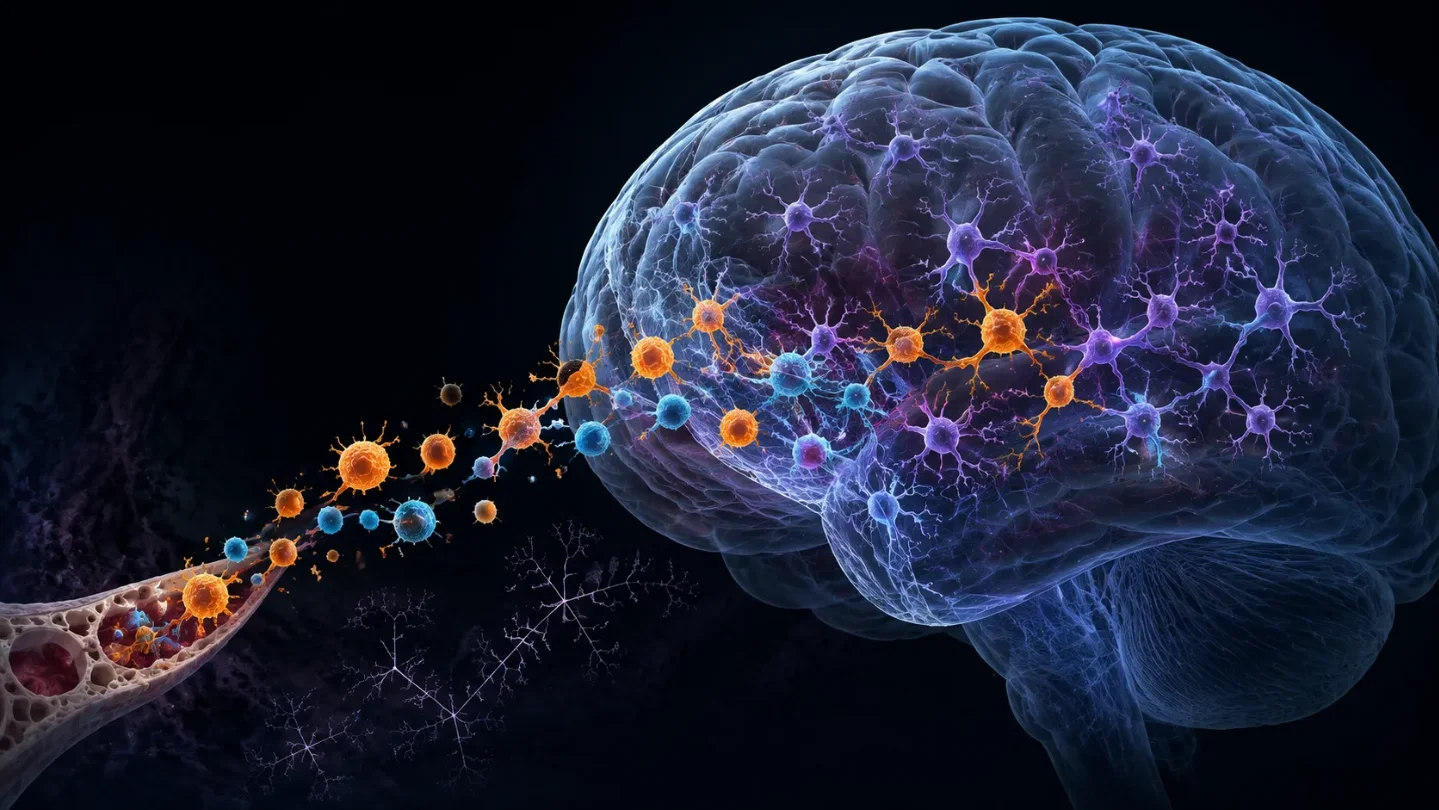
Nature and Science: ancient smallpox DNA, aging microglia, silicon qubits and pre-Panama mammal migrations
This week’s early-attention ranking is led by ancient smallpox DNA from Chile, marrow-derived microglia in aging brains, and silicon spin-qubit hardware, with paleobiogeography and X-chromosome mutagenesis rounding out the top five.
At this point in a paper's life, citation counts are mostly noise: every paper here was published too recently for a meaningful bibliometric separation. The ranking below therefore uses the first attention wave instead — publisher-visible Altmetric snapshots, news pickup, publisher-reported social counts, direct X engagement and the r/science discussion that produced measurable activity.
The window is 24 July at 12:00 ET through 31 July at 12:00 ET. The latest print issues provide the backbone: Nature 655(8125) and Science 393(6810), both dated 30 July, plus a Nature online-first paper published on 30 July. 1 2
The ranking at a glance
| Rank | Paper | Journal and date | Early attention signal |
|---|---|---|---|
| 1 | The genomic identity of early smallpox in South America | Science, 30 July | Altmetric 106; 11 news outlets; 3 X posts. 3 |
| 2 | Somatic mutations reveal the ontogeny of microglia in human aging | Nature, 30 July | Nature's public preview did not expose an Altmetric score; the lead author's X post reached 67,235 views, with 478 likes and 121 reposts at capture. 4 5 |
| 3 | A 10-million-year biogeographic holding pen primed the Great American Biotic Interchange | Science, 30 July | Altmetric 65; 4 news outlets; 11 X posts. 6 |
| 4 | A digitally controlled silicon quantum processing unit | Nature, 29 July | Altmetric 63; an r/science post scored 39 with 2 comments; Springer Nature's X post reached 1,460 views. 7 8 9 |
| 5 | X-chromosome inactivation draws L1 mutagenesis to the human X chromosome | Science, 30 July | Altmetric 25; 17 X posts; 26 Bluesky references. 10 |
The Altmetric values are snapshots from the publisher pages as surfaced during this issue's research, not permanent scores. Exact-title searches did not locate matching r/science threads for four papers; that is a limit of the search, not evidence that no one discussed them there.
1. Ancient smallpox DNA turns a colonial-era history into a molecular record
Paper: The genomic identity of early smallpox in South America
Field: archaeogenomics, infectious-disease history
Journal / date: Science, 30 July 2026
Access: the canonical Science page is linked; open-access status was not confirmed from the public record captured here.
Corresponding authors: Constanza de la Fuente Castro, University of Chile, and Shigeki Nakagome, Trinity College Dublin. The wider team includes the University of Tarapacá and other international collaborators. 11
What the study found
The researchers screened 13 bone samples from the early-colonial archaeological site Camarones 9 in northern Chile and recovered smallpox-virus DNA from two people: an adult woman and a young man. Both were dated to 1492–1631 and carried nearly the same viral variant, suggesting a shared outbreak. The genome belongs to an extinct lineage near the transition between medieval European strains and the lineages that later produced modern smallpox. 11
This is the first molecular evidence of ancient smallpox identified in the Americas. Historical records had already connected epidemics to European colonization, but the genomes show the pathogen itself in people of Indigenous ancestry and document a transmission event that written sources did not record. 11
Why it matters
The result does more than attach a virus to a familiar historical episode. It lets researchers compare how the pathogen was changing while it moved through early-colonial networks. The Chilean team reports progressive gene loss as smallpox specialized as a human pathogen, giving paleogenomics a way to test where written history is silent. 11
How hard is the evidence?
The direct viral-genome identification is strong. The broader reconstruction of transmission routes is more inferential: two individuals from one site cannot map the whole continent's epidemic history. The study also raises a useful archaeological question: lesions previously attributed to chronic arsenic exposure at the same site might warrant re-examination for smallpox, but that is a hypothesis rather than a demonstrated reclassification. 11
Attention and reaction
Science's public metrics snippet gave the paper an Altmetric score of 106, with pickup by 11 news outlets, 3 X users and 7 Bluesky users. A University of Chile research account also summarized the result on X; that post had 1 like and no reposts at capture. 3 12 No matching r/science thread surfaced in the exact-title search.
Read first if
You want a paper that connects ancient DNA, pathogen evolution and the biological consequences of colonization without treating historical documents and molecular evidence as interchangeable.
2. Aging brains may recruit a large marrow-derived microglial population
Paper: Somatic mutations reveal the ontogeny of microglia in human aging
Field: neuroimmunology, aging, Alzheimer's disease
Journal / date: Nature, 30 July 2026
Access: subscription preview; the public page exposes the abstract but not the full article.
Corresponding authors: Julia A. Belk, Howard Y. Chang and Siddhartha Jaiswal, all connected to Stanford-led departments and institutes. 4
What the study found
Microglia are the brain's resident macrophages, and mouse studies have suggested that most are seeded during embryonic development and then maintained locally. This study used the mutations cells accumulate over their lifetimes as clonal labels, combined with single-cell lineage tracing based on mitochondrial-DNA variants, to ask whether the human brain follows the same rule. 4
Across 20 aged individuals, the researchers found evidence that marrow-derived cells entered the brain in every person examined. The infiltrating cells resembled microglia and could make up a large fraction of the microglial pool. In a separate human cohort analysis, most types of clonal hematopoiesis were associated with lower Alzheimer's disease risk. 4
Why it matters
The paper challenges a simple version of the phrase "resident immune cell." Human microglia may be a mixed population whose developmental history changes with age. That matters for cell-targeted therapies: a treatment designed around mouse-like, embryo-seeded microglia may not behave the same way in an older human brain.
How hard is the evidence?
The lineage-tracing evidence is unusually direct for human tissue, but the Alzheimer's result is an association, not a demonstration that marrow-derived cells protect against disease. The 20-person brain-tissue analysis also answers an ontogeny question more cleanly than it answers how much the influx varies across age, disease state or treatment history. The paper is best read as a map of cell origins, not as a therapeutic result.
Attention and reaction
The public Nature preview did not expose an Altmetric number during this run. The lead author Julia Belk's X thread, however, drew 67,235 views, 478 likes, 121 reposts, 16 quotes and 11 replies at capture; its opening claim was that the work found a large influx of immune cells into the aging human brain. 5 No matching r/science thread surfaced in the exact-title search. The social reaction is large, but the author's own thread is not an independent replication of the result; it is evidence of attention.
Read first if
You work on microglia, clonal hematopoiesis or Alzheimer's biology and want to know whether mouse assumptions about brain immune-cell maintenance survive contact with aged human tissue.
3. Mammals were already moving between the Americas millions of years before the land bridge
Paper: A 10-million-year biogeographic holding pen primed the Great American Biotic Interchange
Field: paleobiogeography, vertebrate paleontology, earth history
Journal / date: Science, 30 July 2026
Access: the canonical Science page is linked; open-access status was not confirmed from the public record captured here.
Corresponding author: Z. Jack Tseng, University of California, Berkeley. The collaboration includes the Natural History Museum of Los Angeles County, UNAM-Querétaro, Florida State University and the US Bureau of Land Management. 13
What the study found
The traditional story says that North and South American mammals began their major exchange when the Panamanian isthmus formed about 2.8–3 million years ago. A new database of Mexican fossils instead shows that northern mammals had reached Mexico by roughly 10 million years ago. The authors describe a 10–7-million-year "holding pen" phase, followed by intermittent exchange of smaller mammals from about 7 to 3 million years ago, before broad movement became possible after the isthmus formed. 13
The likely pre-isthmus crossings were not a single open land corridor. The release discusses intermittent routes such as island hopping or rafting on vegetation. Small mammals, including coati relatives and rodents, crossed north to south earlier; sloths are the major South-to-North example in the record described by the authors. 13
Why it matters
The result moves the interesting part of the Great American Biotic Interchange backward by millions of years. Mexico was not simply a new evolutionary province waiting for the land bridge; it acted as a staging region where northern mammals diversified before later dispersals reshaped South American ecosystems. That changes how researchers interpret the origin of present-day biodiversity patterns.
How hard is the evidence?
The new fossils nearly doubled the known Mexican record for the period, which is a substantial gain. The route itself remains uncertain, and the South American fossil record is less complete. The authors' interpretation also conflicts with some geologists' claims that a land bridge existed as early as 15 million years ago; more fossils from South America will be needed to distinguish a genuinely intermittent route from an older continuous connection. 13
Attention and reaction
Science's public metrics snippet showed an Altmetric score of 65, pickup by 4 news outlets and posts from 11 X users. A post by paleoanthropologist Chris Stringer linked the paper directly and had 7 likes, 2 reposts and 592 views at capture. 6 14 The substantive controversy is geological rather than social-media-driven: the paper rejects an early-land-bridge explanation for the fossil pattern.
Read first if
You study migration, island biogeography or the fossil record and want a concrete case where an apparently simple "land bridge opened, animals moved" story breaks into several older phases.
4. A silicon chip brings control electronics closer to the qubits
Paper: A digitally controlled silicon quantum processing unit
Field: quantum computing, semiconductor engineering
Journal / date: Nature, 29 July 2026
Access: the Nature page exposes a PDF link and a Zenodo data record, but the captured record did not make the open-access label explicit. 7 15
Corresponding authors: Jacob Z. Blumoff, Thaddeus D. Ladd and Matthew D. Reed, HRL Laboratories, with the paper's large HRL-led collaboration. 7
What the study found
The engineering problem is not just making a qubit work once. A useful processor needs many qubits, dense wiring and control electronics that do not dump too much heat into the refrigerator. The team combined a cryogenic CMOS controller, a high-density superconducting ribbon cable and an exchange-only silicon qubit device.
The chip contains a three-rail array of 54 quantum dots, configurable for up to 18 exchange-only qubits. The integrated system reported mean errors of 1.7 × 10⁻⁴ for single-qubit gates and 3.5 × 10⁻³ for CNOT gates. It also demonstrated a distance-5 repetition code and a distance-2 error-detecting code. 7
Why it matters
The paper attacks a scaling bottleneck that is easy to miss when quantum-computing comparisons focus only on gate fidelity. The controller runs at 4 K while the qubits operate at millikelvin temperatures, reducing the number of room-temperature connections that a larger machine would need. The reported codes show that the integration stack can support error-correction experiments rather than only isolated gate demonstrations.
How hard is the evidence?
The paper is a system demonstration, not a useful quantum computer. Extrinsic errors — including static magnetic-field gradients and pulse miscalibration — still dominate, leakage remains a problem in multiqubit circuits, and calibration and signal-integrity requirements are substantial. The distance-5 result is therefore evidence that the architecture can be engineered, not evidence that fault-tolerant scaling is close.
Attention and reaction
The Nature page's visible metric was 63 Altmetric. Springer Nature's X post describing two silicon-quantum papers from the same Nature issue had 1,460 views, 4 likes and 2 reposts at capture. 7 9
The clearest r/science signal came from a post linking the paper: 39 score, 2 comments and an 88.2% upvote ratio. The comment tree contained only the subreddit automoderator message, so the score indicates attention rather than a developed public technical debate. 8
Read first if
You follow the hardware side of quantum computing and want to separate a better qubit from a more scalable control stack.
5. X-chromosome silencing may create a landing zone for jumping genes
Paper: X-chromosome inactivation draws L1 mutagenesis to the human X chromosome
Field: genome biology, epigenetics, genetic disease
Journal / date: Science, 30 July 2026
Access: the canonical Science page is linked; open-access status was not confirmed from the public record captured here.
Corresponding authors: John V. Moran, University of Michigan, and Geoffrey J. Faulkner, Mater Research and the University of Queensland. The 19-researcher team spans Australia, Spain and the United States. 16
What the study found
The human X chromosome is unusually rich in LINE-1, or L1, retrotransposons — mobile DNA sequences often called jumping genes. The old explanation was that L1 elements helped establish X-chromosome inactivation and were preserved for that reason. The new work reverses the direction of the explanation: in PA-1 cells, the inactive X chromosome attracted L1 insertions.
The team combined engineered L1 elements carrying reporter markers with targeted long-read sequencing. The PA-1 cell line was useful because its X-chromosome inactivation remained unusually stable, allowing the researchers to distinguish active from inactive X chromosomes and count insertions on each. 16
Why it matters
If the inactive X is a permissive environment where L1 can keep moving, X-chromosome inactivation may shape the genome's mutation landscape rather than merely silence genes. That offers a mechanism for why X-linked disease-causing mutations can accumulate, and it gives researchers a sharper target for studying how mobile DNA interacts with epigenetic state.
How hard is the evidence?
The mechanism is shown in a cell model, not as a population-level estimate of haemophilia or muscular-dystrophy risk. The institutional release says the work may increase the rate of relevant mutations; it does not establish that X-chromosome inactivation doubles disease incidence in people. That distinction matters because the headline implication is much broader than the experiment's direct setting. 16
Attention and reaction
Science's public metrics snippet showed an Altmetric score of 25, with 17 X users and 26 Bluesky references. Science editor Di Jiang's post framed the paper as an answer to why the X chromosome is rich in L1 elements; it had 4,426 views, 62 likes, 21 reposts and 1 reply at capture. 10 17 No matching r/science thread surfaced in the exact-title search.
Read first if
You work on transposable elements, X-chromosome inactivation or genome instability and want a mechanistic explanation that turns a long-standing correlation into a testable hypothesis.
What this week says about attention
The strongest early signal is not confined to one field. Ancient pathogen DNA drew the largest publisher-reported attention score; an aging-brain paper spread through a high-engagement author thread; a fossil paper reopened a geological argument; and two quantum/genome papers attracted attention because they made a clean mechanism visible.
The common limitation is time. These are first-week signals, not settled citation impact. The useful question for a reader is therefore not "Which paper has already won?" It is "Which original should I open before the attention curve and the claims harden into shorthand?"
References
- 1Nature 655(8125), 30 July 2026
- 2Science 393(6810), 30 July 2026
- 3Science paper record
- 4Nature paper record
- 5Julia Belk's X post
- 6Science paper record
- 7Nature paper record
- 8r/science post
- 9Springer Nature's X post
- 10Science paper record
- 11University of Chile research release
- 12Research account's X post
- 13UC Berkeley research release
- 14Chris Stringer's X post
- 15Zenodo data record
- 16University of Michigan research release
- 17Di Jiang's X post
Related content
- Sign in to comment.