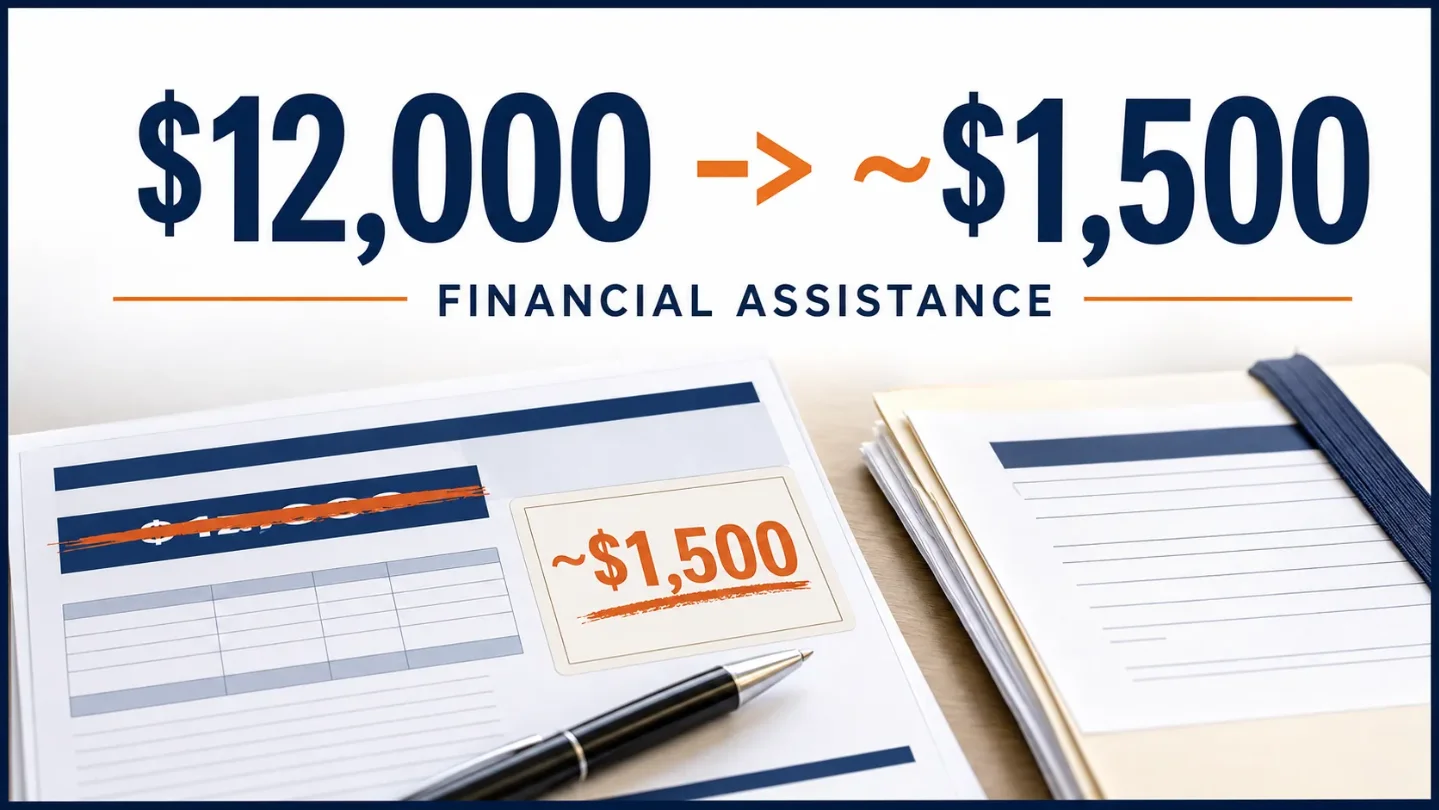
The $12,000 Procedure Bill That Fell to About $1,500
A formerly uninsured couple documented how a hospital procedure bill close to $12,000 fell to approximately $1,500 after a financial-assistance request backed by layoff, unemployment, and hardship documentation.

The Case in One Minute
A Reddit poster in 2015 described a hospital procedure bill that was close to $12,000. The couple was uninsured when the procedure happened. After the poster called the hospital billing department, asked how to qualify for financial assistance, and submitted proof of a layoff, unemployment payments, and a written hardship explanation, the hospital approved a 90% reduction, leaving approximately $1,500 to pay.
That is a reported reduction of about 87.5% when the rounded amounts are used. The poster called it 90%, and also later clarified that the original bill was not exactly $12,000. The honest takeaway is therefore: roughly $12,000 became roughly $1,500, not a precision claim to the cent. 1
The case is useful because the winning move was not a threat, a social connection, or advice to ignore the debt. It was a formal financial-assistance request backed by documents that showed why the household could not pay the sticker amount.
What Is Documented
| Case detail | What the public disclosure says |
|---|---|
| Bill type | A hospital procedure bill |
| Original amount | Close to $12,000; the poster said it was not exactly $12,000 |
| Insurance status | Uninsured when the procedure occurred; the couple obtained ACA coverage the following month |
| First department | The hospital billing department |
| Main request | How to qualify for financial assistance |
| Documents submitted | Employment-date verification, layoff notice, unemployment-payment records, and a written statement about the household's hardship |
| Decision | Notice of a 90% reduction, leaving approximately $1,500 |
| Time reported | About two weeks after the application was submitted |
| Hospital identity | Not named in the post |
| Full letter or itemized bill | Not published in the post |
That last group of missing details matters. We do not know the hospital's name, its income thresholds, whether the $12,000 was a gross charge or patient balance, or whether separate physician or laboratory bills were included. We should not fill those gaps with assumptions. This is a documented financial-assistance success story, not a complete billing audit.
The Situation Was More Than "Uninsured"
The poster wrote that his wife had been diagnosed with terminal cancer and needed full-time care. He had left his job months earlier and could not seek new employment because of her care needs. The procedure took place while they were uninsured. They later obtained ACA insurance, but the coverage came after the procedure and did not solve the earlier bill.
That combination created the evidence for the application:
- The household had a large medical obligation.
- The person who had been working was no longer working.
- The household had a concrete reason for the loss of income.
- The spouse's medical condition made the loss of income more than a temporary budgeting choice.
- The family could document those facts.
The poster had already placed the bill on a payment plan before asking about assistance. That is worth noting because it shows a safer order of operations than simply abandoning the account. The public post does not say whether the hospital paused the plan while reviewing the application, so a reader should not assume that an application automatically suspends payments.
The correct question is not, "Can I make this bill disappear?" It is, "What financial-assistance policy applies to this account, what evidence does it require, and what happens to my current due dates while the application is being reviewed?"
The Call That Opened the Door
The only phone wording the poster published was simple:
"I spoke to their billing department and asked how one might qualify for financial assistance."
That sentence is not a demand for a discount. It routes the account to the department that can explain eligibility and send the paperwork. The poster said the hospital mailed forms asking about the household's situation and requesting justification and documentation.
A practical version you can adapt is below. It is not the poster's verbatim script; it is a reader-ready version based on the sequence he reported:
"I am calling about account [account number]. I need to understand whether I may qualify for your financial-assistance or charity-care program. Please send me the current policy, application, required documents, deadline, and the name of the department handling the review. While the application is pending, what should I do about the current balance and payment due date?"
If the representative says the account is handled by another office, ask for a transfer or a direct phone number. Write down the representative's name, the date, the department, the application deadline, and what the representative says about payments. Follow up with a short message through the hospital portal or by mail so the key points are documented.
The goal is a complete application, not an argument with the first person who answers. A billing representative may not have authority to approve assistance. That is a routing problem, not proof that assistance is unavailable.
The Evidence Packet That Worked
The poster described four categories of support:
- Verification of employment dates. This established when employment ended and helped connect the household's current finances to a specific event.
- The layoff notice. This was direct evidence that the income loss was involuntary.
- Unemployment-payment records. These showed what income actually came in after the job loss.
- A written hardship statement. The poster explained his wife's cancer, her need for full-time care, and why he could not return to work at that time.
The lesson is not to submit every private document you own. It is to read the hospital's policy, provide exactly what it requests, and explain the facts that connect the documents to the account. Redact unrelated account numbers and sensitive information when the application allows it. Keep a complete copy of everything you send.
A safe hardship statement can be organized like this:
Re: Financial-assistance application for account [account number]I am requesting a review under your financial-assistance policy for the medically necessary care billed on [date]. At the time of service, our household was uninsured. My employment ended on [date], and my current income is [brief description]. I am providing the documents listed in your application, including [documents]. Because of [brief factual explanation], I cannot pay the billed amount without serious hardship. Please review the account under the hospital's policy and send me the decision and any revised balance in writing.
Do not call this the patient's original letter. The public post does not reproduce the letter. It only tells us that a written statement was submitted and what it explained. The template above is a transparent adaptation, not a quotation.
Why Financial Assistance Is a Better Frame Than Haggling
The poster later edited the Reddit post to acknowledge that "negotiated" was the wrong word. That correction is important. The result came through financial assistance, not a normal cash-price negotiation.
For an eligible patient at a nonprofit hospital, financial assistance is supposed to operate through a written policy. The IRS says a tax-exempt hospital's financial-assistance policy must describe eligibility criteria, available free or discounted care, how to apply, and the basis for calculating charges. The policy must also explain how the hospital handles billing and collections, including reasonable efforts to determine eligibility before extraordinary collection actions. 2
That does not mean every patient qualifies, every hospital is nonprofit, or every provider working inside a hospital is covered by the same policy. The IRS specifically requires hospitals to identify which outside providers are covered by the policy and which are not. A surgeon, anesthesiologist, radiologist, or lab may send a separate bill.
CMS gives the same practical direction: ask the facility's billing department about financial assistance, find the hospital's policy, check the eligibility requirements and deadline, submit the application, and ask how the bill will be handled while the application is pending. CMS also says that "charity care" is a term sometimes used for financial assistance. 3
This is why the first phone call should be precise. Ask for the policy and process. Do not assume the first invoice is the final amount, but do not assume the debt is invalid either.
The Two-Week Follow-Up
The poster reported receiving the approval notice two weeks after submitting the paperwork. The notice reduced the payment by 90% and left approximately $1,500.
The public account does not say whether the $1,500 was paid in one payment, placed on a new plan, or split among multiple providers. It also does not say whether the hospital recalculated the account under a specific percentage of the federal poverty guidelines. Those are not minor details, so they should be treated as unknown.
For a current reader, the follow-up call should ask five questions:
- What is the revised patient balance after the decision?
- Does the decision apply to every line on the account or only the hospital facility charges?
- Are any professional, laboratory, ambulance, or outside-provider bills separate?
- What is the payment deadline for the revised balance?
- Can the hospital send a final determination and updated statement in writing?
If a payment plan already exists, ask whether it remains active, changes, or is paused. Get that answer in writing. If a collection agency is involved, tell it that a financial-assistance application is pending and ask what documentation is needed to pause collection activity while the hospital reviews the account. CMS recommends telling debt collectors when you are seeking financial help and asking them to pause collections while the process plays out. 3
First 3 Moves: The 72-Hour Version
These steps apply whether the bill is $500 or $50,000.
1. Request the itemized bill
Call the provider's billing department and request a detailed list of each service, supply, facility fee, date, code, and charge. CMS specifically recommends asking for a detailed bill and comparing it with your records. It also recommends checking for duplicate charges and comparing the bill with your explanation of benefits when insurance was used. 4
Use this wording:
"Please send me the complete itemized bill for account [account number], including service dates, billing codes, units, payments, adjustments, and the current patient balance. Please also tell me which charges are facility charges and which are from separate providers."
2. Do not rush to pay the first invoice
The first invoice may arrive before insurance processing is complete, before a financial-assistance review, or before you have checked whether the balance matches your records. Pause long enough to request the itemized bill, check your explanation of benefits if applicable, and ask what happens to the due date during a review.
This is not advice to ignore a valid debt. If you cannot pay on time, call the billing department before the due date and ask for a written extension or payment arrangement. Keep making any payment the provider confirms is still required unless you receive different written instructions.
For insured patients, CMS says the EOB is not itself a bill. It shows provider charges, allowed charges, insurer payments, and the patient balance. The provider bill should not be higher than the patient balance shown on the EOB. 5
3. Check financial-assistance eligibility
Search the hospital's name plus "financial assistance" or "charity care." Ask billing for the policy, application, required documents, deadline, and the department that makes the decision. Apply even if you are unsure you qualify; let the written policy decide.
If you scheduled uninsured care in advance, also save any good-faith estimate. CMS says uninsured or self-pay patients usually must receive one for care scheduled at least three business days ahead, although emergency care is different, and a bill at least $400 above the estimate may qualify for a federal dispute process. 6
What to Copy From This Case
Copy the sequence, not the exact dollar result:
- Keep the account in a documented payment arrangement rather than disappearing.
- Call the hospital billing department and ask how to qualify for financial assistance.
- Get the policy, application, deadline, and payment instructions.
- Submit specific proof of income loss and the hardship that caused it.
- Ask for the decision and revised balance in writing.
- Verify whether separate providers still bill you.
The couple's result was unusually large, but the method was ordinary: use the hospital's process, tell the truth, document the facts, and keep the account moving while the review happens.
That is the part worth remembering when a bill arrives and panic makes every option feel closed. The first useful call may not be to ask for a discount. It may be to ask, calmly and precisely, which financial-assistance policy applies to you.
Source note: This article is based on one public Reddit disclosure from October 2015. The poster did not name the hospital and did not publish the full application, itemized bill, or approval letter. Dollar figures are therefore reported as approximate, and the article does not treat the case as proof that any particular hospital will offer the same reduction.
Related content
- Sign in to comment.