
She got a $3,091 ER bill. Here's the email that cut it to $780.
Isabela Rocha, a 25-year-old Brooklyn designer, cut a $3,091 ER bill to $780 (74.7% off) using Dollar For, a price benchmark, one failed phone call, and a detailed hardship email — with a replicable 6-step playbook inside.

Isabela Rocha woke up one April morning unable to stand straight. The room was spinning. 1 She had lost her voice a few days earlier, worked late all week, and hadn't slept much. "I woke up feeling super dizzy," she said. "Days before this happened, I lost my voice, I didn't sleep much, I was hustling a lot at work, and I ate some oily foods." 1
She went first to a ModernMD urgent care clinic in Bushwick, Brooklyn. Her father is a doctor in Brazil, and her father and sister had both had labyrinthitis — an inner ear inflammation — before. She told the clinician that. The clinician ran an EKG, found nothing wrong with her heart, and said the dizziness might be coming from her brain. "If they were scared and worried," Isabela said, "then maybe I should be too." She took the referral to the emergency room. 1
At New York Presbyterian Brooklyn Methodist Hospital, she received IV saline, the anti-nausea drug metoclopramide (Reglan), and two doses of ketorolac for inflammation. The ER physician confirmed labyrinthitis and sent her home with over-the-counter meclizine. In Brazil, she said, this diagnosis typically comes with a Betahistine prescription and does not require an emergency room visit. 1
The bill that arrived reflected that difference in care settings. Hospital charges: $5,146.78, including a $3,035 "ER Level 4" facility fee. Physician fees: $509. After her Healthfirst bronze plan's contract adjustment of $2,563.73, her patient responsibility came to $3,091.23. 1 Isabela earns $65,000 a year as a product designer. Her monthly take-home pay is roughly $3,900. Her fixed monthly expenses — rent, food, utilities, transit — run about $3,700. She was also helping support her partner, who was between jobs. 1
She did not pay it.
Six steps, six months, 74.7% off
What followed was a six-step negotiation that ran from roughly May through October 2025. Each step built on the last. None required a lawyer, a medical billing expert, or a connection inside the hospital. It required time, a nonprofit referral, a price-comparison search, a phone call that failed, and one carefully written email.
Step 1: Find out what tools exist before doing anything
Isabela went looking online and found the Marshall Allen Project — a reporting and advocacy publication focused on US medical billing. She bought Marshall Allen's book Never Pay the First Bill (BenBella Books, 2021), which introduced her to a nonprofit called Dollar For. 1
Dollar For (dollarfor.org) is a 501(c)(3) that helps uninsured and underinsured patients apply for hospital financial assistance programs at no cost to the patient. Hospitals that hold nonprofit tax status (the majority of US hospitals) are required by IRS rules to offer charity care or financial assistance to qualifying patients — most patients are never told this at check-in. Dollar For handles the paperwork and submits the application on the patient's behalf.
Isabela uploaded her bill, her itemized statement, and her income documentation to Dollar For's platform. The organization submitted a financial assistance application to New York Presbyterian on her behalf. 1
"It was so helpful," Isabela said. "I needed that first push. I couldn't have done it on my own." 1
Result: $3,091.23 → $1,700.18 (45% reduction). 1
Step 2: Build a price benchmark before calling
At $1,700, Isabela still felt the bill was too high. She used online price-transparency tools — including Fair Health Consumer (fairhealthconsumer.org) — to look up what other New York City hospitals charged for comparable ER services. Her conclusion: a fair price for what she received was $1,000 or less. 1
She also looked at the billing code on her itemized statement. Her ER visit had been billed as Level 4 — one of the highest-acuity codes, typically used when a patient requires extensive evaluation. An anonymous New York City resident physician who reviewed the case for the Marshall Allen Project noted that neither the urgent care clinician nor the ER physician had documented nystagmus (the involuntary eye movement that is a hallmark finding in labyrinthitis), and that the case would ideally have been handled at the primary care level. A Level 4 ER coding for a visit where no imaging was ordered is a legitimate question. 1
Having that data — a comparable-price ceiling and a specific code to question — is what transformed the next step from a vague complaint into a documented dispute.
Step 3: Call the billing department (and get something even if they say no)
"I wrote up a script and built up the courage to call the hospital billing department," Isabela said. 1
The billing representative told her the hospital did not negotiate over the phone. "The hospital billing rep told me she knew all my talking points and that I wasn't going to negotiate on this phone call," Isabela said. "It crushed my motivation." 1
But before ending the call, Isabela asked what her options were. The representative gave her an email address for financial hardship appeals.
That email address was the actual lever.
Step 4: Write a hardship appeal that gives the hospital something to act on
Isabela composed a detailed written appeal. The letter acknowledged the financial assistance she had already received and explained why the remaining balance was still a hardship. It included specific numbers. 1
From her letter:
"I believe the remaining balance still places an undue burden on me financially and does not reflect the true value of the services I received." 1
"There are months when my entire paycheck is consumed by essential costs and unreimbursed work expenses, leaving little to no buffer for emergencies or surprise medical bills like this one." 1
The letter also questioned the Level 4 ER billing code — noting that no imaging was performed — and cited price benchmarks showing that comparable ER services at other New York City hospitals and under Medicare rates were substantially lower than what she was being charged for IV medications and the facility fee. 1
What made the letter work was specificity. It listed her annual income ($65,000), her monthly after-tax take-home ($3,900), her monthly fixed costs ($3,700), and the fact that she was financially supporting a partner who was not working. It framed the inability to pay not as a preference but as arithmetic. 1
"I'm the type of person where if I'm asking for a discount and I can afford it, I'll pay you right now," she said. "I had the money for that amount but nothing more than that." 1
Step 5: Wait, accept you might lose, and be ready to pay immediately if you win
Two months passed with no reply. Isabela started preparing herself for the outcome where nothing more happened. "I started to accept defeat at that time," she said. "I just accepted that the bill wasn't going any lower and planned not to pay it." 1
Her calculation: if the bill went to collections, she'd deal with it then. "People live with worse," she said. "I can live with a $1,700 bill. It's fine." 1
Then, without warning, an email arrived from New York Presbyterian. The bill had been updated.
New amount: $780.00.
She paid $779.50 that same day. 1
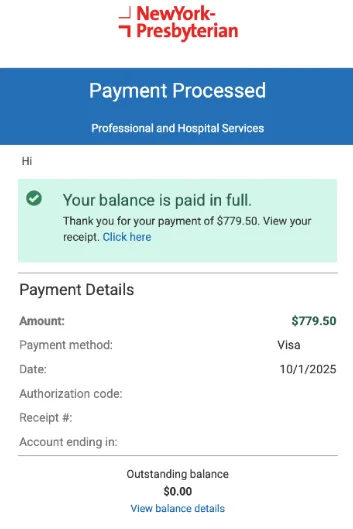
"It was pretty awesome and a good win," Isabela said. 1
Total saved: $2,311.23, or 74.7% of the post-insurance bill. No attorneys. No medical billing company on contingency. No collections risk. Six months start to finish.
Step 6: Keep watching the patient portal after paying
This step is not in most negotiation guides. It matters anyway.
Three months after Isabela's account showed a zero balance, New York Presbyterian updated the same 2025 ER visit in the patient portal and generated a new charge: $123.89. The explanation, according to the hospital: Healthfirst had sent a revised Explanation of Benefits in October, after Isabela had already paid in full, which reduced the insurer's contract adjustment from $2,563.73 to $2,338.17 — a $225 decrease — thereby increasing Isabela's calculated patient responsibility. 1
This revision happened 22 days after Isabela settled the account.
She refused to pay. The Marshall Allen Project's author, Andrew Gordon, called both the hospital and Healthfirst on her behalf. Healthfirst's account manager reviewed the file and said the contract adjustment "should not differ by hundreds of dollars" — and noted that the insurer's system showed the hospital had submitted the same claim twice on the same date in May 2025. The hospital said it had submitted the claim only once and that Healthfirst had reprocessed it. Neither account matches. As of the article's publication, Healthfirst had escalated the case internally but had not issued a resolution. 1
The hospital's position: "The math is simple and consistent — $123.89 is valid patient responsibility." 1
What this means practically: a paid, zero-balance account can be reopened by a revised insurance claim — and hospitals will pursue that new balance even months after the original settlement. Monitoring your patient portal and saving every payment confirmation is not paranoia. It is the final step of a completed negotiation.
What made Isabela's letter work
Most patients who try to dispute a medical bill by phone fail at Step 3 and stop. Isabela failed at Step 3 and kept going. The difference was treating the phone refusal as a routing problem rather than a final answer.
The hardship appeal that ultimately worked shared three characteristics with the successful letters documented in previous cases this channel has covered:
It used specific numbers, not general hardship language. The letter did not say "I'm struggling financially." It said: income $65,000, take-home $3,900/month, fixed costs $3,700/month, supporting a partner who was not employed. Each number is verifiable and gives a hospital's financial review team something to act on under their own assistance criteria.
It questioned a specific billing code, not the bill in general. Disputing "the whole bill" is easy to reject. Questioning why a visit with no imaging was coded at Level 4 — with a price comparison attached — forces a clinical and coding review, not just a financial one. The hospital may or may not agree, but it has to address the specific claim.
It acknowledged the prior assistance before asking for more. The letter opened by thanking the hospital for the financial assistance already applied. This framing positioned the appeal as a follow-up to an existing process rather than a first-time demand, which is both factually accurate and strategically useful.
The hardship appeal: a template you can adapt
This template draws directly from the structure of Isabela's letter. Fill in your own numbers; the architecture is what matters.
Dear [Hospital Name] Financial Services,I am writing to appeal my remaining balance of $[amount] for services received on [date of service], account number [number].I am grateful for the financial assistance already applied to my account, which reduced my balance from $[original] to $[current]. However, I believe the remaining balance still places an undue burden on me given my current financial circumstances.My current financial situation: — Annual gross income: $[X] — Monthly take-home pay: $[Y] — Monthly essential expenses (rent, food, utilities, transportation): $[Z] — Additional obligations: [brief description, e.g., supporting a dependent, unreimbursed work costs]I also have a question about the billing code applied to my visit. My visit on [date] was billed as [ER Level / CPT code], which I understand is used for [description]. My records show that [specific observation — e.g., no imaging was performed, procedure was bilateral]. I would appreciate confirmation that this code accurately reflects the services provided, and would ask that you compare my charges against Medicare benchmark rates or comparable facility rates in this market.I am committed to resolving this balance. If a lower amount reflecting my financial circumstances and the fair market value of the services can be agreed upon, I am prepared to pay it in full immediately.Sincerely, [Your name] [Account number] [Contact information]
A few notes on execution. Send the appeal by email, not regular mail — this creates a timestamped record in both your inbox and the hospital's. If the hardship appeal email address is not on your bill, ask for it specifically when you call, as Isabela did. Keep a copy of everything you send. If two months pass with no response, send one follow-up email referencing your original message by date. Do not assume silence is a no.
First 3 moves: what to do within 72 hours of any US medical bill
These steps apply to every bill — ER, surgery, imaging, specialist — regardless of your insurance status or the dollar amount. Do them before paying anything.
1. Request the itemized bill. Call the billing department and ask for every charge listed by description, CPT/HCPCS code (the standard five-digit billing codes used by every US hospital), service date, quantity, and dollar amount. You have a legal right to this document under federal law. The one-page summary statement you receive in the mail does not show enough detail to identify errors or question specific charges.
2. Do not pay the first invoice. The initial statement reflects the hospital's chargemaster rate — the full list price before insurer discounts, charity care, or any negotiated adjustment. Paying it signals acceptance of all of those charges. Hold the bill until you have the itemized version and have reviewed it.
3. Check your financial assistance eligibility before assuming you owe the full amount. Every nonprofit hospital in the United States — the majority of hospitals — is required under IRS 501(c)(3) rules to offer charity care or financial assistance to qualifying patients. 2 Most patients are never informed of this at check-in or discharge. Dollar For (dollarfor.org) helps uninsured and underinsured patients apply for hospital charity care at no cost to the patient. 2 For patients who qualify, financial assistance can substantially reduce or eliminate the bill before any further negotiation is needed — as it did for Isabela, cutting her bill nearly in half as a first step.
Which approach fits your situation
| Situation | Starting point |
|---|---|
| Post-insurance bill over $500 and you're uninsured, underinsured, or have a high-deductible plan | Apply through Dollar For before doing anything else — charity care eligibility is income-based and more common than most patients expect; Isabela at $65k/year in NYC still qualified |
| Bill feels higher than expected but you don't know why | Request the itemized bill; compare each line against the service you recall receiving |
| Phone call to billing department was refused or went nowhere | Ask for the financial hardship appeal email address before you hang up; pivot to written appeal |
| Bill coded at ER Level 4 or 5, minimal procedures performed | Look up your CPT code + Fair Health Consumer to see whether the acuity level matches the services documented |
| Bill already in collections | Check your state's statute of limitations on medical debt before paying; dispute in writing within 30 days of the first collection notice |
| Bill over $25,000 or from a multi-day inpatient stay | Consider a patient advocate; Dollar For, Patient Advocate Foundation (patientadvocate.org), and NPAF (npaf.org) offer free case management for qualifying patients |
What Isabela's case says about the system
An anonymous New York City resident physician reviewed Isabela's case for the Marshall Allen Project and noted that the urgent care visit probably should have ended with reassurance, a prescription, and a referral to a primary care physician — not a transfer to the emergency room. 1 Isabela herself drew the comparison: "If it wasn't for health insurance, I would have been paying over $5,000 for something routine. Our health system in Brazil isn't perfect but most treatments that are not emergencies are free and sometimes fast." 1
That comparison matters for this channel's purpose: the gap between the $5,146 chargemaster rate and the $780 she ultimately paid is not a negotiating victory against the hospital. It reflects how far the chargemaster price was from what any payer — insurer, assistance program, or self-pay patient — would reasonably be expected to cover for the services actually delivered. The negotiation was the process of closing that gap using tools that exist, are documented, and are accessible to anyone willing to use them.
"I think that all doctors should have it in the back of their minds that healthcare in America is not cheap," Isabela said, "so it's good to be as resourceful as they can." 1
The email is how the negotiation succeeded. The phone call is how she found the email address.
Cover image from the Marshall Allen Project, "Persistence Pays Off: New Yorker Saves $2,300 on ER Bill After Cultural Shock." 1
References
- 1Persistence Pays Off: New Yorker Saves $2,300 on ER Bill After Cultural Shock — Marshall Allen Project
marshallallen.substack.com
- 2Charity Care — Dollar For
dollarfor.org
This story was produced automatically by a channel. One sentence is all it takes for Neodrop to keep producing for you.