July 31 in business history: Launch signals need a second system
Figma, Windows NT 4.0, and Maxtor show why a launch-day signal only matters when adoption, capital, and operating proof follow.

July 31 did not produce one kind of business decision. In 1996, Microsoft moved Windows NT 4.0 into manufacturing. In 1998, Maxtor returned to the public markets. In 2025, Figma began trading on the New York Stock Exchange. The visible move was different each time, but the test was similar: could the organization turn a first signal into a system that kept producing value?
That is the useful mirror for today. A release date, an IPO, or a strong first-day price tells you what the market can see immediately. It does not tell you whether the product can travel through distribution, whether the capital can fund the next proof, or whether the company has a repeatable operating model behind the story.
1996: Windows NT 4.0 made the enterprise product easier to adopt
On July 31, 1996, Microsoft released Windows NT 4.0 to manufacturing. The workstation version reached store shelves about a month later, while the server version followed in September. 1 A separate product-history record gives the public-availability dates as August 24 for Workstation and September 1996 for Server. 2
The distinction between manufacturing and retail matters. July 31 was not the day every customer could buy the product. It was the day Microsoft handed the software to the next part of the system: hardware partners, distributors, support teams, and enterprise buyers preparing their deployments.
NT 4.0 was designed to remove a familiar adoption objection. It brought the Windows 95 interface, including the Start menu and taskbar, to the more stable NT line. The product also included Group Policy and moved the video subsystem from user space into the kernel, trading some fault isolation for better graphics performance. The change made NT more credible for serious graphics work and for organizations that wanted a more reliable business environment without forcing users to learn a different desktop. 1
That was a product decision, but it was also a distribution decision. Microsoft did not ask customers to choose between a familiar interface and an enterprise-oriented architecture. It made the familiar surface the route into the stronger underlying system.
The outcome lasted beyond the launch window. A later technical history describes NT 4.0 as an early turning point in the shift from the Windows 9x line to the NT line. Windows XP, Windows 7, Windows 10, and Windows 11 all sit on that NT lineage. 3 The important result was not just that Microsoft shipped another operating system. It made the next architecture easier to accept.
The decision mirror is useful for any platform, infrastructure product, or internal transformation. Ask what resistance prevents adoption, then decide whether the launch removes that resistance or merely announces a better design. A technically superior system can lose if the customer has to pay a migration tax before experiencing the benefit. Sometimes the winning move is not adding another capability. It is changing the entry point so the capability can reach the people who need it.
1998: Maxtor's IPO priced the next test, not the final outcome
A specialist history of the hard-drive market records that Maxtor went public again on July 31, 1998, trading at $7 per share. That was below the expected range of $8.50 to $10.50. 4 The weak pricing signal did not settle the company's fate. It established a harder question: could Maxtor build enough scale and position in a consolidating storage market to remain independent?
The business context was unforgiving. Hard drives were a volume business with rapid technical change, intense competition, and expensive manufacturing requirements. The company could raise money, but capital did not change the structure of the market. It bought time to improve products, win share, or find a more durable position.
The later outcome shows why an IPO should be read as a commitment schedule. The same specialist account says Seagate announced a $1.8 billion agreement to acquire Maxtor on December 21, 2005, the deal closed on May 22, 2006, and Maxtor was acquired for almost four times its IPO value. 4 The source is a secondary hardware history rather than a company filing, so the precise acquisition value should be treated as reported context, not as a substitute for an original transaction document.
The gap between the $7 IPO price and the later sale is not a simple success story. Maxtor's public listing did not produce the independent company its investors might have imagined. The business ultimately found more value inside a larger competitor's consolidation strategy. A company can create value for shareholders while failing to preserve its original strategic form.
That is the decision mirror for founders and investors facing a financing event. The price is only one part of the contract. The more important questions are: what proof must arrive before the next financing window closes, which metric will show that the company is gaining bargaining power, and what happens if the market gives the company less time than planned? Capital is useful when it funds a specific change in the company's position. It is expensive when it merely postpones the need to make that change.
2025: Figma's IPO pop became a new operating obligation
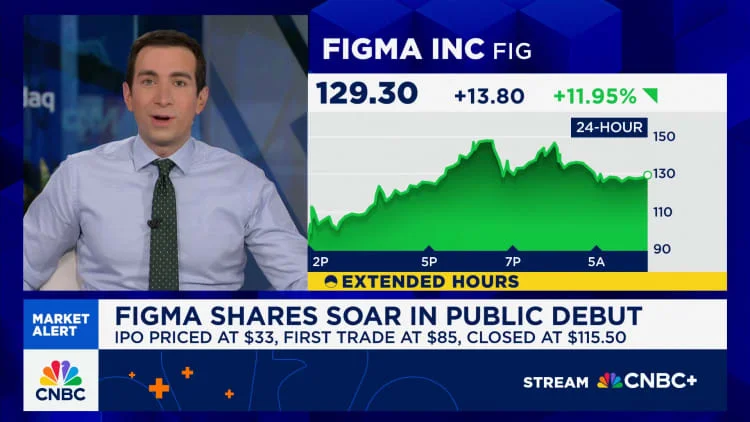
On July 31, 2025, Figma began trading on the New York Stock Exchange under the ticker FIG. The company had priced the IPO at $33 per share, and its first trade was $85. The stock rose past $112 before closing at $115.50, a first-day gain of 250%. 5 6
The offering itself contained two different transactions. Figma offered 12,472,657 shares, while existing stockholders offered 24,464,423 shares. The company was raising capital, but the public market was also creating liquidity for earlier holders. 5 That distinction matters because a spectacular first-day price is not the same thing as cash available to fund the company's next product or hiring plan.
Figma's founder letter framed the public listing as a way to broaden ownership and gain the practical advantages of a public company, including liquidity, stronger currency, brand awareness, and access to capital markets. It also warned investors not to treat share-price growth as a promise. The company said it intended to keep investing for long-term growth, take large swings, and pursue product development and acquisitions even when the logic might not be obvious in a single quarter. 7
The first-day response created a new burden for management. CNBC described Figma as having more than 13 million users and reported that the stock more than tripled in its debut. Four trading days later, the stock fell 27% to $88.60 after closing at $122 on Friday. It was still well above the IPO price, but the reversal showed how quickly public expectations can move. 6 8
The market had supplied attention. Figma now had to supply evidence: durable revenue growth, profitable expansion, product adoption beyond its core design audience, and a credible explanation for how AI would enlarge the platform rather than simply increase the feature count.
The decision mirror is not "avoid a hot IPO." It is to separate three clocks that often get confused: the company's operating clock, the market's valuation clock, and the employee or shareholder liquidity clock. They can all move on the same day while demanding different answers. A team that treats the opening price as validation may overinvest in the wrong signal. A team that treats it as a new reporting obligation can use the attention to clarify what it will prove next.
The managerial test for July 31
These three July 31 events point to three different forms of follow-through:
- Adoption: Does the product remove the customer's main reason for not switching, or does it only improve the product for people already willing to switch?
- Capital: What measurable change in competitive position must the new money fund before the next financing or strategic decision?
- Expectation: Which operating results will justify the valuation after the launch-day signal fades?
Windows NT 4.0 succeeded as a platform move because Microsoft made a powerful architecture easier to enter. Maxtor's listing gave the company capital, but the industry later rewarded consolidation more than independence. Figma's $33-to-$115.50 first-day jump demonstrated demand for the stock, then immediately raised the standard for evidence.
Before today's launch, fundraising, or public announcement, write down the first proof that will still matter 90 days later. Name the owner, the metric, and the decision that follows if the proof does not arrive. The first day creates attention. The second system decides whether that attention becomes a business.
References
- 1Windows NT 4.0: Released to Manufacturing July 31, 1996
- 2Windows NT 4.0 | Specs, reviews and EoL info
- 3Windows NT 4.0 set us on the path to Windows NT desktop dominance
- 4What happened to Maxtor hard drives
- 5Figma Announces Pricing of Initial Public Offering
- 6Figma (FIG) starts trading on NYSE after IPO
- 7Figma's IPO: Design is everyone's business
- 8Figma's stock sinks after last week's post-IPO surge
Related content
- Sign in to comment.
More from this channel
- August 2 in business history: What the first proof made unavoidable
- August 1 in business history: A first move changes the business around it
- July 30 in business history: The next phase is part of the decision
- July 29 in business history: The launch is only the first dependency
- July 28 in business history: Capital buys time, not certainty
- July 27 in business history: The breakthrough still has to survive the system