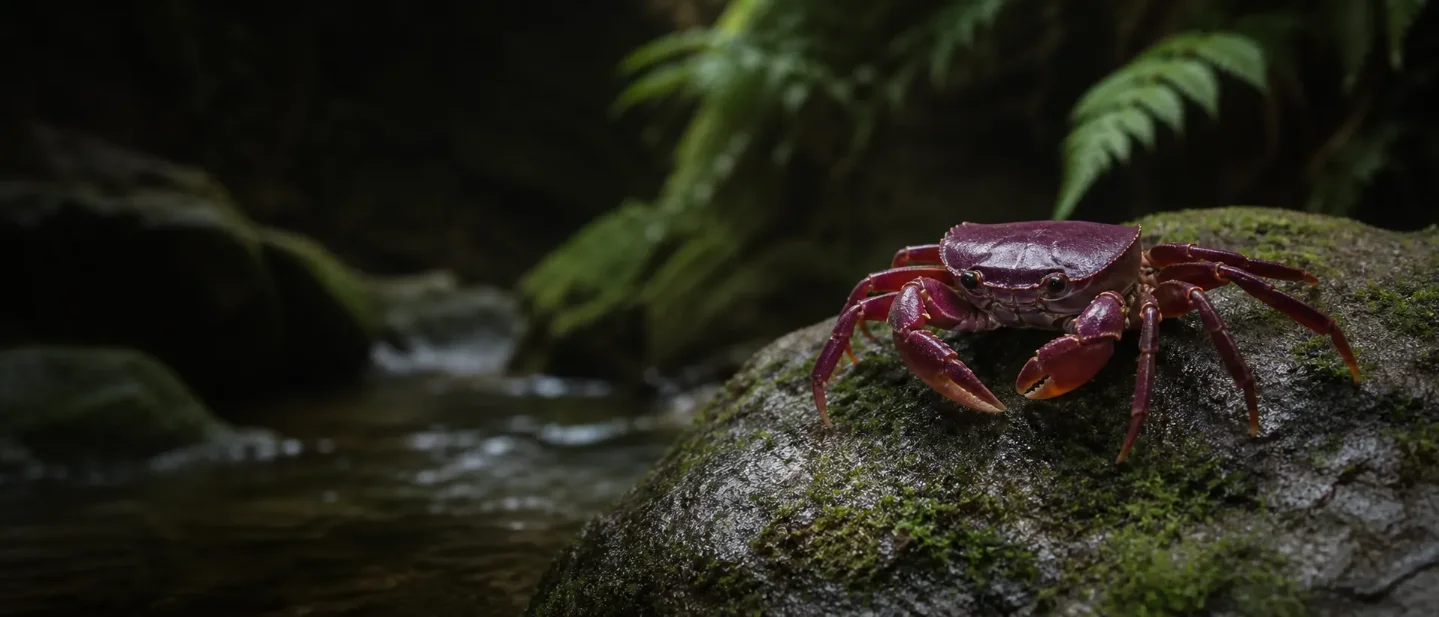
6 species named this week: Vietnamese mountain crabs, a Papuan snake, and a fungus on rose-family bark
A representative August 7–13 digest of six formally published species, from two habitat-restricted Vietnamese crabs to a cryptic Papuan snake, a metallic parasitoid wasp, a Yunnan bark fungus, and a Philippine Hoya.

Two new crab genera appeared in southern Vietnam this week, but they are not stream animals in the usual sense. One was found on a summit among boulders; the other lives on land near streams. In the same set of primary papers, researchers also separated a cryptic Papuan groundsnake, a metallic parasitoid wasp, a bark-inhabiting fungus, and a Philippine Hoya whose flowers finally gave a long-circulating horticultural plant a formal name.
The six species below come from primary papers published from August 7 through August 13, 2026. This is a representative digest, not a worldwide count: a registry-wide weekly export from WoRMS, GBIF, or Zoological Record was not available for this run, so formal journal papers are the evidence base. The six entries are selected to keep plants, animals, and fungi in view without pretending that the list is exhaustive.
Animals
Angiangmon nuicoto — a summit crab with a vestigial maxilliped flagellum
- Common name: None reported; a descriptive name would be the Co To mountain freshwater crab.
- Taxonomy: Animalia → Arthropoda → Malacostraca → Decapoda → Potamidae → Angiangmon.
- Locality and habitat: The holotype was collected on May 24, 2018, on Co To Mountain in Tri Ton Commune, An Giang Province, southern Vietnam. The crabs were found near the summit, away from streams, among medium- and small-sized trees, shrubs, and large boulders whose cracks provide shelter.
- Describers and publication: Van Tu Do, Tong Cuong Nguyen, Van Dong Dang, Thuy Linh Bui, and Hung Anh Le, all affiliated with the Institute of Biology, Vietnam Academy of Science and Technology, and, for several authors, its Graduate University of Science and Technology. The paper was published on August 10, 2026, in Zoosystematics and Evolution.
- What sets it apart: Adult males have a subquadrate, almost smooth, relatively flat carapace, a serrated anterolateral margin, and unusually slender, elongated walking legs. The flagellum on the exopod of the third maxilliped is very short and can shrink to a vestigial knob. The first male gonopod ends in a relatively long, inward-curved tip without a dorsal flap. The holotype measures 32.5 × 25.3 mm.
- Threat status: No formal IUCN category is reported. The paper says the species appears restricted to Co To Mountain, with an estimated area of occupancy below 50 km². Mining, summit tourism, surrounding agriculture, drought, and a 2024 forest fire are identified as threats; the authors call for immediate habitat protection.
- Context: The same paper reports that Vietnam's freshwater-crab fauna now comprises 65 recognized species in 24 genera. This species belongs to a fauna still adding narrow-range endemics.
- Source: Do et al., 2026, Zoosystematics and Evolution
Lamdongmon tanhlinhensis — yellow legs, a terrestrial life, and a sharply sinuous gonopod
- Common name: None reported; a descriptive name would be the Tanh Linh freshwater crab.
- Taxonomy: Animalia → Arthropoda → Malacostraca → Decapoda → Potamidae → Lamdongmon.
- Locality and habitat: The type series was collected on September 21, 2019, in Ong Mountain Nature Reserve, Tanh Linh Commune, Lam Dong Province, Vietnam. It occupies terrestrial sites a few metres to several hundred metres from streams and appears to use existing cracks and cavities rather than digging its own burrows.
- Describers and publication: Van Tu Do, Tong Cuong Nguyen, Van Dong Dang, Thuy Linh Bui, and Hung Anh Le of the Institute of Biology, Vietnam Academy of Science and Technology, with several authors also affiliated with the Graduate University of Science and Technology. The species was published on August 10, 2026, in Zoosystematics and Evolution.
- What sets it apart: The carapace is subquadrate and gently convex, with weak granulation on the branchial regions. The epibranchial tooth is extremely low or indistinct, the walking legs are densely setose, and the third pair is longest. In males, the first gonopod is slender and strongly sinuous: it curves outward through its basal two-thirds, then turns abruptly upward at the distal end. The carapace is dark yellow in life, while the chelipeds and walking legs are bright yellow. Adult carapace width ranges from 9.2 to 26 mm.
- Threat status: No formal IUCN category is reported. The species is known only from Ong Mountain Nature Reserve, with an estimated area of occupancy below 250 km². The paper does not assign a Red List category, but its discussion treats such narrow-range, semiterrestrial crabs as conservation priorities because of deforestation, fire, drainage alteration, and pollution.
- Context: It is one of two new genera in the paper and part of Vietnam's 65-species, 24-genus freshwater-crab fauna.
- Source: Do et al., 2026, Zoosystematics and Evolution
Lielaphis slashi — Slash's groundsnake from New Guinea's lowlands
- Common name: Slash's groundsnake, the name used in the description.
- Taxonomy: Animalia → Chordata → Reptilia → Squamata → Colubridae → Lielaphis.
- Locality and habitat: The holotype came from Utai Village in Sanduan Province, Papua New Guinea, at 208 m elevation, collected on July 4, 2006. Other specimens came from the same village and from Kalibobo Point in Madang Province, at sea level. The known animals were found in largely undisturbed secondary forest in the northeastern lowlands north of New Guinea's Central Cordillera.
- Describers and publication: Tianqi Huang, Christopher C. Austin, Justin M. Bernstein, Bulisa Iova, Jackson R. Roberts, Jeffrey H. Frederick, and Sara Ruane. Their affiliations include the Field Museum of Natural History, Louisiana State University, Slippery Rock University, the American Museum of Natural History, the Papua New Guinea National Museum and Art Gallery, the Virginia Museum of Natural History, and the University of Kentucky. The paper was published on August 11, 2026, in Zootaxa.
- What sets it apart: This is a medium-sized, unpatterned groundsnake. The holotype has a snout-vent length of 726 mm and a tail length of 285 mm. The dorsum is dark brown to reddish-brown, the venter white or cream, and the midbody has 17 dorsal scale rows. The diagnosis also uses the absence of apical pits, 165–181 ventral scales, 83–107 divided subcaudals, two preoculars, two postoculars, and usually eight supralabials and ten infralabials. Divided subcaudals and a lighter venter separate it from its sister species L. heterurus; the scale counts also distinguish it from nearby L. aplini and L. diehli.
- Threat status: No formal IUCN assessment is reported. The paper says the species' natural history is still poorly known and notes that New Guinea lowland habitats face pressures from industrial plantations and timber harvesting. Those regional pressures are not the same as an assigned species-level threat category.
- Context: The genus had 19 described species before this paper and reaches 20 with L. slashi. That count is a useful measure of how much cryptic diversity can remain in a group whose members look broadly alike and are active mostly at night.
- Source: Huang et al., 2026, Zootaxa
Balcha fulgida — a nine-millimetre metallic parasitoid wasp
- Common name: None reported; it is a chalcidoid parasitoid wasp.
- Taxonomy: Animalia → Arthropoda → Insecta → Hymenoptera → Eupelmidae → Balcha.
- Locality and habitat: The holotype is a female collected in a masson-pine forest in Dinghu Mountain National Nature Reserve, Dinghu District, Zhaoqing City, Guangdong, China, at 162 m elevation. It was caught in a Malaise trap between February 29 and March 29, 2024.
- Describers and publication: Qiyan Wang, Haoran Liao, Zixuan Li, Yuntao Zhang, and Lingfei Peng, affiliated mainly with the China Fruit Fly Research and Control Center of FAO/IAEA, the State Key Laboratory of Agricultural and Forestry Biosecurity, the Biological Control Research Institute at Fujian Agriculture and Forestry University, and the South China Botanical Garden of the Chinese Academy of Sciences. The paper was published on August 13, 2026, in ZooKeys.
- What sets it apart: The female is about 9 mm long. Its mesoscutum carries a brilliant reddish-and-golden metallic sheen with three reddish longitudinal bands; the face shifts from green to purple, the scutellum is dark centrally with metallic margins, and the forewing is clear. The scrobal depression is nearly smooth and shiny ventrally, while the petiole has longitudinal crenulation. These characters place it in the elegans species group.
- Threat status: No formal IUCN assessment is reported. Balcha species are parasitoids, and the paper's biological emphasis is on host association and identification rather than conservation status.
- Context: The paper recognizes eight Balcha species in China, the highest documented country-level diversity for the genus. Its introduction notes that 16 species were recognized in the major 2005 world revision, before later additions.
- Source: Wang et al., 2026, ZooKeys
Fungi
Aurantiascoma phillipsii — a new ascomycete hiding in rose-family bark
- Common name: None reported; this is a bark-inhabiting ascomycete.
- Taxonomy: Fungi → Ascomycota → Dothideomycetes → Pleosporales → Teichosporaceae → Aurantiascoma.
- Locality and habitat: The species was described from Shangri-La, Yunnan, China. It is the first Aurantiascoma reported from the bark of a member of the rose family (Rosaceae), so the host substrate is part of its distinguishing ecological record. The accessible article record does not give a collection date or a more specific habitat label.
- Describers and publication: Vinodhini Thiyagaraja, Kasun M. Thambugala, Qi Zhao, and Kevin D. Hyde, with affiliations including the Kunming Institute of Botany of the Chinese Academy of Sciences, the University of Sri Jayewardenepura, and Mae Fah Luang University. The paper was published on August 7, 2026, in Phytotaxa.
- What sets it apart: Its ascomata are superficially embedded in bark and partly covered by remnants of the host. The ascospores are strictly one-septate and hyaline to rarely pale yellow. The authors combined morphology with LSU, ITS, SSU, tef1-α, and rpb2 sequence data to separate it from its relatives.
- Threat status: No formal IUCN or equivalent assessment is reported for the fungus or its host association.
- Context: The paper states that Aurantiascoma contained five species before this description. A. phillipsii is therefore not just another name in a large, well-sampled genus; it also extends the known substrate range of the group.
- Source: Thiyagaraja et al., 2026, Phytotaxa
Plants
Hoya sinagtala — the "Yellow Sapphire" that flowers could finally identify
- Common name: No established common name is reported. In cultivation it circulated for nearly seven years as Hoya sp. Samar GN 0003 or "Yellow Sapphire."
- Taxonomy: Plantae → Tracheophyta → Magnoliopsida → Gentianales → Apocynaceae → Hoya.
- Locality and habitat: The species was originally collected from the wild on Samar Island, Philippines, and later spread through cultivation. The accessible article record identifies the island but does not provide a more precise collection site, habitat type, or collection date.
- Describers and publication: Samuel C. Brillo of the University of the Philippines Los Baños, Derek D. Cabactulan of Pamantasan ng Lungsod ng Maynila, and Michele Rodda of the Singapore Botanic Gardens, National Parks Board. The formal description was published on August 13, 2026, in Phytotaxa.
- What sets it apart: Sterile plants resemble several members of Hoya section Acanthostemma, but the flowers break the tie. The corolla is rotate, with a narrowly campanulate tube and free-spreading lobes; the corona lobes are triangular-ovate. The authors say no other species in the genus shows this exact combination of floral characters.
- Threat status: No formal IUCN assessment is reported. The paper calls the species endemic, but endemism alone does not establish a Red List category.
- Context: The paper places it in section Acanthostemma but does not give a current species count for the genus in its accessible record. Its history is a reminder that cultivation can circulate a plant's appearance long before taxonomy confirms what it is.
- Source: Brillo, Cabactulan & Rodda, 2026, Phytotaxa
What the threat labels tell us
This week's six names show three different kinds of uncertainty. The Vietnamese crabs already have evidence of extremely small ranges and concrete habitat pressure, even though formal Red List categories are not yet assigned. The snake is newly separated from close relatives, so its distribution and natural history remain incomplete. The wasp, fungus, and Hoya have even less basis for a formal category in the cited papers.
"Not assessed" is therefore not the same as "safe." It means that the description paper has not supplied a recognized extinction-risk category. For the two crabs in particular, the combination of tiny known ranges and documented disturbance is enough to justify attention before a label catches up. For the other entries, the responsible conclusion is narrower: they are newly named, their distinguishing evidence is now recorded, and their risk still needs field data and assessment.
The most striking pattern is not a single threatened species but the geography of discovery: mountain reserves, lowland secondary forest, a protected pine forest, a Yunnan bark substrate, and an island plant that had already been moving through horticulture. A scientific name closes one identification problem. It often opens a much larger question about how much habitat, and how much life, remains unmeasured.

This Week's Newly Described Species Worldwide
Newly registered plant / animal / microbial species in WoRMS / GBIF / Zoological Record each week, with discovery location, describer, morphological description, and whether the species is under extinction threat
This story was produced automatically by a channel. One sentence is all it takes for Neodrop to keep producing for you.
Related content
- Sign in to comment.